
Thailand is one of the most popular places in the world to retire, and many Thai families have a parent, spouse or relative abroad who would like to come and live with them for the long term. A tourist visa cannot do that. This guide sets out the main routes for people aged 50 or over, the money tests, and the duties that come with the visa.
Visa rules change often, and each embassy may ask for slightly different documents. Before you apply, always check with the Royal Thai Embassy or Consulate in your country, or with the immigration office where you will file.
The four main routes
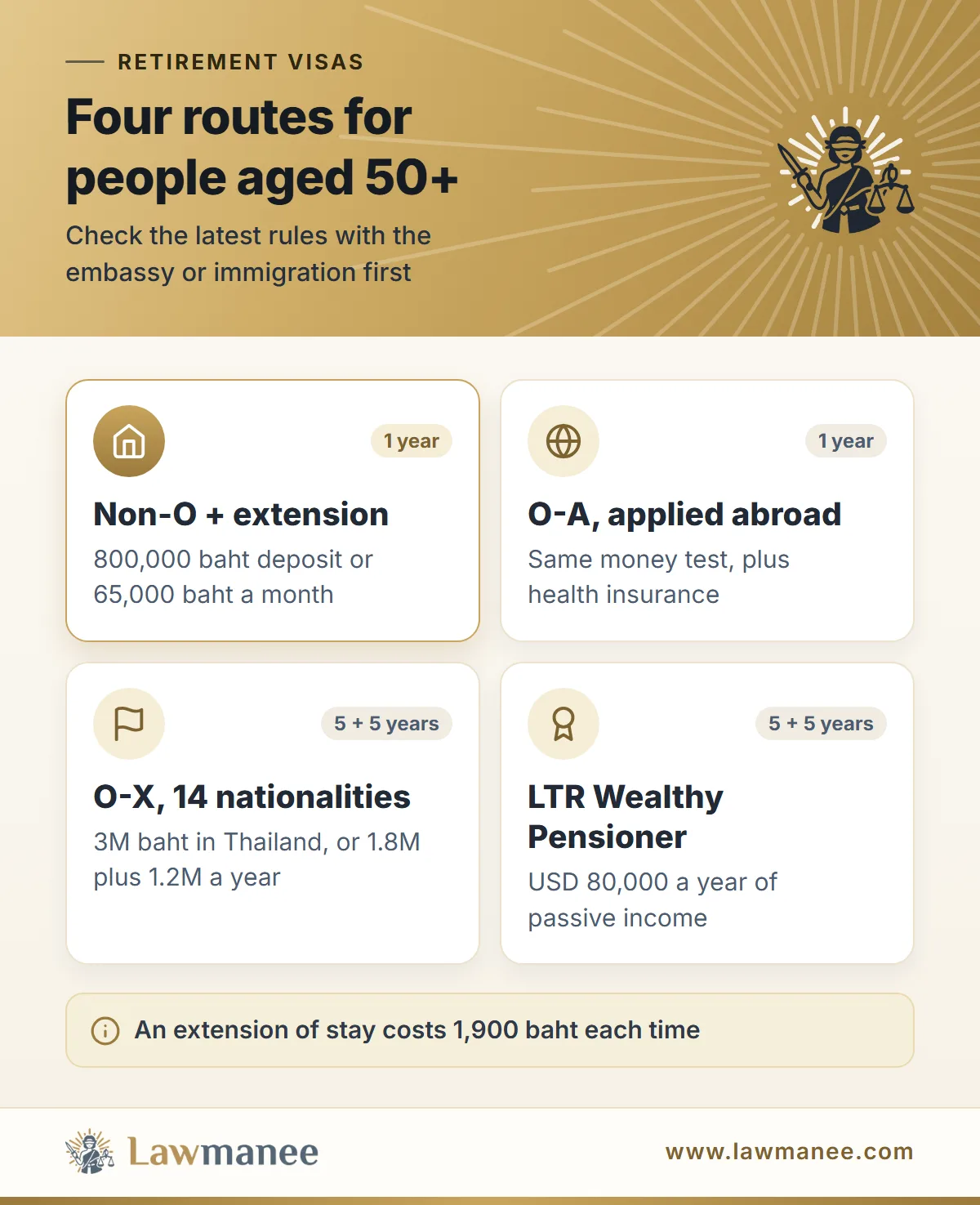
| Visa | Where you apply | Stay | Main conditions |
|---|---|---|---|
| Non-O (retirement) + extension | Enter on a Non-O, then extend at an immigration office in Thailand | 1 year at a time, renewable every year | Age 50+, 800,000 baht in a Thai bank account or 65,000 baht a month in income |
| O-A (Long Stay) | A Thai embassy or consulate abroad | 1 year | Same money test as the Non-O, plus health insurance |
| O-X (10-year Long Stay) | A Thai embassy, for 14 listed nationalities only | 5 years, renewable for 5 more | 3 million baht in Thailand, or 1.8 million baht plus 1.2 million baht of yearly income |
| LTR (Wealthy Pensioner) | Online through the BOI | 5 years, renewable for 5 more | USD 80,000 a year of pension or other passive income |
The Non-O and the yearly extension
The most common route is to enter on a Non-Immigrant O visa, which gives a first stay of up to 90 days, and then apply for an extension of stay for retirement at the immigration office covering where you live. If it is approved you may stay for 1 year, and you can apply again every year.
The main conditions for the extension:
- Age 50 or over.
- Money, one of three ways: at least 800,000 baht deposited in a bank account in Thailand; a pension or income from abroad of at least 65,000 baht a month, certified by your embassy or consulate; or a deposit and income that together reach at least 800,000 baht a year.
- The deposit must already be in the account for the period immigration requires before you file, so plan several months ahead of your deadline.
- Apply in person on form TM.7 with your passport and the bank letter or embassy income letter.
- Extension fee: 1,900 baht each time.
For example, John is 66 and receives a pension of 40,000 baht a month, 480,000 baht a year. That is below 65,000 baht a month, but if he also keeps 320,000 baht in a Thai bank account the total reaches 800,000 baht a year, so he can use the combined method.
The O-A, applied for from abroad
The O-A is issued by Thai embassies and consulates abroad and gives a stay of 1 year from entry. As an example, the Royal Thai Embassy in Washington, D.C. asks for:
- age 50 or over on the day of application;
- 800,000 baht in deposits, 65,000 baht a month in income, or a combination of 800,000 baht a year;
- health insurance covering at least 3,000,000 baht or USD 100,000 per policy year;
- a criminal record certificate and a medical certificate, each issued within the last 3 months.
The O-X, a 10-year visa for some nationalities
The O-X gives a stay of 5 years that can be extended once for another 5, 10 years in all. It is open only to people aged 50 or over from 14 countries: Japan, Australia, Denmark, Finland, France, Germany, Italy, the Netherlands, Norway, Sweden, Switzerland, the United Kingdom, Canada and the United States. The money test is a deposit of at least 3 million baht with a financial institution in Thailand, or 1.8 million baht plus a yearly income of at least 1.2 million baht, and health insurance is required.
The LTR for well-off pensioners
The Long-Term Resident visa, Wealthy Pensioner category, is run by the Board of Investment (BOI):
- age 50 or over with passive income, such as a pension or investment returns, of at least USD 80,000 a year;
- with between USD 40,000 and 80,000 a year, an extra investment of USD 250,000 in Thailand, for example in Thai government bonds or property;
- health insurance of at least USD 50,000, or another condition the BOI accepts;
- a stay of 5 years renewable for 5 more, a fee of 50,000 baht, and a yearly report instead of the 90-day report.
Your duties once you have the visa
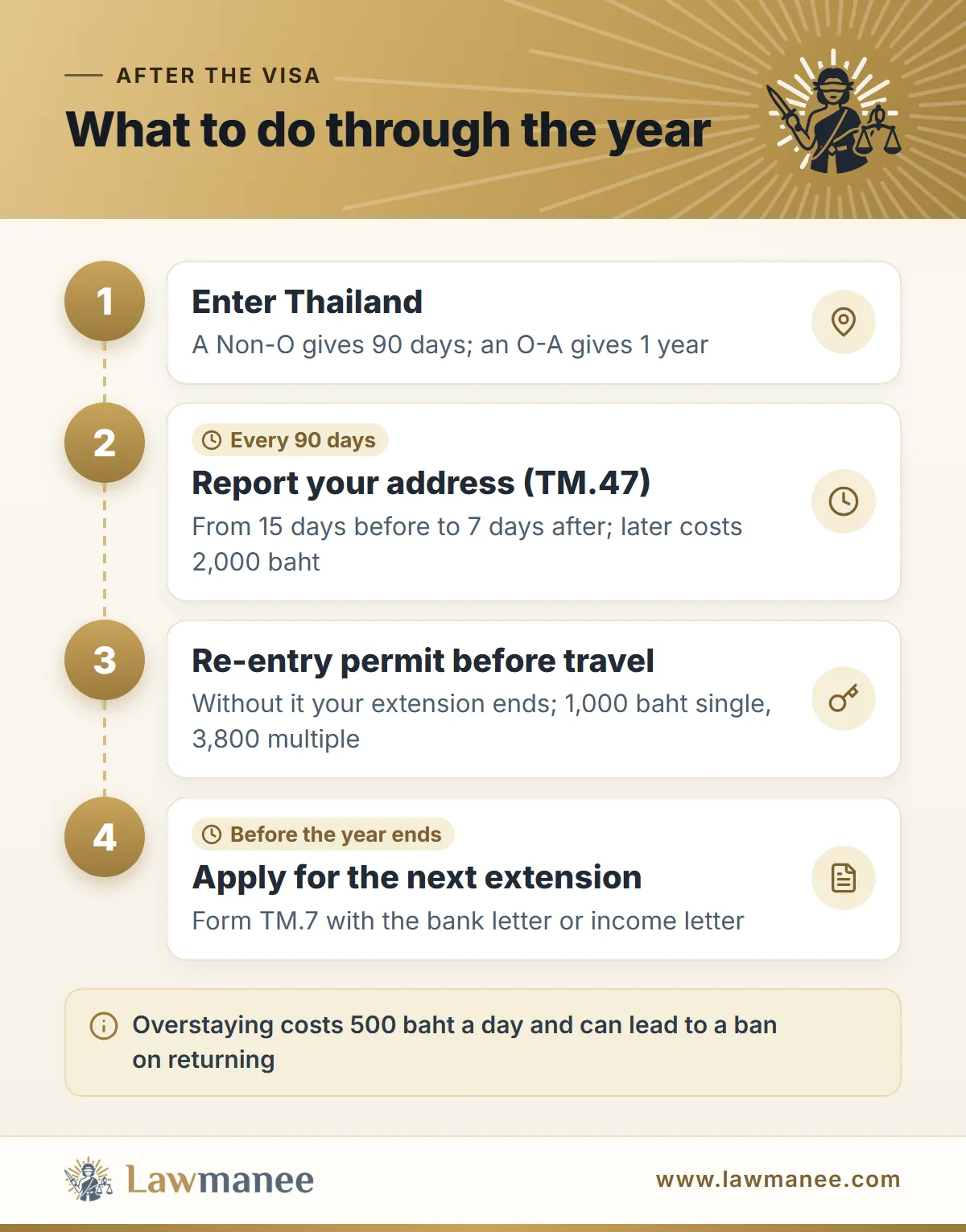
90-day reports. A foreigner who stays in Thailand for more than 90 days in a row must report their address to immigration every 90 days, under Section 37(5) of the Immigration Act B.E. 2522, on form TM.47. You can report at the immigration office, by post or online, from 15 days before the due date until 7 days after it. Report later than that and you pay a 2,000-baht fine.
A re-entry permit before you travel. If you leave Thailand without one, your extension of stay ends the moment you leave and you have to start again with a new visa. A single re-entry permit costs 1,000 baht and a multiple one 3,800 baht.
Extend before your permission runs out. Overstaying costs 500 baht a day and can lead to a ban on re-entering Thailand; see Lawmanee's guide to overstay.
Get help from an immigration lawyer
Retirement visas involve a lot of paperwork: the embassy income letter, how long the deposit must be held, or what to do if an extension is refused. On Lawmanee you can describe your situation for free so that immigration lawyers can reply in the platform chat, or search lawyers by case type, province and the languages they speak.