


Boundary problems usually start small: a neighbour builds a new fence, extends a roof, or the boundary markers disappear after the land is filled. Then they turn into long disputes. This guide explains how to check a boundary, what Thai law says when someone builds over the line, and which deadlines you cannot afford to miss.
Start with evidence, not by pulling down the fence
If you think the boundary is wrong, do not tear down the fence or move a marker yourself: you could be accused of trespass or damage to property. First:
- Copy both sides of your title deed; the back shows the plot map and marker numbers.
- Photograph the fence, buildings and any remaining markers, with the date.
- Gather evidence of who has used the strip and since when: building permits, old photos, witnesses.
- Talk to your neighbour calmly. Many cases end with a joint survey and an agreed line.
A fence, wall or ditch sitting exactly on the boundary is presumed to belong to both owners jointly (Section 1344), so neither side should remove it alone.
Ask the Land Office for a boundary survey
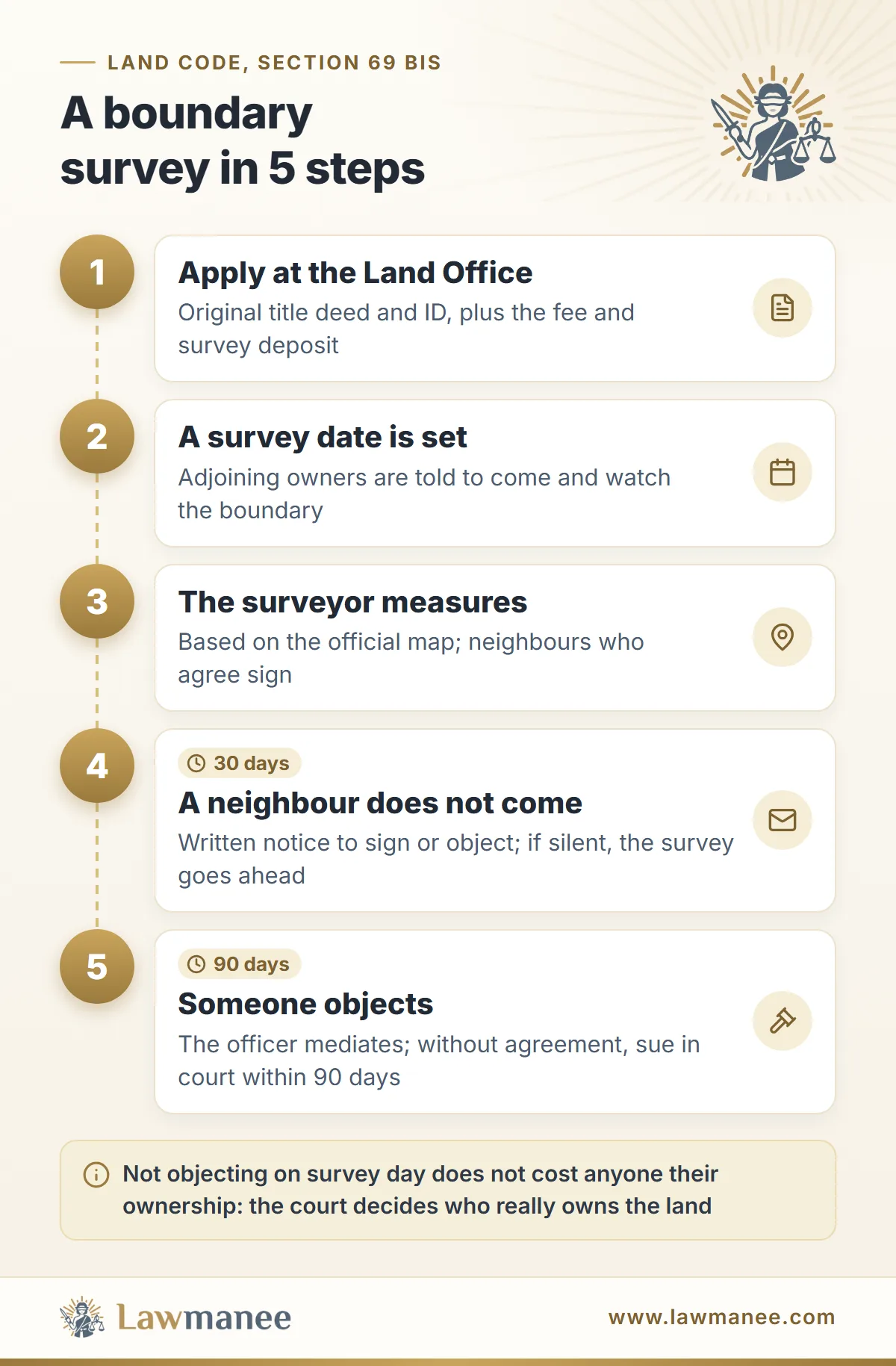
An owner with a title deed (chanote) can ask the Land Office to survey and check the boundary under Section 69 bis of the Land Code. In short:
- Apply at the Land Office for the area where the land lies, with the original title deed and your ID, and pay the fee and survey deposit, which depend on the number of plots and the distance.
- A survey date is set and the owners of adjoining plots are notified to attend and watch the boundary.
- The surveyor measures the land using the official map as the main evidence. Neighbours who agree sign to certify the boundary.
- If a neighbour does not come, the officer writes asking them to sign or object within 30 days. If they neither come nor object in time, the officer can proceed without their certification.
- If someone objects, the land officer investigates and mediates on the basis of the map evidence. If there is no agreement, the parties are told to sue in court within 90 days of the notice. If nobody sues in time, the applicant is treated as no longer wanting the application to proceed.
A neighbour who does not object on survey day does not lose ownership on the spot. Who really owns a disputed strip is ultimately for the court to decide.
A neighbour's house crosses the line: good faith or bad faith
If the survey shows that part of a neighbour's building, such as the house, an extension or a shophouse, stands on your land, Section 1312 of the Civil and Commercial Code applies, with two cases:
- Built in good faith, meaning the builder did not know at the time that the strip belonged to someone else: the builder owns the building but must pay the landowner for the use of the land and register the right as a servitude. If the building is later completely destroyed, the landowner can ask for the registration to be cancelled.
- Built in bad faith, meaning the builder knew it was someone else's land and built anyway: the landowner can require the builder to remove it and restore the land at the builder's own expense.
The law presumes that people act in good faith, so the side claiming bad faith has to prove it, for example with a written objection sent before building or an earlier survey that showed the line. Things that are not buildings, such as fences or car parks, and buildings standing entirely on someone else's land follow different rules, so have a lawyer look at the facts.
Example: Somchai extends his kitchen, believing the old fence marks the boundary. Later his neighbour has the boundary surveyed, and the kitchen turns out to be 0.5 metres over the line along 8 metres, 4 square metres in all. If Somchai built in good faith, he keeps the kitchen but pays for the use of those 4 square metres and registers a servitude. If the neighbour had sent him a written warning with the survey result before he built, a court may find bad faith, and Somchai may have to remove the part over the line at his own cost.
Adverse possession: 10 years of inaction can cost you the land
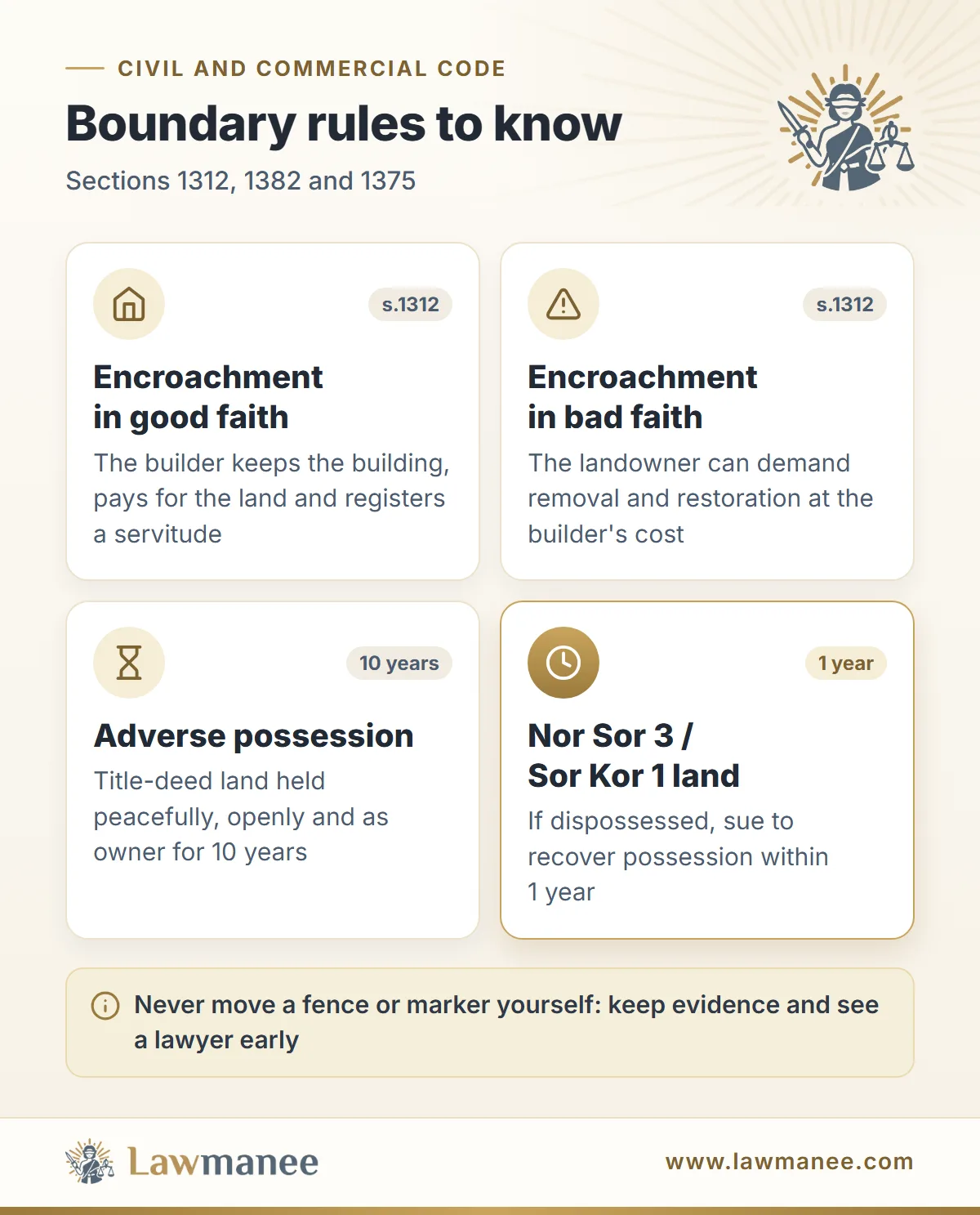
Under Section 1382, a person who possesses someone else's immovable property peacefully, openly and with the intention of owning it, continuously for 10 years, acquires ownership. If a neighbour fences in part of your land and openly uses it as their own for long enough, you can really lose that strip.
Worth knowing:
- Adverse possession applies to land with a title deed. The possessor has to petition the court for an order and then register it.
- Until it is registered, the right cannot be raised against a third party who bought the land for value and in good faith and registered in good faith (Section 1299, paragraph 2).
- The owner stops the clock by going to court, for example by suing for eviction or for the return of the land. A verbal warning alone may not be enough.
Land with Nor Sor 3 or Sor Kor 1 papers: only 1 year
Land held only under a certificate of use (Nor Sor 3, Nor Sor 3 Kor) or a Sor Kor 1 gives a right of possession, not ownership, so adverse possession does not apply. But if someone takes possession of it, the holder must sue to recover possession within 1 year of being dispossessed (Section 1375). Miss that and the right to the strip may be lost, so holders of these papers need to move much faster than title-deed owners.
Mediation, a civil suit, or a criminal complaint
| Option | Best when |
|---|---|
| Talk and survey together | Both sides still talk and the facts are simple |
| Mediation at the Land Office or a mediation centre | Someone objected on survey day, or you want a written agreement |
| Civil lawsuit | No agreement, a 90-day, 1-year or 10-year deadline is near, or you need a removal order |
| Trespass complaint to the police | Someone deliberately occupies the land or disturbs your possession |
Taking over or disturbing possession of someone else's land can be the offence of trespass under Section 362 of the Criminal Code. In the ordinary case it is a compoundable offence, so a complaint must be filed within 3 months of learning of the act and the offender. A boundary dispute where each side honestly believes the land is theirs is usually a civil matter, though.
Foreign nationals generally cannot own land in Thailand, but a boundary problem can still affect you if you lease land or your Thai spouse owns the house plot. The registered owner is the one who applies for the survey and signs, and all Land Office documents are in Thai, so bring someone you trust to translate.
Talk to a lawyer about a boundary dispute
Boundary disputes turn on details: the type of land document, who built first, who knew what and when, and how much time is left. A lawyer who reads the survey result and plans early helps you avoid missing a key deadline. On Lawmanee you can describe your situation for free so that interested property lawyers reply in the platform chat, or search lawyers by case type, province and language.