

When a seller says a plot “has papers”, those papers might be a chanote, a Nor Sor 3 Gor, a Nor Sor 3, or only a Sor Kor 1. Each gives a different right, changes hands in a different way and carries different risks, so find out which one you are looking at before you agree to buy or pay a deposit. This guide explains the rules of the Thai Land Code and the Civil and Commercial Code in plain terms.
Ownership or possession: the first difference
Section 1 of the Land Code defines a title deed (chanote) as the document of ownership of land. A certificate of utilisation (Nor Sor 3, Nor Sor 3 Gor or Nor Sor 3 Khor) is an official certificate that the land has been put to use; its holder has a right of possession, not ownership.
Both kinds of land can be sold, but a transfer must be made in writing and registered with the land official (Land Code Section 4 bis), and a sale of immovable property that is not made in writing and registered is void (Civil and Commercial Code Section 456).
The difference shows when someone else starts using the land:
- Land with a chanote: a person who possesses it peacefully, openly and as owner for 10 years in a row acquires ownership (Section 1382).
- Land held with a right of possession only: if someone dispossesses you, you must sue to recover it within 1 year (Section 1375).
Section 6 of the Land Code adds that if land is left unused or abandoned for more than 10 consecutive years (chanote) or more than 5 consecutive years (certificate of utilisation), the Director-General of the Department of Lands may petition the court, and once the court revokes the document, that land passes to the State.
Six land documents compared
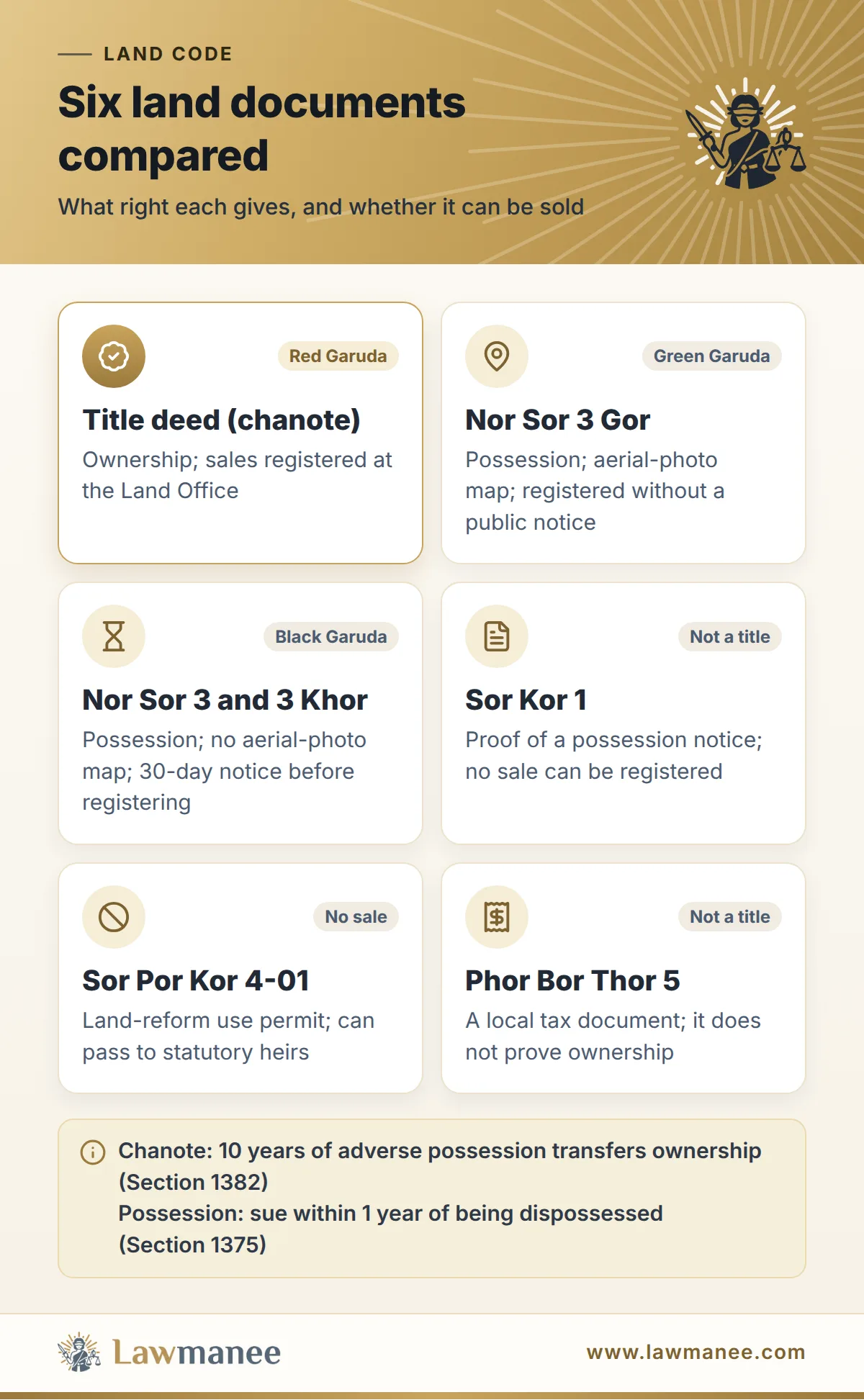
| Document | Right | Can it be sold? |
|---|---|---|
| Title deed (chanote, Nor Sor 4 Jor), red Garuda | Ownership | Yes, registered at the Land Office |
| Nor Sor 3 Gor, green Garuda | Possession; boundaries from aerial-photo maps | Yes, registered without a public notice |
| Nor Sor 3 and Nor Sor 3 Khor, black Garuda | Possession; no aerial-photo map | Yes, after a 30-day public notice |
| Sor Kor 1 | Proof that possession was notified, not a land-rights document | The Land Office cannot register a sale |
| Sor Por Kor 4-01 | Permit to use land in a land-reform area | No |
| Phor Bor Thor 5 | A local development tax document, not a land-rights document | It does not prove ownership |
Nor Sor 3 Gor vs Nor Sor 3: the 30-day notice
A Nor Sor 3 Gor is issued against aerial-photo maps, so its position and boundaries are clearer, and the Land Office records a sale without any public notice. A Nor Sor 3 or Nor Sor 3 Khor has no aerial-photo map, and before a sale or a lease is registered the Land Office posts a notice for 30 days (Ministerial Regulation No. 7, B.E. 2497). If nobody objects by the end of the notice, the office calls the parties in to register.
For example, Manop agrees to buy 2 rai of Nor Sor 3 Khor land from Suda. They file the sale at the Land Office on 2 March, and the officer posts the notice for 30 days. Nobody objects, so the office then asks them to come back and register the transfer. Had the plot been Nor Sor 3 Gor or chanote land, there would have been no 30-day notice.
A holder of a Nor Sor 3, Nor Sor 3 Gor or Nor Sor 3 Khor can apply to the Land Office for an individual chanote (Land Code Section 59). The office surveys the plot and notifies the neighbours; if nobody objects to the boundaries, it issues a chanote in place of the certificate.
Sor Kor 1 is not a title deed
A Sor Kor 1 is the form with which people who possessed and used land before the Land Code came into force on 1 December 1954 (B.E. 2497) notified the authorities. It only shows that possession was notified; it is not a land-rights document.
- The Land Office cannot register a sale, a lease or a usufruct on Sor Kor 1 land.
- The holder has a right of possession, which passes by handing over possession (Civil and Commercial Code Section 1378) and is lost if the holder is dispossessed and does not sue within 1 year (Section 1375).
- The Land Code Amendment Act (No. 11) B.E. 2551 (2008) gave Sor Kor 1 holders 2 years to apply for a title deed, a period that ended on 8 February 2010 (B.E. 2553). For applications filed after that, the Land Office can issue a chanote only once a final court judgment or order confirms that the applicant lawfully possessed and used the land before the Land Code came into force.
Sor Por Kor 4-01 cannot be sold; Phor Bor Thor 5 is not a title
A Sor Por Kor 4-01 is a permit to use land in a land-reform area; it is neither a chanote nor a certificate of utilisation under the Land Code. Section 39 of the Agricultural Land Reform Act B.E. 2518 (1975) forbids holders from dividing or transferring their rights to others, except by inheritance to statutory heirs or by transfer to a farmers' institution or to the Agricultural Land Reform Office (ALRO). The general public therefore cannot buy land-reform land, and land for which ALRO has issued an “agricultural title deed” (โฉนดเพื่อการเกษตร) is still land-reform land, not chanote land under the Land Code.
A Phor Bor Thor 5 is a document about the local development tax. It is not a land-rights document and does not prove that the person named owns, or has any right to, the land.
Some deeds cannot be transferred yet
Some documents carry a transfer ban under the Land Code, even when they are already chanotes:
- Issued after a reservation slip (bai jong), a document allowing temporary possession that the authorities issue when they allocate land to the public or permit people to claim it: if the slip was issued on or after 14 December 1972 (B.E. 2515), the land may not be transferred for 10 years from receipt of the chanote or certificate; for earlier slips where the State provided infrastructure, the ban is 5 years (Section 31).
- Issued to someone who began possessing the land after the Land Code came into force, without a reservation slip or other evidence: transfer is banned for 10 years from receipt of the document (Section 58 bis).
The bans do not apply to inheritance or to transfers to certain state bodies named in the law. Before buying, check whether the plot is still within a transfer-ban period.
Five checks before you pay
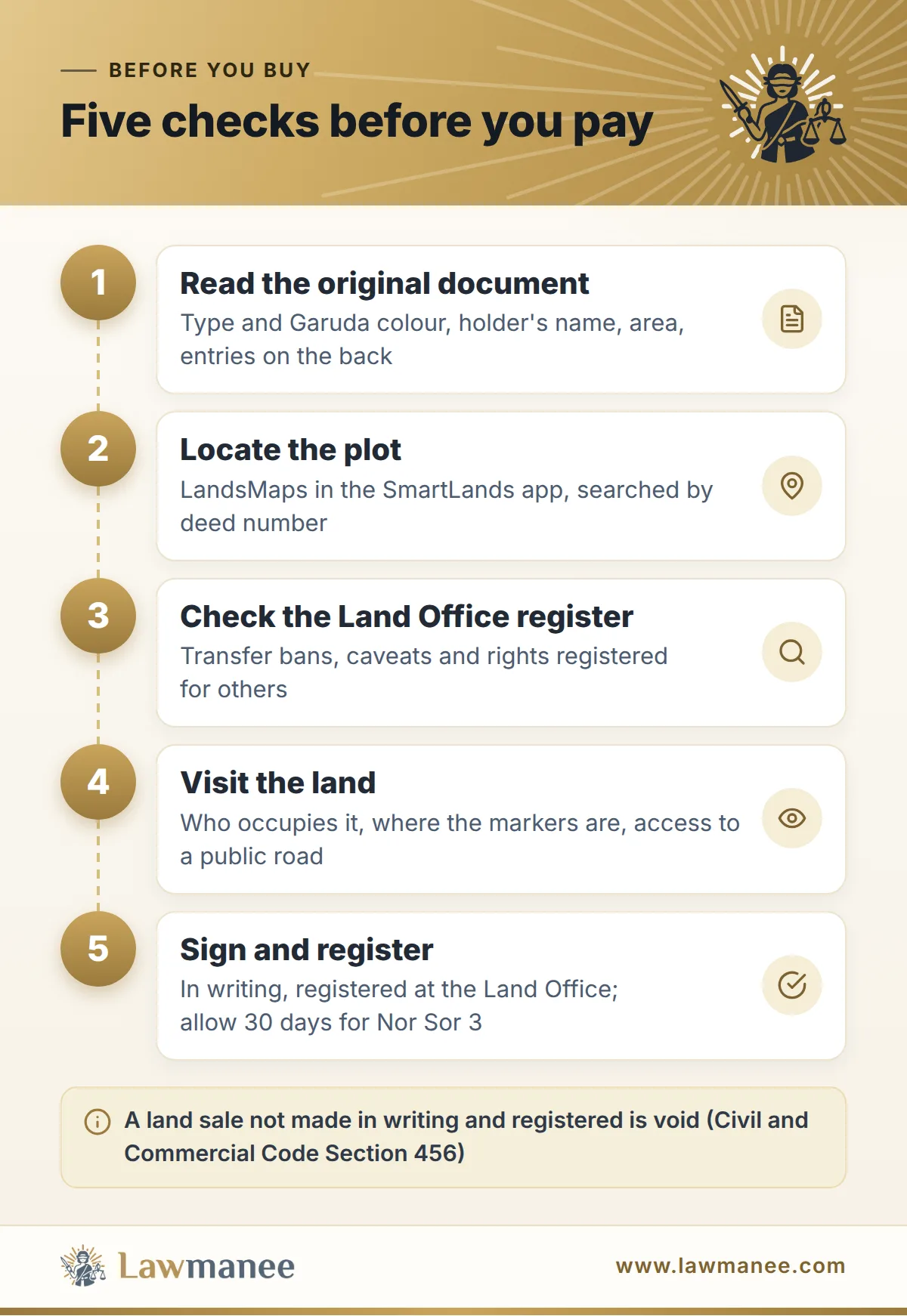
- Read the original document: the type and Garuda colour, the number, the holder's name, the area, and the registration entries on the back that show how it changed hands.
- Locate the plot with the Department of Lands' LandsMaps, in the SmartLands app or on the web, searching by deed number to see its position and shape.
- Check the Land Office register against the document you were shown: any transfer ban, caveat, or rights registered for others, such as a lease, a servitude or a usufruct.
- Visit the land: who occupies or uses it, where the boundary markers are, and whether it has access to a public road.
- Sign in writing and register the sale at the Land Office; for Nor Sor 3 or Nor Sor 3 Khor land, allow for the 30-day notice.
For foreigners
As a rule, foreigners cannot acquire land in Thailand (Land Code Section 86), but they can lease it. A lease of more than 3 years must be made in writing and registered, or it can only be enforced for 3 years (Civil and Commercial Code Section 538). If the land is Nor Sor 3 or Nor Sor 3 Khor, the Land Office posts the 30-day notice before registering the lease, so plan for the extra month.
Talk to a property lawyer
If the document is not a chanote, the plot is still under a transfer ban, or someone offers you Sor Kor 1 or land-reform land, have a lawyer check the papers and the draft contract before you pay. On Lawmanee you can post your situation for free and interested property lawyers will reply in the platform chat, or search lawyers by case type, province and language.