
When one land title deed names several people, for example siblings who inherited their parents' land together or several people who bought one plot together, things may work well at first. The questions start when one of them wants to sell, wants their own part of the land, or wants to use it differently: who can decide what? This guide explains the co-ownership rules of the Thai Civil and Commercial Code and the ways to divide co-owned land.
What co-ownership means
When property belongs to several people together, the co-ownership rules of the Civil and Commercial Code apply, unless another law provides otherwise (Section 1356). Each person is a co-owner and holds a “share” of the whole plot, such as one third, but does not own any particular area of it until the land is actually divided.
If the shares are not specified, the co-owners are presumed to have equal shares (Section 1357), so anyone claiming a larger share has to prove it. If you agree from the start that the shares are unequal, for example because one person paid more of the price, have the shares registered at the Land Office (the registration called บรรยายส่วน, a description of shares) so that each person's share is on record.
Co-owners' rights and duties
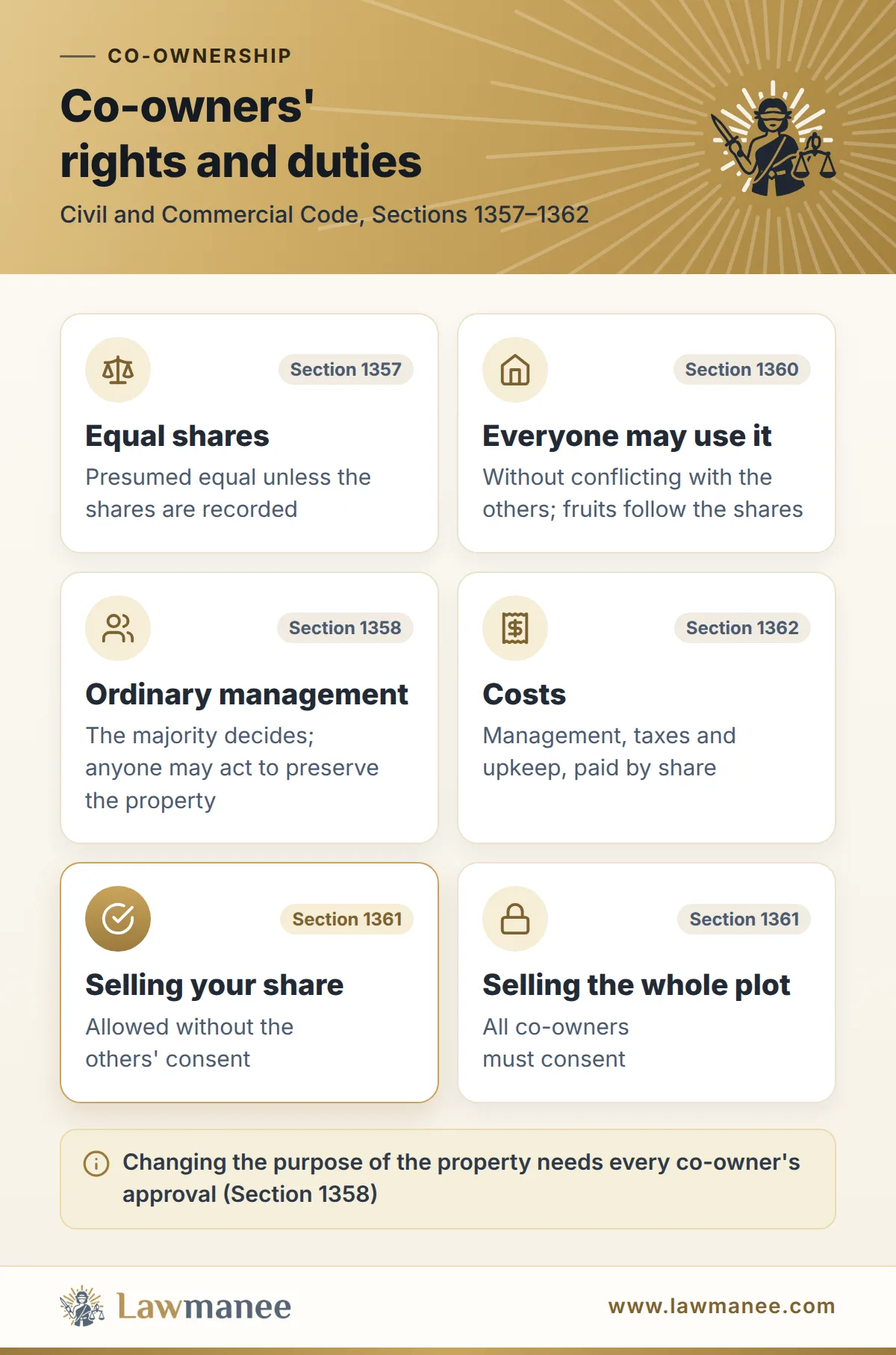
- Use: every co-owner may use the land, but not in a way that conflicts with the other co-owners' rights, and each is presumed to be entitled to the fruits in proportion to their share, such as rent when the land is let (Section 1360).
- Costs: every co-owner must contribute, in proportion to their share, to the costs of management, taxes, upkeep and joint use (Section 1362).
- Outsiders: one co-owner alone may exercise the owner's rights over the whole plot against a third party, but a claim to get the land back must be made for the benefit of all the co-owners, not for themselves alone (Section 1359).
Who decides what
| Matter | Who decides |
|---|---|
| Acts to preserve the property | Any co-owner, alone, at any time |
| Ordinary management | A majority of the co-owners |
| Essential management | A majority of the co-owners who together hold at least half the value of the property |
| Changing the purpose of the property | All co-owners |
| Selling or transferring your own share | You alone, without anyone's consent |
| Selling or transferring the whole plot | All co-owners |
The first four rows come from Section 1358, the last two from Section 1361.
You can sell your share, but not the whole plot alone
A co-owner may sell or transfer their own share without the other co-owners' consent (Section 1361, paragraph 1). The Land Office registers this as a sale of a specific share (ขายเฉพาะส่วน). The buyer takes the seller's place as a co-owner, under the same co-ownership rules as everyone else.
The land itself, however, can be sold or transferred only with the consent of every co-owner (Section 1361, paragraph 2). If one co-owner refuses, the one who wants to sell can either sell just their own share or demand a partition, as explained below.
The right to demand a partition, and its three limits
Any co-owner may demand that the property be divided (Section 1363), except:
- where a juristic act, such as an agreement between the co-owners, excludes partition; such an exclusion cannot last more than 10 years at a time;
- where the purpose of the co-ownership is permanent in nature;
- at a time that is not opportune.
If the land is still part of an undivided estate, an heir who holds the estate property may demand a partition even after the 1-year limitation period for inheritance claims has passed, and this right too cannot be excluded for more than 10 years at a time (Section 1748).
How to divide: by agreement, or by the court
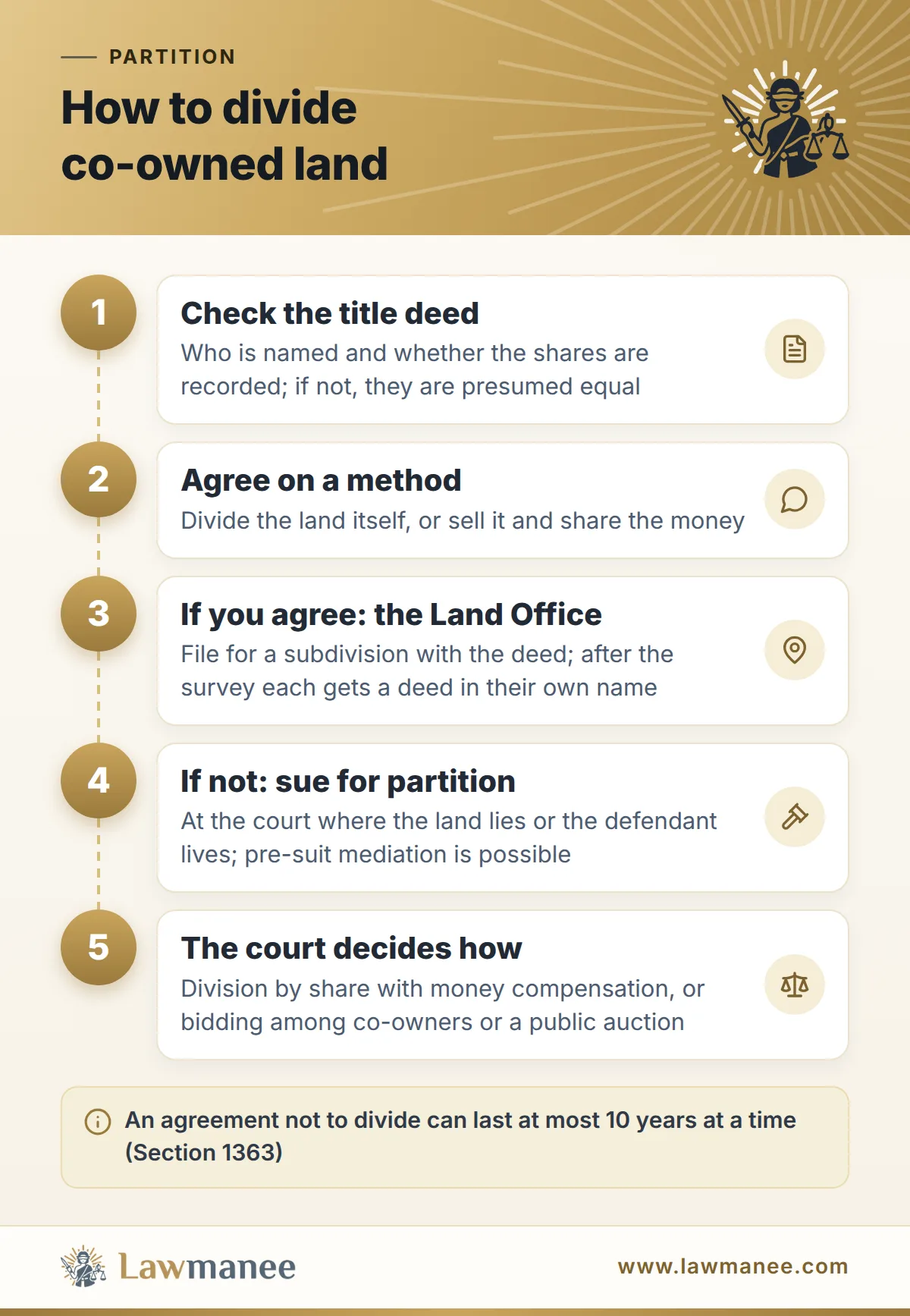
Partition can be made in two ways: by dividing the land itself between the co-owners, or by selling it and dividing the money (Section 1364, paragraph 1).
If you agree, file a subdivision request with the title deed at the Land Office responsible for the area where the land lies; requests that need a survey cannot be filed at another office (Land Code Sections 71 and 79). The officers survey the land, the partition of co-ownership is registered, and each co-owner receives a title deed for their own plot in their own name. If you agree to sell instead, all co-owners consent to the sale of the whole plot and share the money according to their shares.
If you cannot agree, any co-owner may sue for partition. A case about land can be filed at the court in whose area the land lies or at the court of the defendant's domicile (Civil Procedure Code Section 4 bis). Before suing, you can petition the court for pre-suit mediation; the court arranges it if it sees fit and the other side agrees, and no court fee is charged (Section 20 ter).
When the co-owners cannot agree, the court may order (Section 1364, paragraph 2):
- division of the land itself, with money compensation if the parts allotted are unequal;
- if division is impossible or would cause great loss, a sale by bidding among the co-owners or a public auction, with the money divided according to the shares.
For example, three siblings, Daeng, Dam and Khao, inherit a 3-rai plot under one title deed and register it in all three names without describing their shares, so each is presumed to own one third. Daeng wants to sell; Dam and Khao want to keep the land. Daeng may sell their one-third share to anyone without asking the others, but cannot sell the whole 3 rai. If Daeng wants a separate plot, the three can agree to a subdivision at the Land Office. If they cannot agree, Daeng can sue for partition: the court may divide the land according to the one-third shares or, if division is impossible or would cause great loss, order the siblings to bid among themselves or order a public auction, with the money split one third each.
Living on the land for years does not take the others' shares
If one sibling has built a house on co-owned land, or farmed it, for many years, long occupation alone does not give them the other co-owners' shares. The Supreme Court has held that one co-owner's possession is also possession on behalf of the other co-owners, and that as long as no notice has been given changing the nature of the holding, saying the occupier no longer holds for the others, the other co-owners' rights do not end (Supreme Court Judgment 6237/2541 (1998), with Section 1381).
Prevent disputes from the day the names go on the deed
- Agree on each person's share, and if the shares are unequal, have them registered (บรรยายส่วน).
- Make a written agreement between the co-owners, for example on who uses which part and what happens if someone wants to sell their share.
- If everyone already wants to use separate parts, a subdivision gives each person a title deed of their own, which they can then sell or transfer without waiting for anyone's consent.
For foreign nationals
The co-ownership rules apply to any property owned together, not only to land (Section 1356). Land itself is different: as a rule, foreigners cannot acquire land in Thailand (Land Code Section 86), and special rules apply when a foreigner is among the heirs to land. If a foreign national is involved, have a lawyer check the position before anything is signed at the Land Office.
Talk to a property lawyer
If the co-owners cannot agree, you are unsure of your share, or someone claims the land because they have lived on it for years, have a lawyer check the title deed and the documents before you sell or sue. On Lawmanee you can post your situation for free and interested property lawyers will reply in the platform chat, or search lawyers by case type, province and language.