
Foreigners who have lived in Thailand for years, married a Thai partner or plan to retire here usually ask the same question: can I buy land in my own name? The short answer is no. Thai law does, however, offer legal ways to live on and use land for decades. This guide walks through each option and explains why putting land in a Thai person's name for you is the route to avoid.
Can a foreigner buy land?
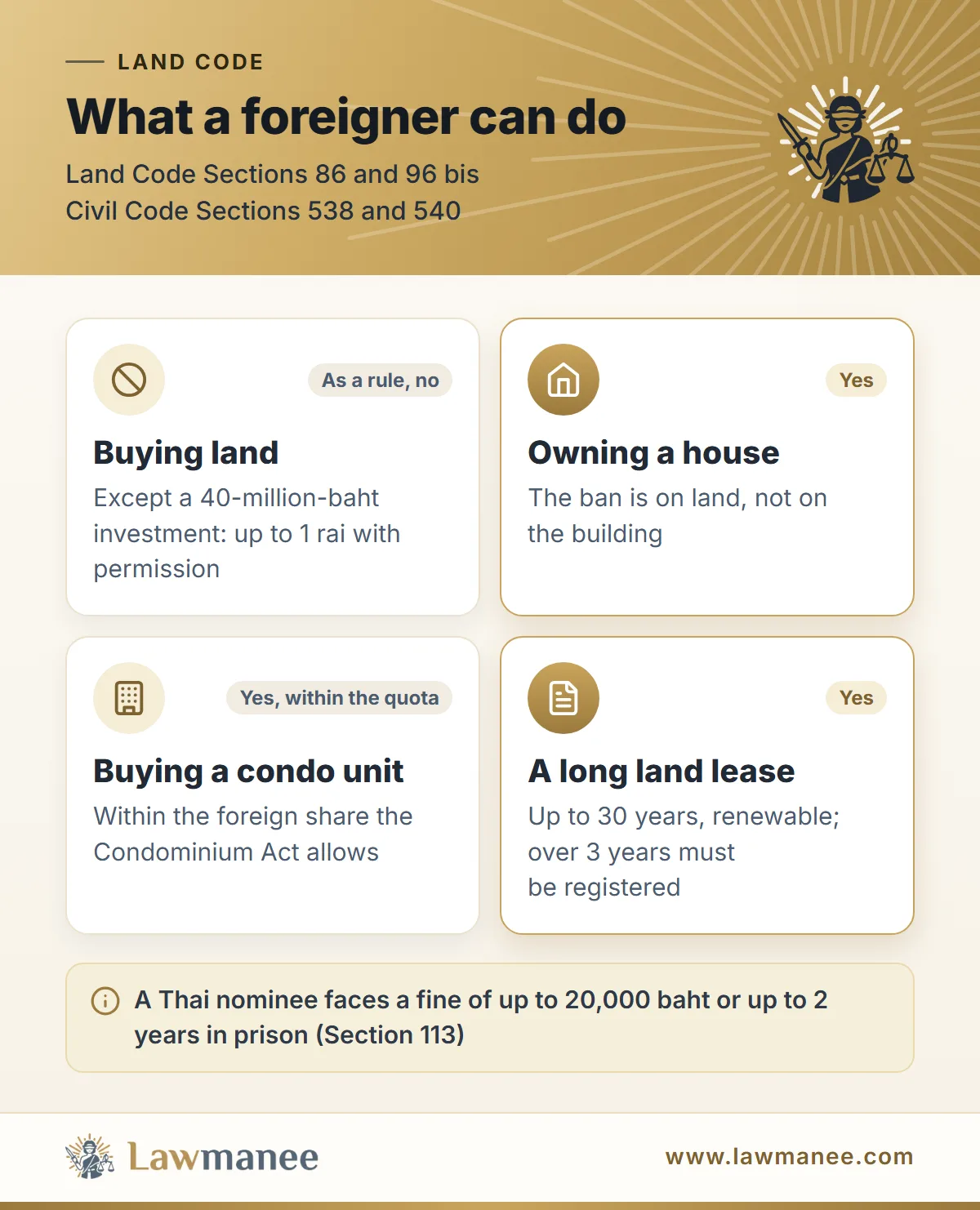
Section 86 of the Land Code lets foreigners acquire land only where a treaty grants that right, and no such treaty currently applies. In practice, a foreigner cannot buy land in their own name.
The exception people ask about is Section 96 bis: a foreigner who brings in an investment of at least 40 million baht in the kinds of business or assets the law lists may be permitted by the Minister of Interior to acquire up to 1 rai of land for residence. The conditions are detailed, so have a lawyer check them before you plan around it.
What a foreigner can do:
- Own a house or building. The restriction is on land, not on owning the building itself.
- Buy a condominium unit, within the share the Condominium Act allows for foreign owners.
- Take a long lease of land and register it at the Land Office.
- Register a right over someone else's land: a superficies, a usufruct or a right of habitation.
Long leases: up to 30 years, and they must be registered
A lease is the option foreigners use most. Two rules matter:
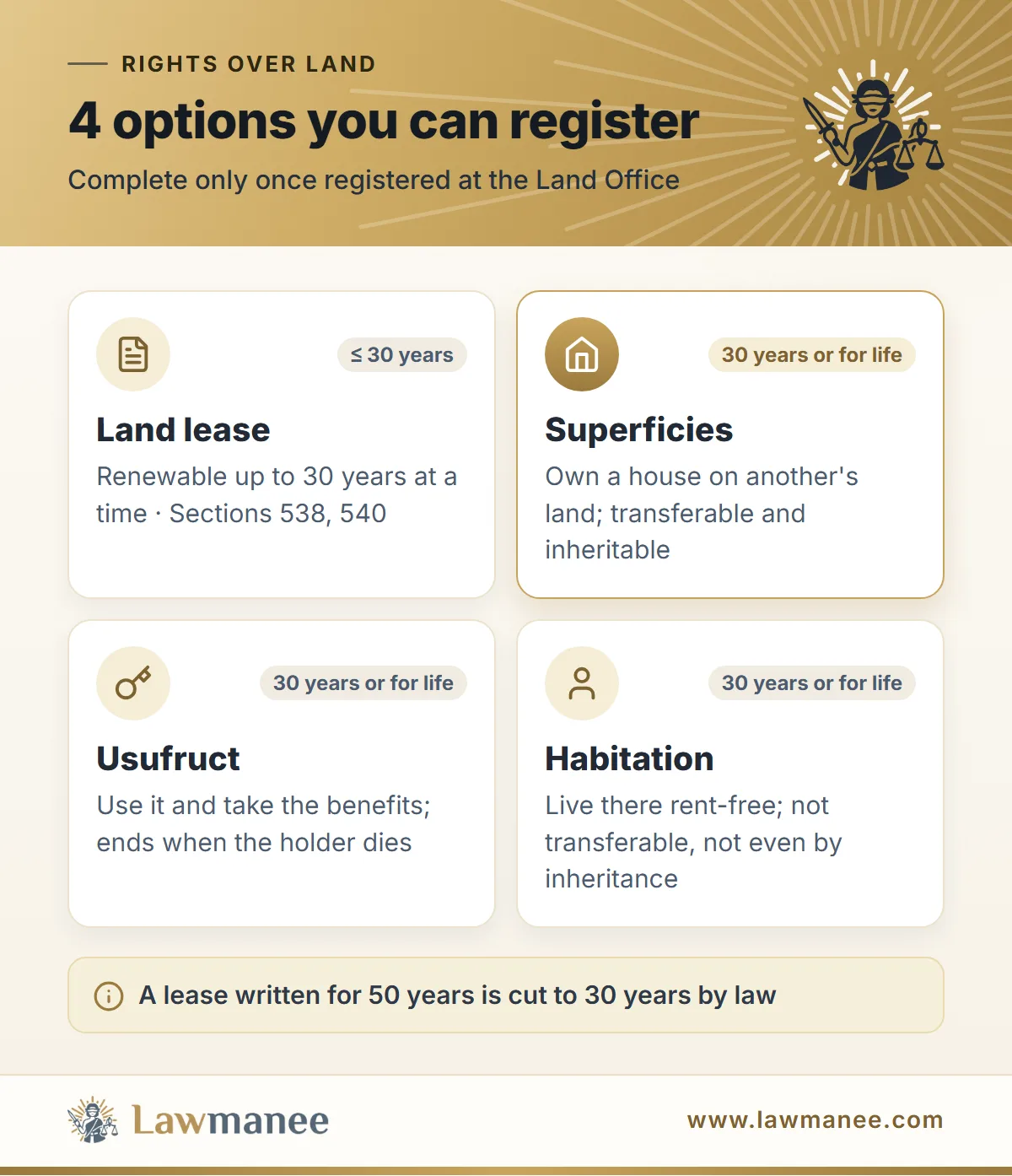
- A lease of land or buildings may not exceed 30 years. A longer term is reduced to 30 years. It can be renewed when it ends, but each renewal may not exceed 30 years from the date of renewal (Civil and Commercial Code, Section 540).
- A lease of more than 3 years must be in writing and registered with the competent official. Without registration it can be enforced for only 3 years (Section 538).
Example: Peter leases land from a Thai owner to build a house. He signs a 30-year lease and registers it at the Land Office, so it is enforceable for the full 30 years. Had he only signed a private 30-year contract and the owner changed their mind in year 5, Peter could enforce it for just 3 years. And a lease written for 50 years would still be cut to 30.
There have been proposals to allow longer terms. Before you sign, ask a lawyer which rules are in force on that day.
Superficies: owning a house on someone else's land
A superficies lets the landowner grant another person ownership of buildings, structures or plantations on or under the land (Section 1410). It suits a foreigner who builds a house with their own money on land owned by a Thai person.
- It can be for a fixed term of up to 30 years, or for the lifetime of the landowner or of the holder (Section 1412).
- It can be transferred and passes to heirs (Section 1411).
Many people combine a superficies with a land lease, so that both the use of the land and the ownership of the house are clearly documented.
Usufruct and habitation
A usufruct gives the holder the right to possess, use and take the benefits of the land or house, for example living there, farming it, or renting it out and keeping the rent (Section 1417). It can be for up to 30 years or for the holder's lifetime. If no term is set, it is presumed to last for life, and it always ends when the holder dies (Section 1418).
A right of habitation lets the holder live in the house without paying rent (Section 1402). It can be for up to 30 years or for life, but if no term is set the owner may end it at any time with reasonable notice (Section 1403). It cannot be transferred, not even by inheritance (Section 1404).
Both are real rights and are only complete once registered at the Land Office (Section 1299). A verbal promise or a private document is not enough.
| Option | Maximum term | Transferable or inheritable? |
|---|---|---|
| Registered land lease | 30 years, renewable for up to 30 years at a time | Depends on the contract; have a lawyer draft it |
| Superficies | 30 years, or the life of the landowner or the holder | Yes |
| Usufruct | 30 years, or the holder's life | Ends when the holder dies |
| Habitation | 30 years, or the holder's life | No, not even by inheritance |
When your Thai spouse buys land
A Thai person married to a foreigner can still buy land in their own name. The Land Office will ask the Thai buyer to state that the money comes from their personal property, not marital property, because marital property would give the foreign spouse a share in the land. The statement must be true, and both of you should understand what it means for your family assets before signing.
Why a nominee arrangement is risky
Having a Thai person, or a company with Thai shareholders acting for you, buy land while the money and the real decisions are yours is exactly what the law prohibits.
- A Thai person who acquires land as an agent for a foreigner faces a fine of up to 20,000 baht, up to 2 years in prison, or both (Land Code, Section 113).
- False statements to officials can also be an offence under the Criminal Code.
- In civil terms, the name on the title deed is the owner. If the relationship breaks down, a foreigner will find it very hard to prove any right to the land.
The Department of Lands checks for land held on behalf of foreigners. Leases and registered rights, as described above, are the safer route.
Talk to a lawyer before you sign
Long leases and registered rights need careful drafting: who owns the house, what happens if the landowner sells or dies, and what happens on divorce or separation. On Lawmanee you can post your situation for free and interested lawyers reply in the platform chat, or browse lawyers by case type, province and the languages they speak.