
You pick up a wallet at a bus stop, spot a phone lying by the road, or dig up something valuable in your garden. Most people want to give it back but are not sure how, and some think "finders keepers". Under Thai law, dishonestly keeping lost property is a crime. This guide explains the finder's duties and reward under Sections 1323 to 1328 of the Thai Civil and Commercial Code, and the related offences in the Criminal Code. The rules apply to anyone who finds property in Thailand, including foreign residents and visitors.
What counts as lost property
Lost property is something that has left its owner's control by accident, such as a wallet dropped in the street.
Something the owner has only put down for a moment and forgotten, or is still looking for, is not lost property. The Supreme Court has held in several cases that the owner is still in possession in these situations, and that a person who dishonestly takes such an item, knowing it belongs to someone else or that the owner is still looking for it, commits theft (Criminal Code, Section 334). Theft carries a heavier penalty: up to 3 years in prison and a fine of up to 60,000 baht.
If you see something the owner has just left behind, such as a phone on a restaurant table, call them back or hand it back straight away. Do not walk off with it.
The finder must do one of three things
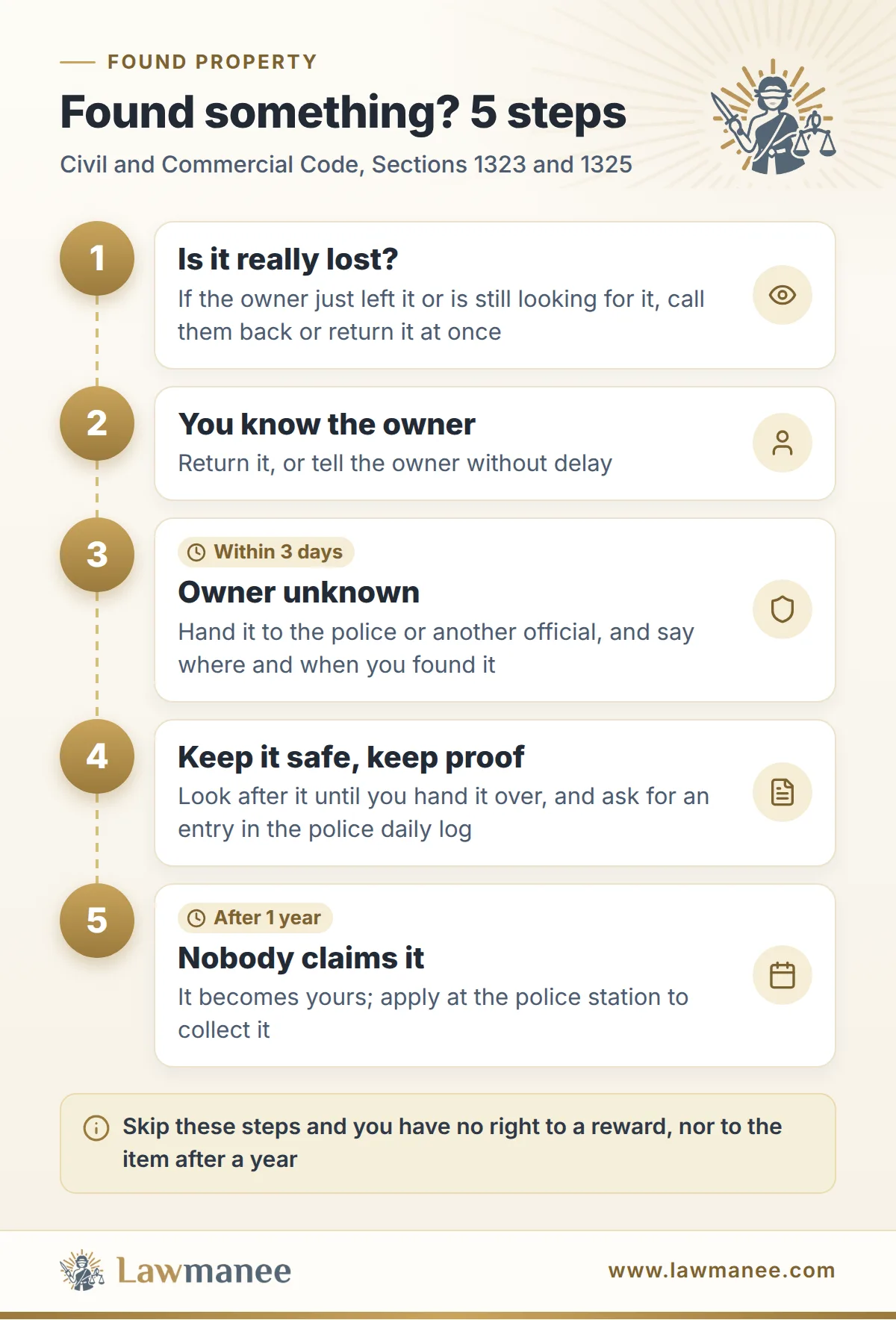
Section 1323 requires a person who finds lost property to do one of the following:
- Deliver it to the person who lost it, the owner, or anyone else entitled to receive it.
- Tell that person without delay, for example when the wallet holds a card with the owner's name and contact details.
- Deliver it to the police or another competent official within 3 days, and tell them anything you know that may help find the person entitled to it, such as where and when you found it.
If the owner is unknown or refuses to take the item back, option 3 is the one to use. Whichever option you take, you must look after the property with reasonable care until you hand it over.
When you hand something in at a police station, ask the officer to record it in the daily log as proof of what you handed in and when.
The finder's reward
A finder who has followed Section 1323 may claim a reward from the person entitled to the property; claiming it is optional (Section 1324):
- 10% of the value up to 30,000 baht;
- plus 5% of any value above 30,000 baht;
- if the finder handed the property to the police or another official, the person who gets it back also pays a 2.5% fee of its value to that office, separate from the reward and capped at 1,000 baht;
- a finder who did not follow Section 1323 has no right to a reward.
| Value of the property | Finder's reward | Fee if handed in to the police |
|---|---|---|
| 10,000 baht | 1,000 baht | 250 baht |
| 30,000 baht | 3,000 baht | 750 baht |
| 50,000 baht | 4,000 baht | 1,000 baht |
| 100,000 baht | 6,500 baht | 1,000 baht |
For example, A finds a wallet with 50,000 baht in cash at a bus stop. Nothing in it identifies the owner, so A hands it in at the police station the next day. Later B comes forward as the owner. (This example counts only the cash as the value.)
- A's reward: 10% of 30,000 baht is 3,000 baht, plus 5% of the remaining 20,000 baht, which is 1,000 baht: 4,000 baht in total.
- The fee: 2.5% of 50,000 baht is 1,250 baht, but the law caps it at 1,000 baht.
- B gets the full 50,000 baht back. If A claims the reward, B pays A 4,000 baht, and B also pays the 1,000-baht fee to the office.
If nobody claims it within one year
- If the finder followed Section 1323 and nobody entitled to the property claims it within one year from the day it was found, it becomes the finder's (Section 1325). A finder who left it with the police can then apply at the police station to collect it.
- If the property is an antique, it goes to the State instead, and the finder is entitled to a reward of 10% of its value.
- Someone who kept the item without following Section 1323 does not become its owner under this rule, even after a year.
Hidden or buried valuables
A valuable movable that was hidden or buried, and is found in circumstances where no one can claim to own it, belongs to the State. The finder must hand it to the police or another competent official and is entitled to a reward of one third of its value (Section 1328).
A finder who keeps it for themselves or for someone else commits an offence under Section 355 of the Criminal Code: up to 1 year in prison or a fine of up to 20,000 baht, or both.
Keeping it is a crime
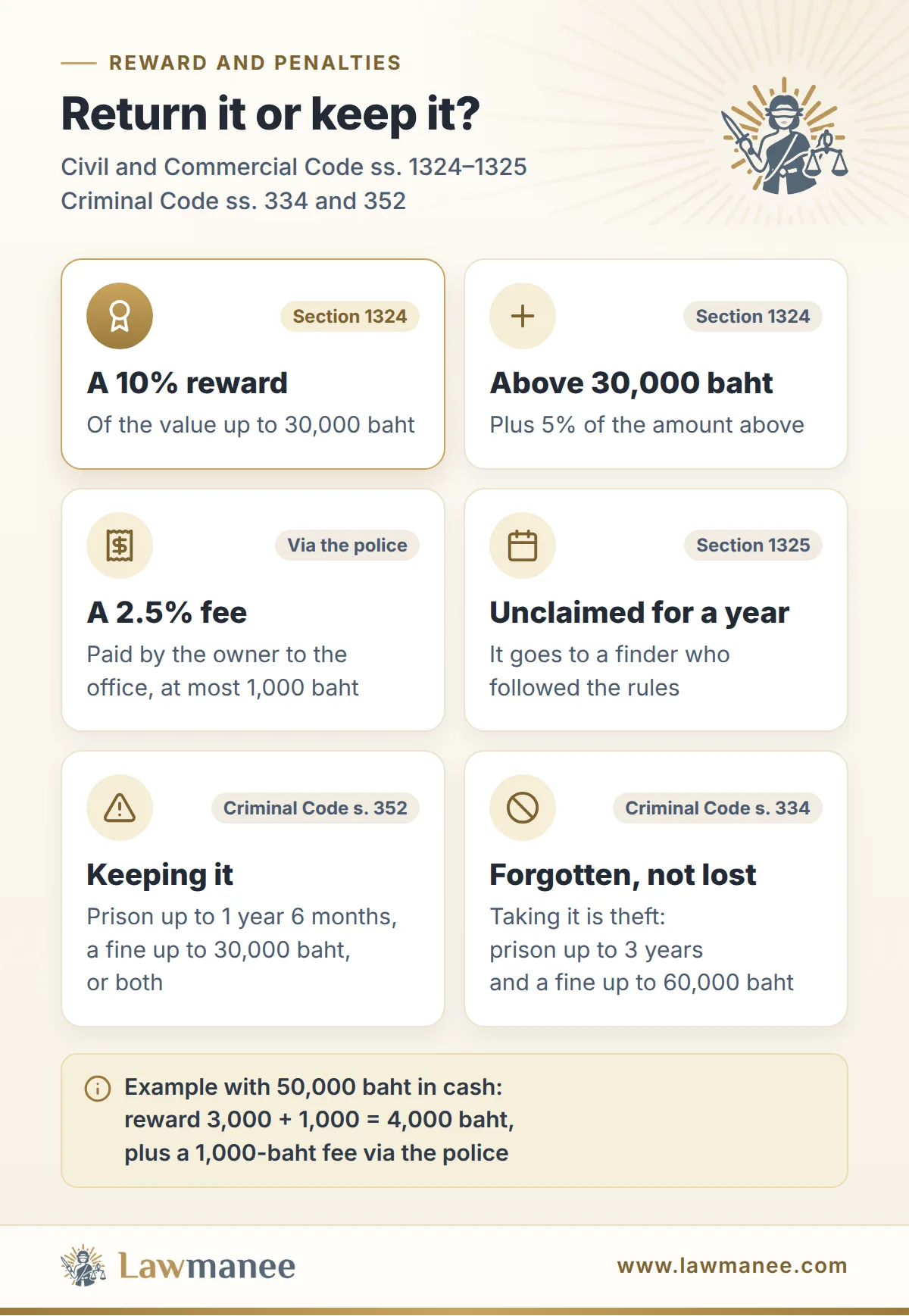
- A finder who dishonestly converts lost property to themselves or someone else, for example by spending the cash or selling the item, commits misappropriation of lost property (Criminal Code, Section 352, paragraph 2). The penalty is half that for ordinary misappropriation: up to 1 year and 6 months in prison or a fine of up to 30,000 baht, or both.
- Misappropriation is a compoundable offence, meaning it can be settled (Section 356). The injured person must file a complaint within three months of learning of the offence and of the offender, or the case is time-barred (Section 96). If the complaint is withdrawn or the parties lawfully settle, the right to prosecute ends (Criminal Procedure Code, Section 39 (2)).
- Taking something the owner had only forgotten or was still looking for is theft, as explained above.
If you are the one who lost something
- Ask at the police station for the area where you lost it, since a finder who cannot identify the owner has to hand the item to the police or another official.
- Claim it within one year of the day it was found.
- When you get it back, the finder may claim the reward set out above, and if the item came through the police or another official, you also pay the fee.
- If you know who picked it up and kept it, file a complaint with the inquiry official within three months of learning of the offence and the offender. As the owner, you can also recover your property from anyone who holds it without a right (Civil and Commercial Code, Section 1336).
- If you lost a passport, a Thai ID card, a house registration book or a title deed, see our guide to lost documents for how to replace them.
- If you need help in English or Chinese, the Tourist Police hotline 1155 answers 24 hours a day.
Talk to a lawyer
Most lost-property cases end with the item going back to its owner. When the parties disagree about who owns it or what it is worth, or someone has been reported for theft or misappropriation, small facts matter: where it was found, whether the owner was still looking for it, and when it was handed over. On Lawmanee you can post your case for free in English, and interested lawyers reply in the platform chat. You can also search the directory for civil and criminal lawyers by province and by the language they speak.