
A fence dispute with the neighbours, a contractor who did not deliver what was agreed, siblings who cannot agree how to divide an inheritance: many disputes do not have to start with a lawsuit. Thai law lets you bring in a neutral third party to mediate before anyone goes to court. This guide explains where to apply, what can be mediated, what it costs, and what you can do if the other side signs an agreement and then does not keep it.
What mediation is
In mediation, a neutral third party helps both sides negotiate a solution they can both accept. The mediator does not decide who is right. Everyone takes part voluntarily, and if there is no agreement, you can still take the matter to court.
This guide covers the two channels you can use yourself:
| Pre-suit mediation at court | Mediation under the Dispute Mediation Act | |
|---|---|---|
| Law | Civil Procedure Code, Section 20 ter | Dispute Mediation Act B.E. 2562 (2019) |
| Where | The court with jurisdiction, or the Court of Justice online system | Rights and Liberties Protection Department, provincial justice offices, people's mediation centres, or online |
| Cost | No court fee | No fee |
| The neutral | A conciliator appointed by the court | A registered mediator chosen jointly by the parties |
| If you agree | Sign the agreement; you can ask the court for a consent judgment | A written settlement agreement |
The rules are the same for foreign residents. The forms are in Thai, and the court's online system signs in with a 13-digit Thai ID number or ThaID; you can also file at the court itself, or send a representative with a power of attorney.
Pre-suit mediation at court
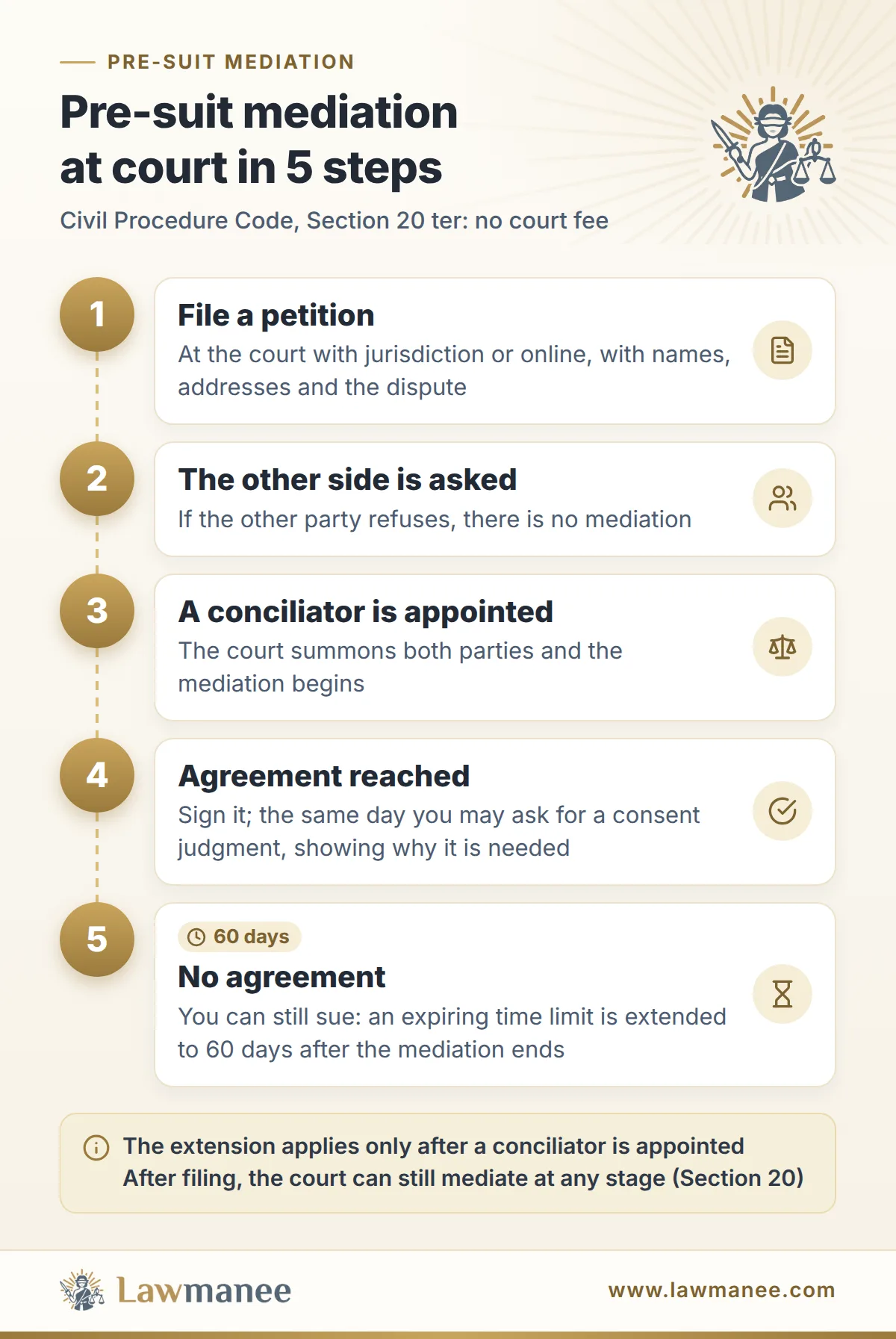
Before filing a civil case, a person who would be a party can petition the court with jurisdiction to appoint a conciliator to mediate (Civil Procedure Code, Section 20 ter). The petition must give the names and domiciles of the parties and details of the dispute. You can file at the court or online through the Court of Justice mediation system. No court fee is charged for the petition or anything done under this section.
- The court accepts the petition if it sees fit, and asks whether the other party is willing to take part. If the other party refuses, there is no mediation.
- The court summons the parties once the other party agrees, and appoints a conciliator.
- If you reach agreement, the conciliator presents it to the court. When the court finds that it reflects the parties' intentions, is made in good faith, is fair and does not break the law, the parties sign it.
- Consent judgment: on the day of the agreement, the parties may ask the court to give judgment in its terms, explaining why this is necessary. If the court agrees that a judgment is needed then, it gives judgment according to the agreement.
- If you cannot agree, the mediation ends, and either side can go on to sue in the usual way.
If a case has already been filed, the court can still mediate, however far the trial has gone (Section 20).
No agreement: the time limit is extended by 60 days
Mediation takes time, so Section 20 ter provides that once the court has appointed a conciliator, if the mediation ends without success and the limitation period expired after the petition was filed, or will expire within 60 days of the end of the mediation, it is extended by 60 days from the day the mediation ended.
Example: suppose your claim would become time-barred on 31 March. You petition for pre-suit mediation on 1 March, the other party agrees and the court appoints a conciliator, but you cannot agree and the mediation ends on 20 April. The time limit expired after you filed the petition, so it is extended by 60 days from 20 April, and you can still sue within that period.
If the other party refuses to take part from the start, the court never appoints a conciliator and this extension does not apply. Do not wait until the time limit is almost up before asking for mediation.
What the Dispute Mediation Act covers
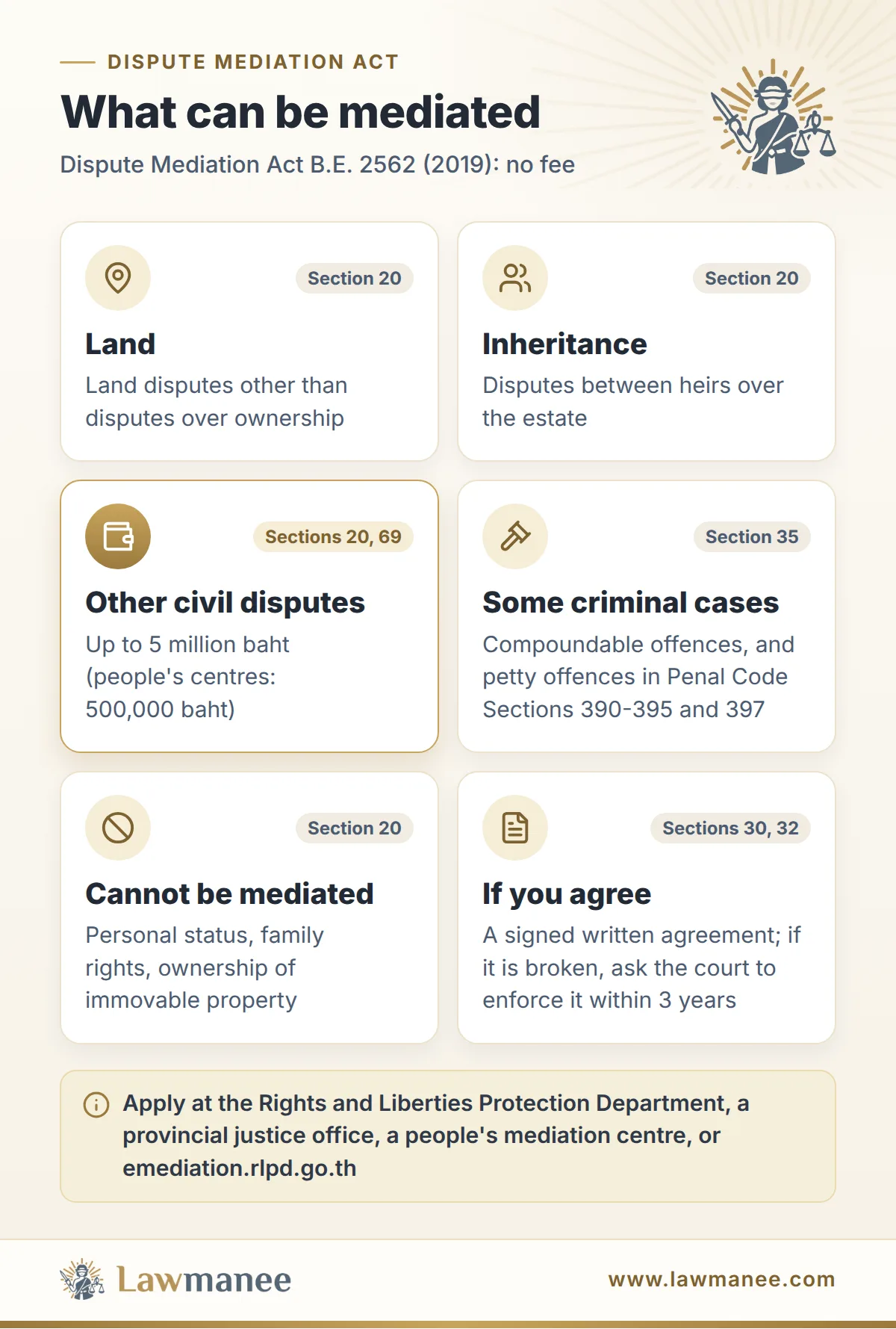
The Dispute Mediation Act B.E. 2562 (2019) governs mediation outside court by state agencies and people's mediation centres. Under Section 20, these civil disputes can be mediated:
- disputes about land, other than disputes over ownership;
- disputes between heirs over the estate;
- other disputes specified by royal decree;
- other disputes where the amount in dispute is no more than 5 million baht, or the amount set by royal decree.
Disputes about rights of personal status, family rights or ownership of immovable property cannot be mediated under this Act. A people's mediation centre can only mediate civil disputes of up to 500,000 baht, or the amount set by royal decree (Section 69).
On the criminal side, the Act allows mediation of compoundable offences, such as defamation or damage to property, and of the petty offences in Sections 390 to 395 and 397 of the Penal Code (Section 35). In a compoundable offence, a settlement made in accordance with the law ends the right to bring a criminal case (Criminal Procedure Code, Section 39 (2)), so make sure you understand the agreement before you sign it.
Facts arising from mediation under this Act cannot be admitted as evidence in a case, except to enforce the agreement (Section 29).
Where to apply: the Rights and Liberties Protection Centre of the Rights and Liberties Protection Department (Ministry of Justice), a provincial justice office or a local people's mediation centre, or online through the central dispute mediation system, which also lists centres near you. There is no fee. The officials ask the other party whether they are willing, then invite both sides to choose a mediator from the register. People's mediation centres are set up by members of the public under the Act and supervised by the Rights and Liberties Protection Department.
Agreement reached, but the other side does not comply
What you can do depends on the form the agreement took:
- Consent judgment: if the court has given judgment in the terms of the agreement and the other side does not comply, ask the court to enforce the judgment; there is no need to file a new case.
- Compromise agreement without a consent judgment: you have to sue to enforce it, and you need written evidence signed by the party who is liable (Civil and Commercial Code, Section 851).
- Settlement agreement under the Dispute Mediation Act: it must be in writing and signed by the parties and the mediator (Section 30). If you have asked the other side to perform and they have not, you can petition the court with jurisdiction to enforce it within 3 years from the day the agreement could be enforced (Section 32).
Read every clause before you sign, including amounts, dates and what each side must do. A compromise agreement extinguishes the claims each side gave up, and each side acquires the rights written in the agreement (Section 852).
Before you apply
- The other party's name and address, and the details of the dispute: a petition to the court must state them.
- Your proof of identity and the evidence you have, such as contracts, receipts or photos.
- A power of attorney if someone else will act for you.
Talk to a lawyer before mediation
A lawyer can tell you which channel fits your dispute, how much of the time limit is left, and whether a draft agreement covers what you need. On Lawmanee you can describe your situation for free so that interested lawyers reply in the platform chat, or search lawyers by case type, province and language.