
A portable charger overheats and catches fire, an appliance leaks current and gives someone an electric shock, or packaged food is contaminated and sends a family to hospital. When a product used in the normal way injures someone or damages other property, the law that helps the injured person most directly is Thailand's Unsafe Product Liability Act B.E. 2551 (2008), often called the PL (product liability) law, in force since 2009. This guide explains who is liable, what you must prove, what you can claim and the deadline to sue. Nothing in the Act limits it to Thai nationals: an injured person is anyone harmed by an unsafe product, so foreign residents and visitors are protected in the same way.
What counts as an unsafe product
The Act covers products: all movable goods produced or imported for sale, including agricultural produce and electricity, except goods excluded by ministerial regulation (Section 4). A product is unsafe when it causes, or may cause, damage for one of these reasons, judged by its condition and the normal use and storage that can be expected:
- a manufacturing defect;
- a design defect;
- missing instructions for use or storage, warnings or product information, or instructions that are incorrect or not reasonably clear.
Damage means harm to life, body, health, mind or property, but not damage to the unsafe product itself. An injured person is anyone harmed by an unsafe product; you do not have to be the buyer.
Who is liable
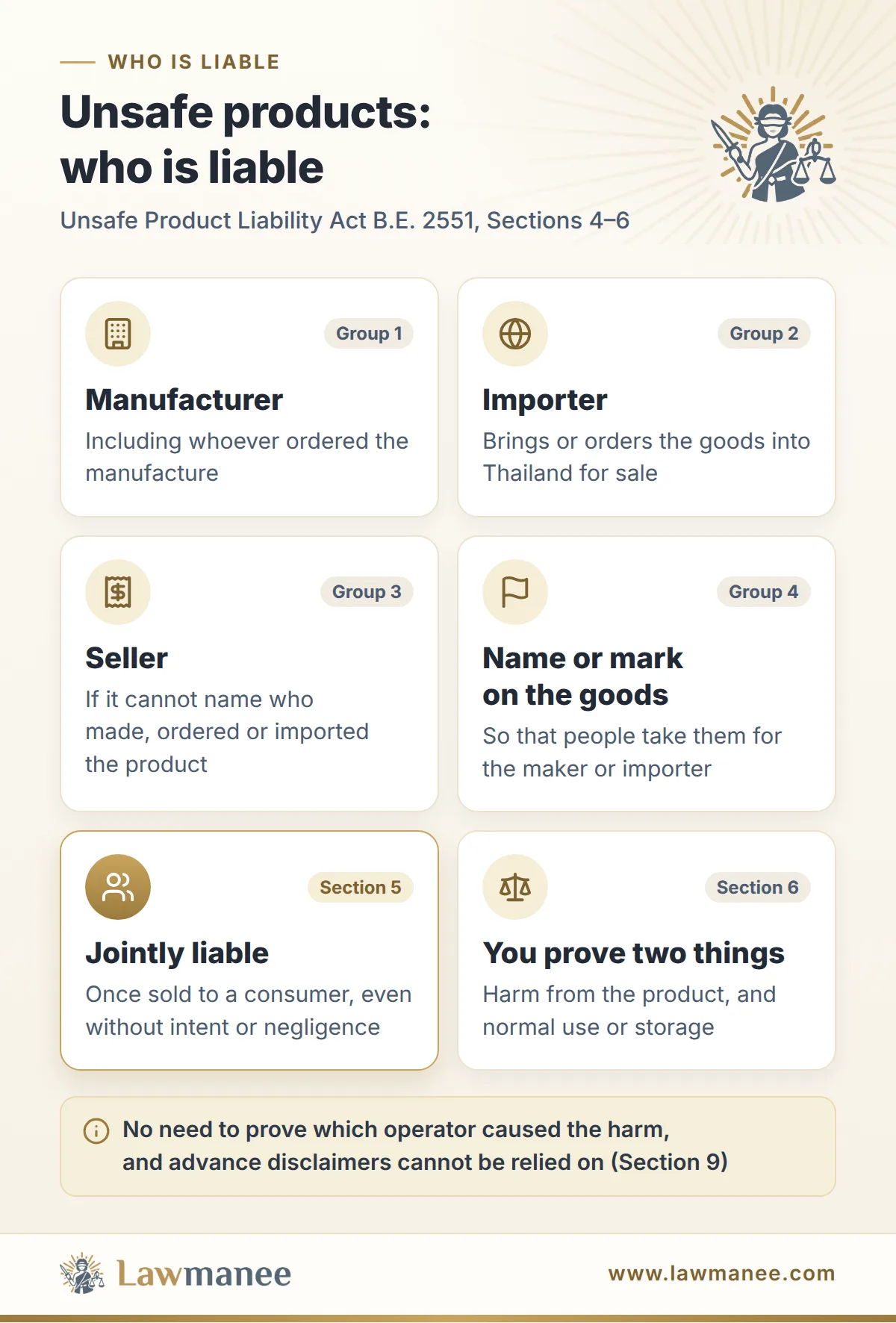
The Act calls the liable parties operators, in four groups (Section 4):
- the manufacturer, or whoever hired someone to manufacture the product;
- the importer;
- a seller who cannot identify the manufacturer, whoever ordered the manufacture, or the importer;
- anyone who uses a name, trade name, mark or statement that makes people understand they are the manufacturer, whoever ordered the manufacture, or the importer.
Once an unsafe product has been sold to a consumer, all operators are jointly liable to the injured person, whether or not they acted intentionally or negligently (Section 5). In an ordinary tort claim you would have to show intent or negligence (Civil and Commercial Code, Section 420). The Act also keeps your right to claim under other laws (Section 14).
What the injured person must prove
You prove two things: that you were harmed by the operator's product, and that you used or stored it in the normal way. You do not have to prove which operator caused the damage (Section 6).
In a consumer case, when facts about how the product was made, assembled or designed, or what is in it, need to be proved and the court finds they are known only to the business, the burden of proof is on the business (Consumer Case Procedure Act B.E. 2551, Section 29).
When an operator is not liable
An operator escapes liability if it proves that (Section 7):
- the product is not unsafe;
- the injured person already knew the product was unsafe; or
- the damage came from using or storing the product contrary to instructions, warnings or information that the operator had given correctly and reasonably clearly.
Any agreement, notice or announcement made before the damage that excludes or limits liability, such as "the manufacturer accepts no responsibility for any damage" on a label, cannot be relied on (Section 9).
What you can claim
You can claim compensation for a wrongful act under the Civil and Commercial Code, such as medical bills and other expenses, compensation for lost earning capacity now and in the future (Section 444), and the value of damaged property. The court may also award two more kinds of damages (Section 11):
- Mental damages resulting from harm to your body or health, such as pain, fear, anxiety or humiliation. If the injured person dies, their husband or wife, ascendants (such as parents) and descendants (such as children) are entitled to mental damages.
- Punitive damages when the operator produced, imported or sold the product knowing it was unsafe, failed to know because of gross negligence, or learned of the danger later and did not take reasonable steps to prevent damage. The court may add up to twice the actual damages.
Example (hypothetical): A buys a 900-baht portable charger from an online shop. A charges it as the manual says and it catches fire, burning A's hand and damaging the curtains and a laptop. The shop can name the importer.
- A can claim the medical bills, the curtains, the laptop and mental damages from the importer by proving that the damage came from the portable charger and that it was used normally.
- The portable charger itself is not "damage" under this Act, but the seller is liable for defects in the goods it sold (Civil and Commercial Code, Section 472).
- If the court sets the actual damages at 80,000 baht and finds that the importer knew the product was unsafe but kept selling it, it may add punitive damages of up to 160,000 baht, for a total of up to 240,000 baht.
| Question | Unsafe Product Liability Act | Defects in a sale |
|---|---|---|
| Used when | the product injures someone or damages other property | the product itself is defective or loses value |
| Claim against | the four groups of operators | the seller |
| Time limit | 3 years from knowing of the damage and the liable operator, at most 10 years from the sale | 1 year from discovering the defect (Section 474) |
Time limits: 3 years, and never more than 10
- A claim under this Act is time-barred 3 years after the injured person learns of the damage and of the liable operator, or 10 years after the product was sold (Section 12).
- If harm to life, body or health comes from substances that build up in the body, or takes time to show symptoms, you must claim within 3 years of learning of the damage and the liable operator, but no later than 10 years after learning of the damage.
- While you negotiate compensation with the operator, the time limit stops running until either side calls off the negotiations (Section 13).
If a product has injured you
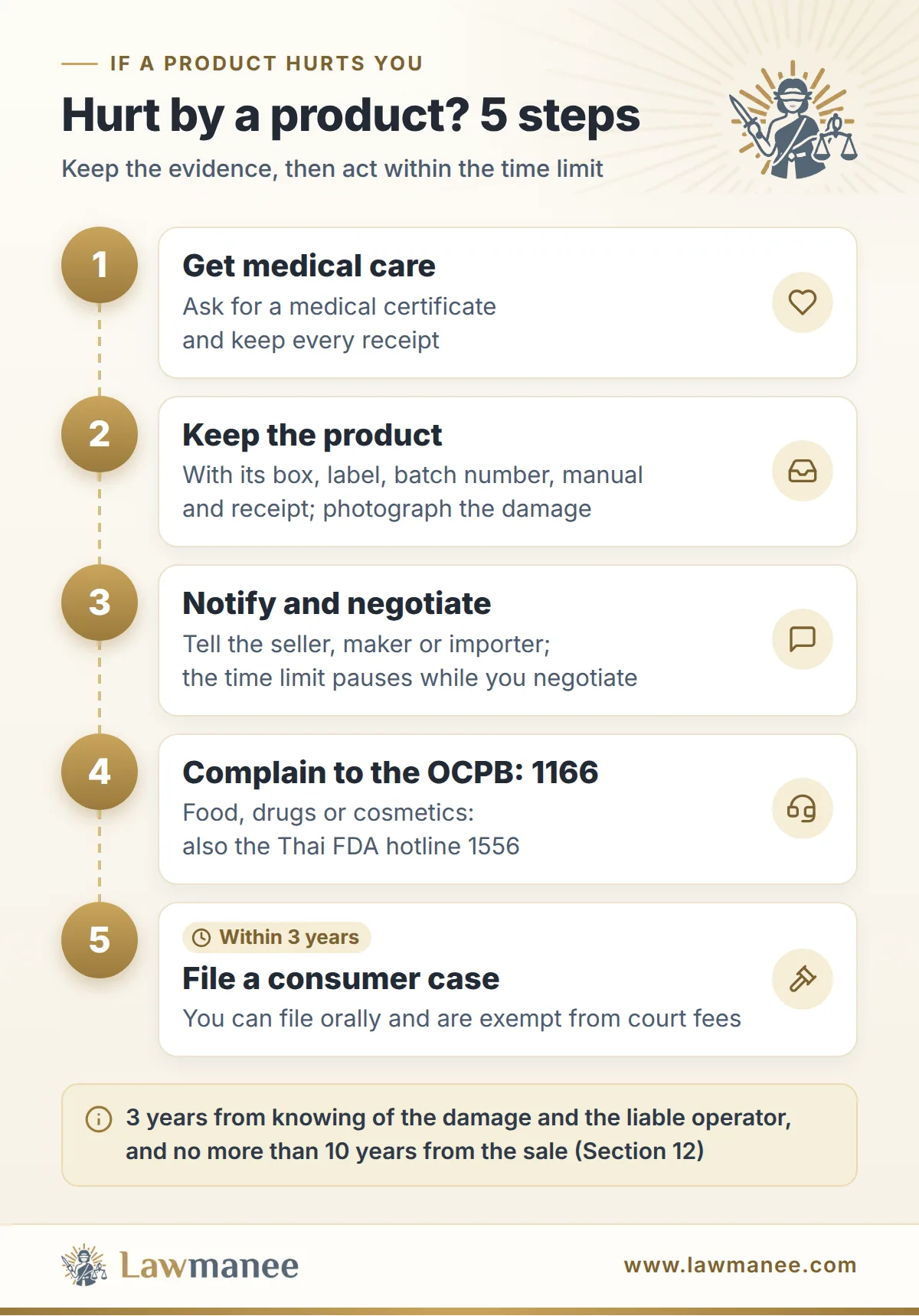
- Get medical care first, ask for a medical certificate and keep every receipt.
- Keep the product and do not throw it away, with its packaging, label, batch or serial number, manual and receipt, and photograph the injury, the product and the damaged property.
- Notify the seller, manufacturer or importer and negotiate compensation.
- Complain to the Office of the Consumer Protection Board (OCPB) on hotline 1166, through the OCPB Connect app, at ocpb.go.th or at a Damrongtham Centre. For food, drugs, cosmetics and other health products you can also call the Thai Food and Drug Administration (FDA) on 1556.
- File a consumer case if you cannot settle, within the time limits.
Filing a consumer case yourself
A claim under the Unsafe Product Liability Act is a consumer case (Consumer Case Procedure Act, Section 3). You can file it yourself, orally or in writing (Section 20), and you are exempt from court fees, although the exemption does not cover liability for costs ordered when the case becomes final (Section 18). The Consumer Protection Board, and associations and foundations it has certified, may also sue for damages on the injured person's behalf (Unsafe Product Liability Act, Section 10). For the steps of a consumer case, see our guide to online purchases that are not as described.
Talk to a lawyer
If the injury is serious, the operator denies liability, or you cannot tell who made or imported the product, a lawyer can assess your claim and prepare the case. On Lawmanee you can post your case for free in English, and interested lawyers reply in the platform chat. You can also search the directory for consumer and civil lawyers by province and by the language they speak.