
A Thai traffic ticket can be handed to you on the road, left on your car, or mailed to your home after a camera catches the car. Many people put it in a drawer and forget it — but an unpaid ticket now affects your annual car tax and your driving-licence points. This guide covers checking, paying and disputing a ticket under the Land Traffic Act B.E. 2522 (1979) and the latest measures of the Royal Thai Police and the Department of Land Transport.
Types of ticket
The Royal Thai Police notification on ticket forms of 2020 (B.E. 2563), issued under Section 140 of the Land Traffic Act, sets two forms:
- A ticket given to the driver or left on the vehicle when an officer sees the offence.
- A ticket sent by post to the registered owner or possessor of the vehicle, usually when a camera records the offence, with the picture or evidence attached.
Because camera tickets go to the registered owner, anyone who lends a car, or has sold one without transferring the registration, should check the tickets in their name regularly.
Fines are set by the Land Traffic Act. Amendment No. 13 of 2022 (B.E. 2565) raised the penalties for many offences from 5 September 2022. The amount you actually pay is printed on each ticket.
Checking and paying
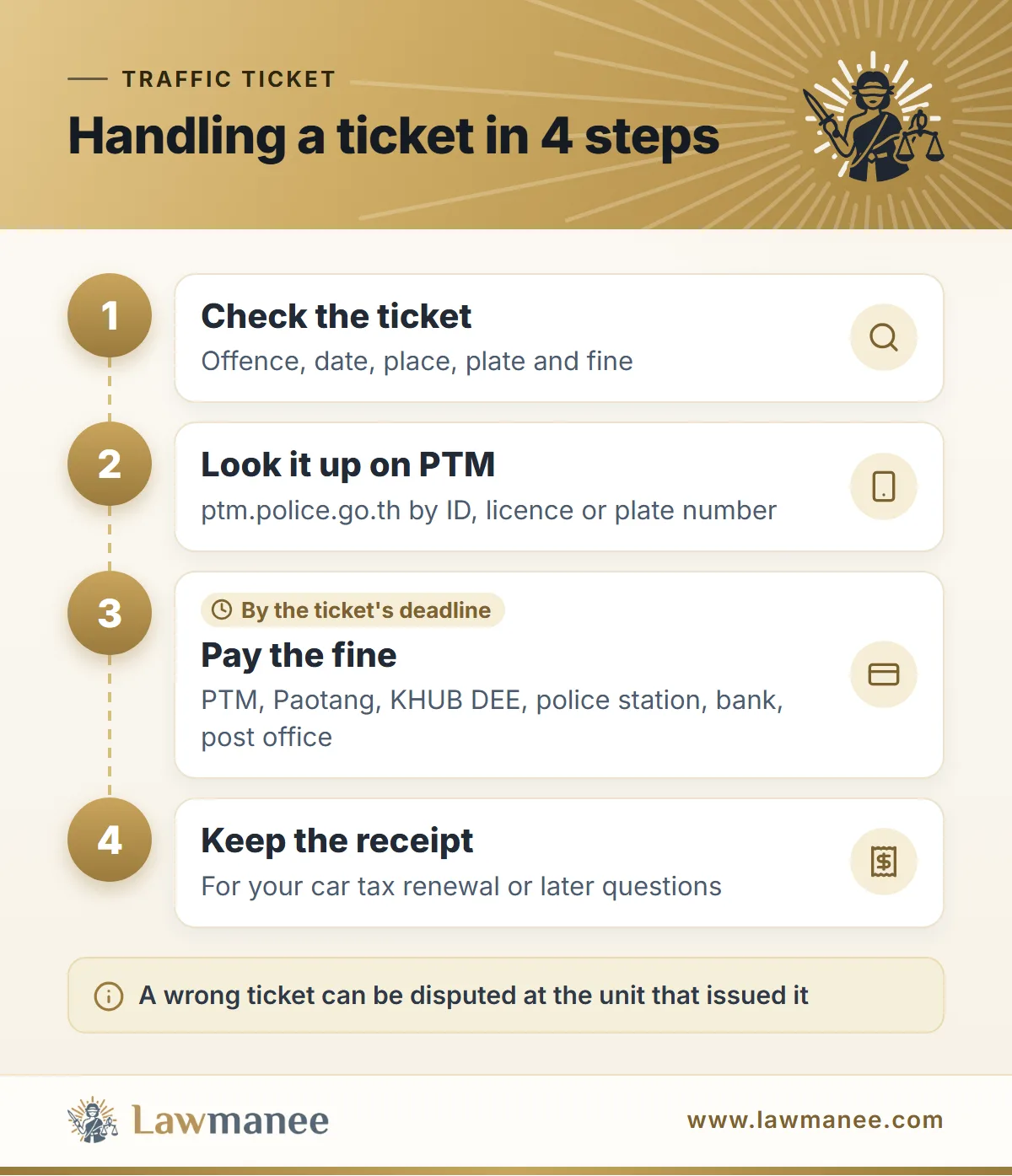
- Check the ticket: the offence, date, time, place, plate number and fine must match what happened.
- Look it up on PTM at ptm.police.go.th, the police e-Ticket system, with a Thai ID number, driving-licence number or plate number. It lists your unpaid tickets and, for the new ticket format, lets you view the ticket, the warning letter, the proof of postal delivery and the issuing officer's unit.
- Pay within the time stated on the ticket: on PTM, the Paotang app, the KHUB DEE app, at a police station, a bank or a post office.
- Keep the receipt for your car tax renewal or any later question.
Disputing a ticket
If you think the ticket is wrong, do not pay it first. The ticket notification allows you to dispute or deny the charge, for example because:
- you did not commit the offence;
- you were not driving at the time;
- the vehicle is not yours.
Contact the unit named on the ticket; the officer records your denial. Bring evidence such as the vehicle sale contract, proof you were elsewhere, or dash-cam footage. If the matter does not end at the police and you want to fight it, talk to a lawyer.
Unpaid tickets and car tax renewal
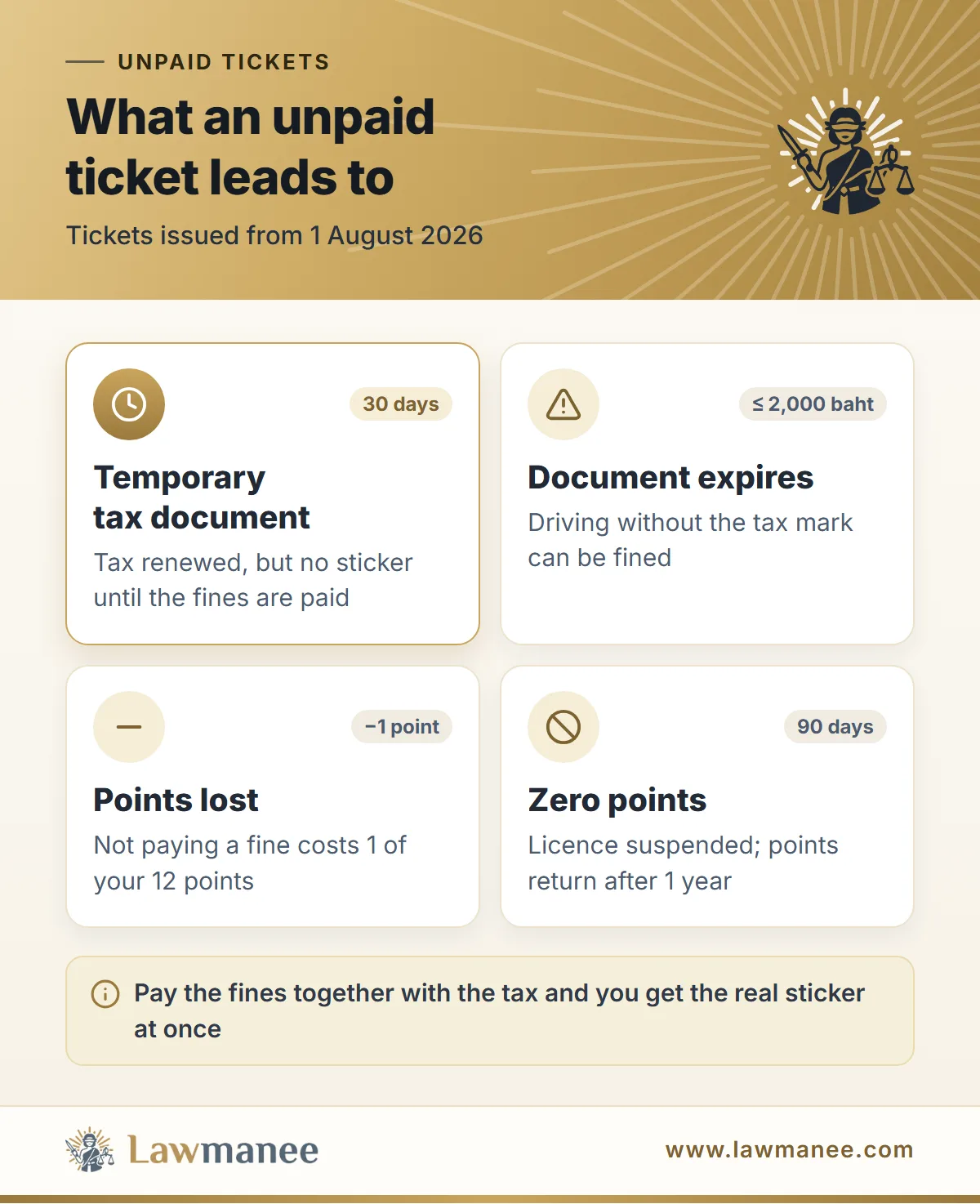
Since 1 August 2026 the Royal Thai Police and the Department of Land Transport share ticket data:
- You can still renew the tax, but with an unpaid ticket you receive only a temporary document valid for 30 days instead of the round tax sticker.
- Pay the fines, then bring the proof of payment to collect the real sticker within 30 days of the renewal. Pay the fines and the tax together and you get the sticker at once.
- If the temporary document expires and you keep driving, the car is used without displaying the tax mark under the Motor Vehicle Act — a fine of up to 2,000 baht.
- Only tickets issued from 1 August 2026 count; older tickets are not included.
Ticket data does not reach the Department of Land Transport at once: the police send warning letters first, and an unpaid ticket enters the department's system about 60 to 90 days after it was issued.
The licence points system
Since 9 January 2023 every licence holder has 12 points. Each offence costs a different number:
| Offence | Points lost |
|---|---|
| Parking where prohibited | 1 |
| Not paying a ticket fine | 1 |
| Running a red light | 2 |
| Driving against the traffic | 2 |
| Drunk driving | 4 |
At 0 points your licence is suspended for 90 days. Lost points come back after 1 year. You can check your points on PTM, KHUB DEE or Paotang.
Example. Amy starts with 12 points. In March a camera catches her running a red light: −2, leaving 10. In April she gets a ticket for parking where prohibited: −1, leaving 9. If she does not pay the parking fine, she loses 1 more and has 8 left — after only two offences.
Foreigners driving in Thailand
Tickets and fines work the same way for everyone who drives in Thailand. Camera tickets go to the registered owner, so if you rent or borrow a car, agree clearly with the owner who pays them.
Talk to a lawyer
Most tickets end with a paid fine, but some need a lawyer: a charge for driving you did not do, a cloned plate, or a traffic case with an accident and injuries. On Lawmanee you can post your case for free and interested lawyers reply in the platform chat, or find a lawyer by case type, province and the language you speak.