


Moved to a new house, bought a condo or signed a long lease? Many people leave their name at the old address for years, until they need the house registration for a government office, or a school place, and find they have to travel back. This guide sums up the Civil Registration Act B.E. 2534 (1991): when to report a move, the three ways to do it, the documents, and the fines for reporting late. The last section covers foreigners, who use a different book.
Report within 15 days
The law makes the householder report a change of address to the registrar (Section 30).
- Move-out: within 15 days of the day the resident moved out
- Move-in: within 15 days of the day the person moved in
A person can be listed in only one house registration. Until the move-in is reported, the name stays at the old address.
The householder is not always the owner
Under the Act, the "householder" (chao baan) is the head who occupies the house, whether as owner, tenant or in any other capacity (Section 4). The owner is the person named on the title deed. A house registration therefore shows where people live, not who owns the property.
This matters because adding your name to a house needs the consent of that house's householder. Tenants should ask the householder first. If you bought a new house or condo that has no householder yet, take your ownership papers to the registry office and register yourself as householder first.
Three ways to move a house registration
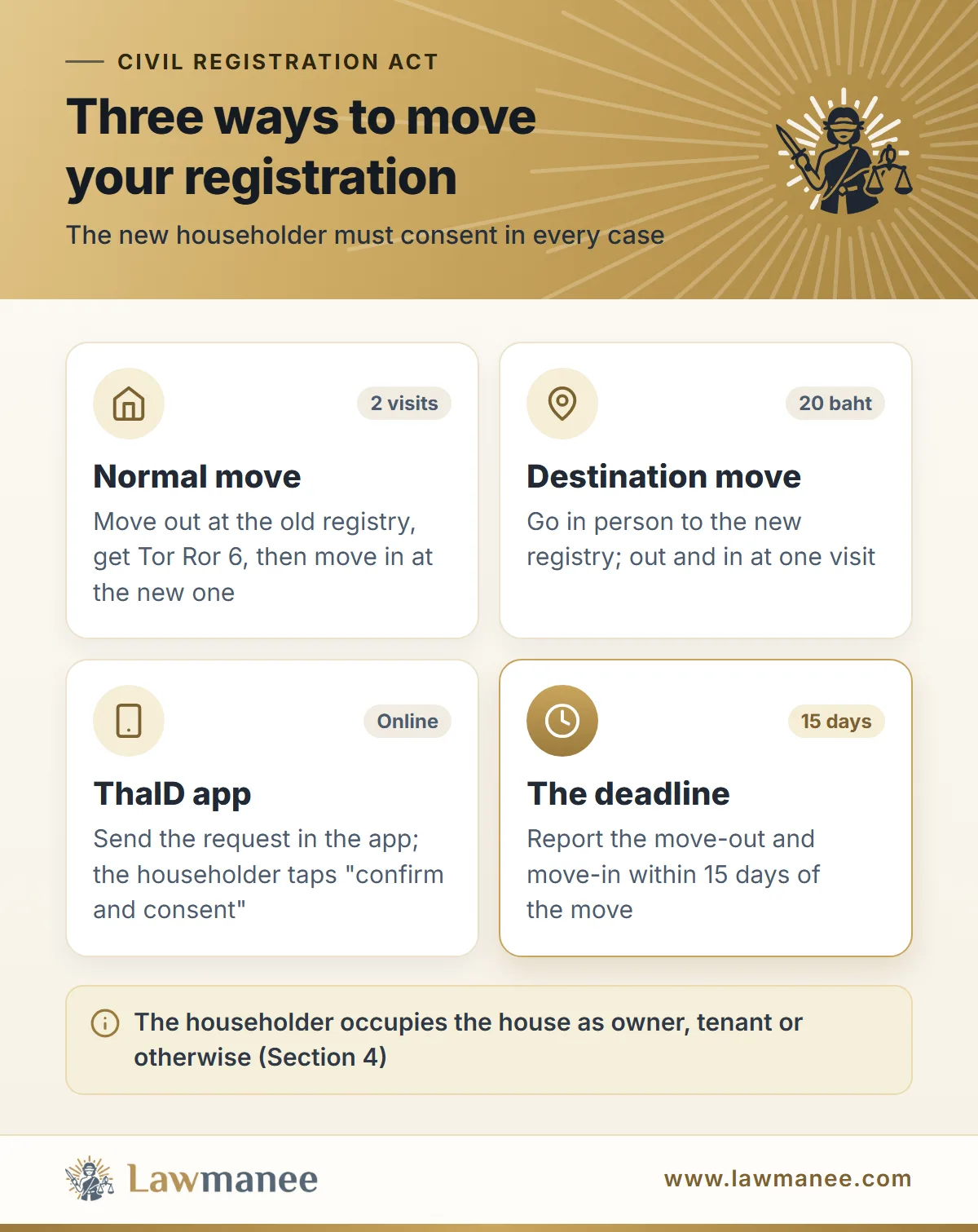
1. Normal move: out first, then in
Report the move-out at the district registry of the old house. The registrar gives you a change-of-address form (Tor Ror 6). Take it to the registry of the new house and report the move-in within 15 days. It takes two visits, but suits people who do not yet know where they will move to, and someone else can do it for you with a power of attorney. A person aged 15 or over may report their own move-out.
2. Destination move: one visit
You go in person to the registry of the new house. The registrar removes you from the old house and adds you to the new one in a single visit. Bring a copy of the new house registration and the new householder's written consent if they are not with you. The fee is 20 baht. This is the easiest option when the old house is in another province.
3. The ThaID app
The Department of Provincial Administration lets you report a move yourself through the ThaID app. You sign in to the online registration service with ThaID, enter the new householder's 13-digit ID number and submit the request. The householder must have ThaID too and press "confirm and consent" in their own app; only then does the request go to the registrar, who decides and notifies you. A new house with no householder on record cannot use this route.
Documents to prepare
Offices may ask for more, but the core set is:
- The mover's Thai ID card
- The householder's copy of the house registration (the actual book) for the house you leave or join
- The householder's ID card
- Form Tor Ror 6 signed by the householder, for a normal move-in
- A power of attorney from the householder plus the agent's ID card, if someone else goes
Late by more than 15 days: the fine
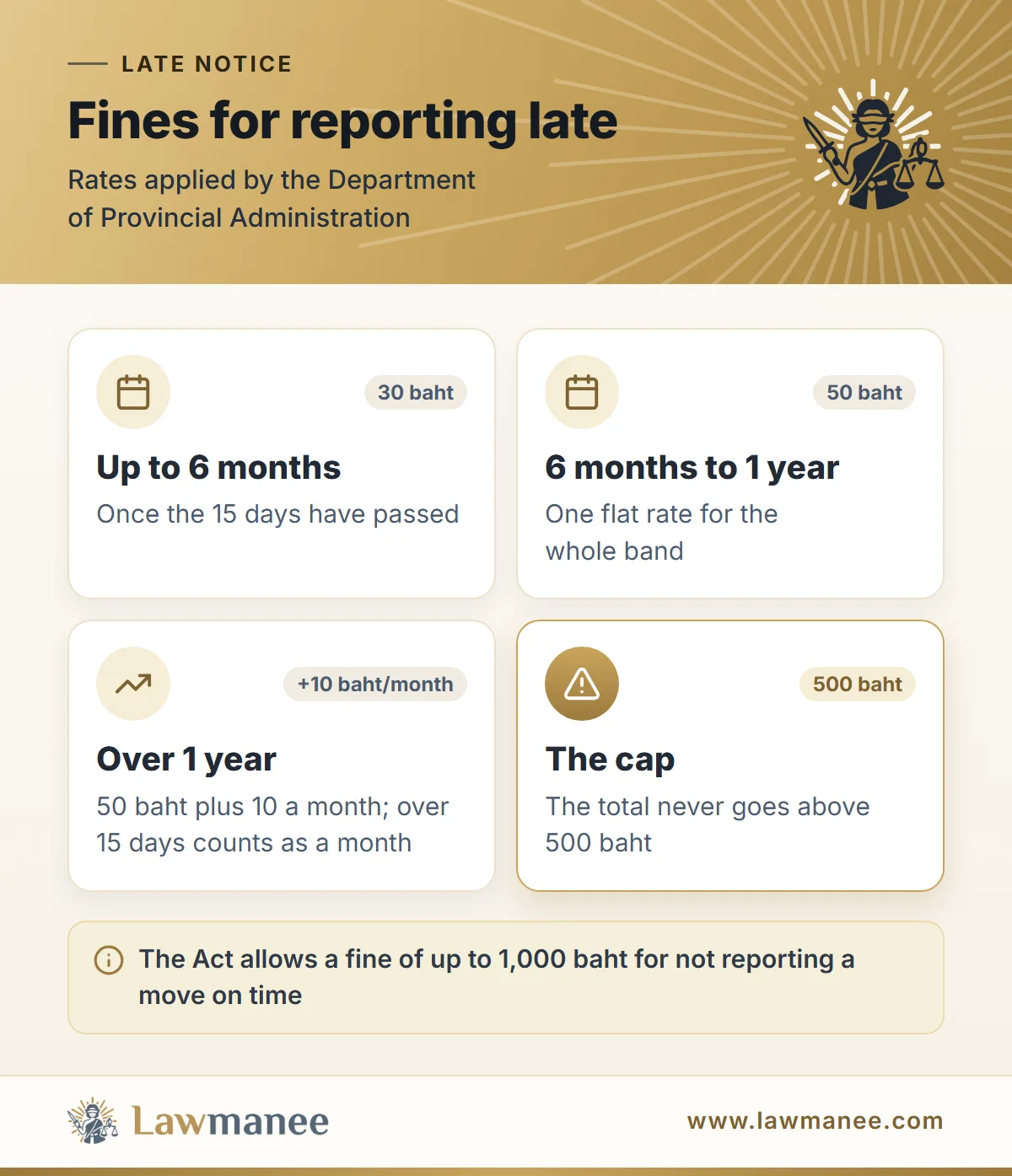
The Civil Registration Act sets a fine of up to 1,000 baht for not reporting a move on time. In practice the Department of Provincial Administration settles it at these rates:
| Late by | Fine |
|---|---|
| Up to 6 months | 30 baht |
| Over 6 months, up to 1 year | 50 baht |
| Over 1 year | 50 baht plus 10 baht a month, 500 baht at most |
A part of a month over 15 days counts as a full month.
Example: you move into a new condo in January but report the move-in in April of the same year. That is more than 15 days late but under 6 months, so the fine is 30 baht. Leave it for more than a year and the fine grows month by month up to 500 baht.
Someone left long ago but is still listed
If a person listed in the house has lived elsewhere for more than 180 days and the householder does not know where, the householder can report a move-out to an unknown address. The registrar inquires first, then moves that person's entry to the central house registry (Section 33), the register for people who are not listed at any house. Once they have a new address, they can move in there as usual.
This often comes up with former tenants who never moved their name out, or when a buyer wants the seller's family removed from the house registration.
Foreigners: the yellow book (Tor Ror 13)
Foreigners cannot be listed in the blue book (Tor Ror 14), which is for Thai nationals and foreigners holding an alien certificate (permanent residents). A foreigner who entered legally and has permission to stay temporarily can be listed in the yellow book, Tor Ror 13 (Section 38); the entry is removed when the permission to stay ends.
You apply at the registry of the area where the house is, with the householder's consent as for Thais, and with a passport whose permission to stay has not expired. The document list differs from office to office, so ask the registry for that address what to bring before you go. Like the blue book, the yellow book records residence, not ownership.
When you need a lawyer
Most moves are simple, but some need advice: a householder who will not let you move in, a former tenant who will not move out, or a foreigner's house registration linked to a condo purchase. On Lawmanee you can post your situation for free without personal details; interested lawyers reply through the platform chat. Or find a lawyer by case type, province and language, including lawyers who work in English.