


"How much will a lawyer cost?" is usually the first question people ask when a legal problem lands on their desk, and the hardest one to answer. Thai law does not set lawyers' fees, so every firm prices its own work. What you can do is understand what the money in a case is made of, and then compare several quotes on the same basis.
Where the money in a case goes
The cost of a case usually falls into four parts, and only one of them goes to your lawyer.
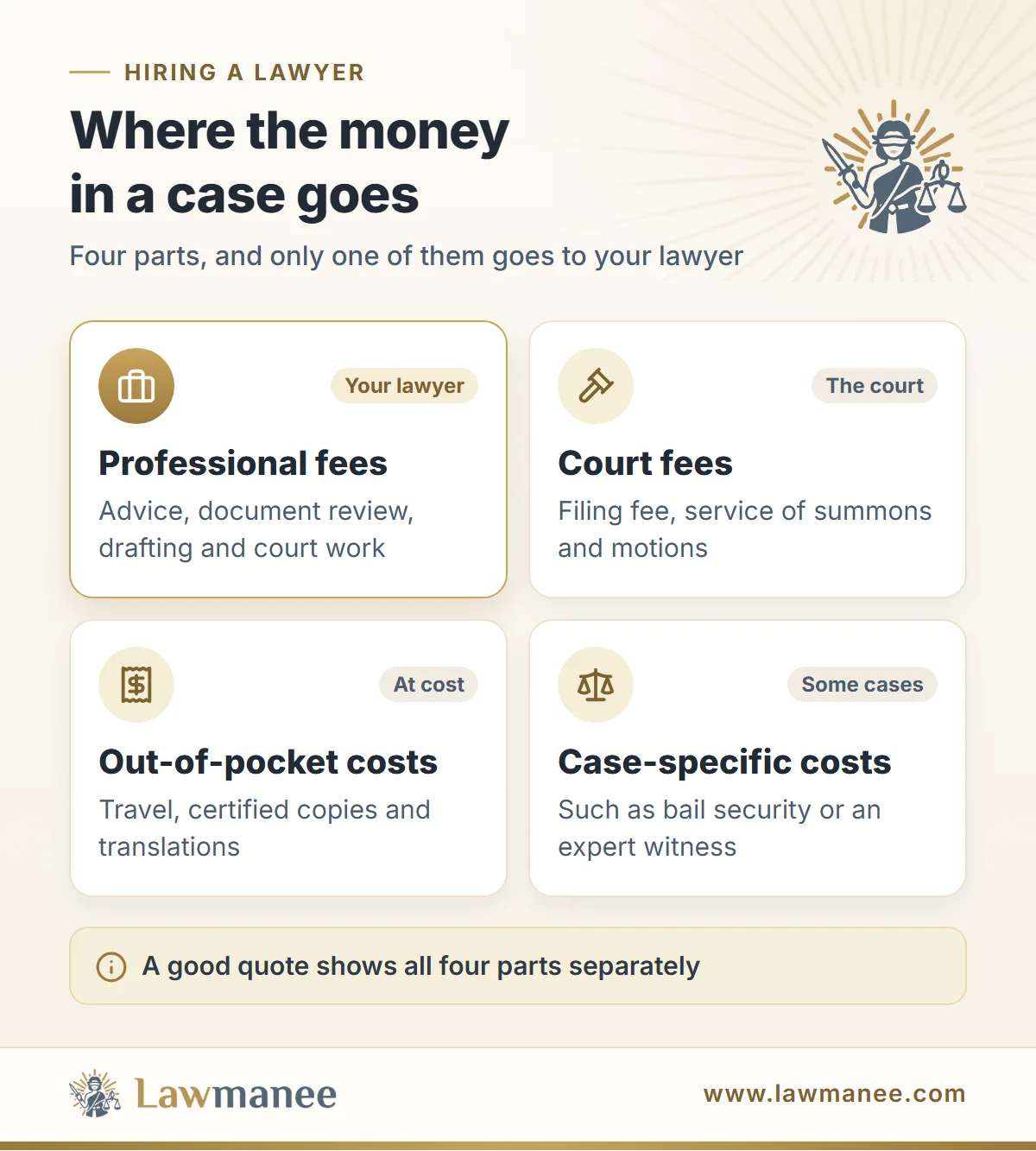
- Professional fees: consultations, document review, demand letters or contracts, and court representation.
- Court fees: paid to the court itself, most notably the filing fee when a lawsuit is lodged, plus fees for serving summonses and filing motions.
- Out-of-pocket expenses: travel to courts in other provinces, certified copies, and translation of foreign-language documents.
- Case-specific costs: for example, security for temporary release (bail) in a criminal case, or fees for an expert witness.
A good quote separates these parts clearly. If you receive a single number with no breakdown, ask what it includes before you agree.
Why quotes differ so much
- Complexity and workload: many witnesses or a large volume of documents take more time.
- Amount in dispute: the higher the stakes, the greater the lawyer's responsibility.
- Court level and number of hearings: most quotes cover the Court of First Instance only; the Court of Appeal and the Supreme Court are priced separately.
- Location: a court far from the lawyer's office adds travel costs and time.
- Urgency and language: out-of-hours work, or a case where the lawyer must work with you in English or Chinese, usually costs more.
Common fee arrangements
- Fixed fee per case or per court level: the most common arrangement for everyday cases. You know the total upfront, usually paid in instalments tied to stages of the case, such as filing and witness hearings.
- Hourly billing: common in business advisory work and at international law firms. Ask for an estimate of hours and a fee cap.
- Success fee: some firms charge an extra amount if you win or actually recover money. Put in writing exactly what counts as "success" and which amount the fee is calculated on.
Whatever the arrangement, sign a written engagement agreement and ask for a receipt for every payment.
How civil court filing fees are calculated
Filing fees are based on the amount claimed, under Table 1 appended to the Thai Civil Procedure Code.
| Case | Filing fee |
|---|---|
| Small claims up to 300,000 baht | 2%, capped at 1,000 baht |
| Claims up to 50 million baht | 2%, capped at 200,000 baht |
| Portion of a claim above 50 million baht | an additional 0.1% of the excess |
| Claims with no monetary value | 200 baht |
| Labour cases | exempt |
| Consumer cases brought by the consumer | exempt (the court may order payment later) |
For example, a claim for 1,000,000 baht carries a filing fee of 20,000 baht, while a claim for 20 million baht hits the 200,000-baht cap.
A common misunderstanding concerns the "lawyer's fee" the court orders the losing party to pay. Courts award it at the rates in the tables appended to the Civil Procedure Code, which are usually well below what you actually pay your lawyer, so do not count on recovering your full legal fees.
Court proceedings in Thailand are conducted in Thai, and documents in a foreign language must be filed together with a Thai translation. If your contracts or evidence are in English or Chinese, budget for translation.
If you cannot afford a lawyer
- The Lawyers Council of Thailand offers free legal advice (hotline 1167) and case assistance to people with limited means, subject to its criteria. You still pay any fees owed to the court or government agencies.
- The Justice Fund can support lawyer's fees, court fees and other litigation costs, subject to its criteria.
- Court fee exemption: a party without sufficient means can petition the court to waive court fees.
- Labour and consumer cases carry no filing fee, and the claim can even be made orally at court.
7 questions to ask before you hire a lawyer
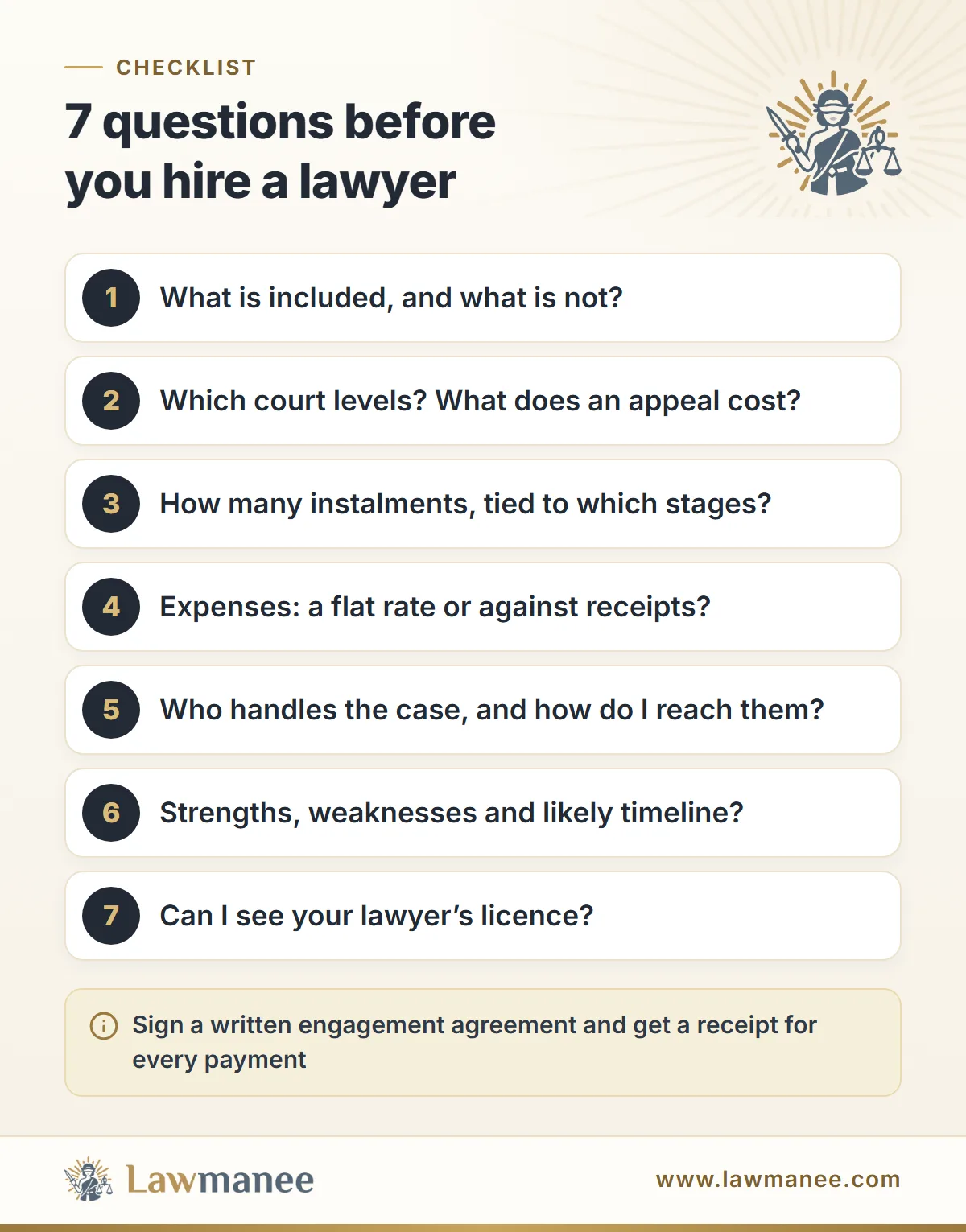
- What does the quote include, and what does it not include?
- Which court levels does it cover, and what will an appeal cost?
- How many instalments are there, and which stage triggers each one?
- Are out-of-pocket expenses charged at a flat rate or against receipts?
- Who will actually handle the case, and how can you reach them?
- What are the strengths, weaknesses and likely timeline of the case?
- Can you see the lawyer's licence? (Lawyers can be looked up on the Lawyers Council of Thailand website.)
Compare several lawyers without chasing them by phone
The easiest way is to describe your case once and let interested lawyers come to you. On Lawmanee you can post a case for free. Interested lawyers respond to your post and message you in the platform's chat; ask each of them for a scope of work and a fee, then compare their experience and verification status before you hire. You can also browse lawyers by case type, province and language, including lawyers who speak English or Chinese.