


You name your shop, design a logo and sales take off, until one day someone else is using the same name or has filed it first. This happens often to small and online businesses. Here is how trademark registration works under Thailand's Trademark Act B.E. 2534 (as last amended in 2016), from the first search to renewal, with the official fees from the Department of Intellectual Property (DIP).
Why register
Once registered, the owner has the exclusive right to use the mark for the goods listed (Section 44). The owner of an unregistered mark cannot sue to prevent infringement or claim damages for trademark infringement (Section 46); what remains is a passing-off claim, which is harder to prove.
The same law covers service marks, such as the name of a restaurant, clinic or delivery service.
What can be registered
Section 6 sets three conditions:
- Distinctive: the mark tells people your goods apart from others (Section 7). Words that directly describe the product's character or quality, such as calling a snack "crispy", usually are not.
- Not prohibited, such as national flags or state emblems.
- Not identical or confusingly similar to a mark someone else has already registered, whether for the same class or a different class of goods the Registrar considers to be of the same character (Section 13).
Search before you file
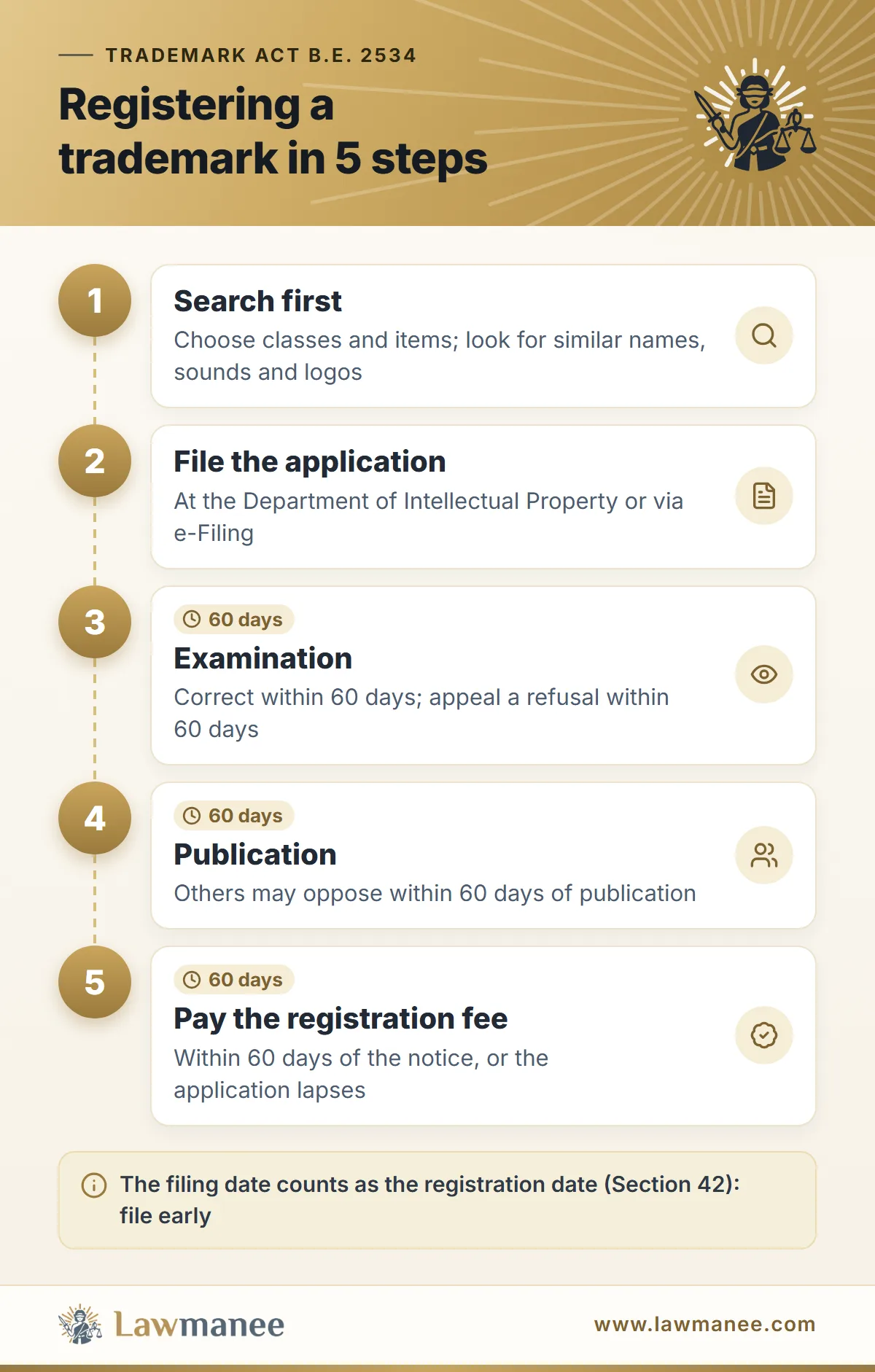
Goods and services are divided into 45 classes (goods 1–34, services 35–45). Before filing:
- Decide exactly which goods or services you will use the mark for: each item must be listed in the application (Section 9).
- Search the trademark database on the DIP website for similar spellings, similar sounds and similar logos.
- If you find something close, change the name or design now; it is cheaper than amending later.
After filing
File at the DIP or online through its e-Filing system. Then:
- Examination: if the application is defective, the Registrar orders you to correct it within 60 days of receiving the order (Section 15). If the mark is refused (Section 16), you may appeal to the Trademark Board within 60 days (Section 18).
- Publication: once the Registrar accepts the mark, the application is published (Section 29).
- 60-day opposition window: anyone who claims a better right, or believes the mark cannot be registered, may oppose within 60 days of publication (Section 35). The applicant must file a counter-statement within 60 days of receiving the opposition, or the application is treated as abandoned.
- Pay the registration fee within 60 days: with no opposition, or after winning one, the Registrar orders registration and you must pay within 60 days of the notice, or the application is treated as abandoned (Section 40).
The filing date counts as the registration date (Section 42), so your rights go back to the day you filed: another reason to file early.
Official fees
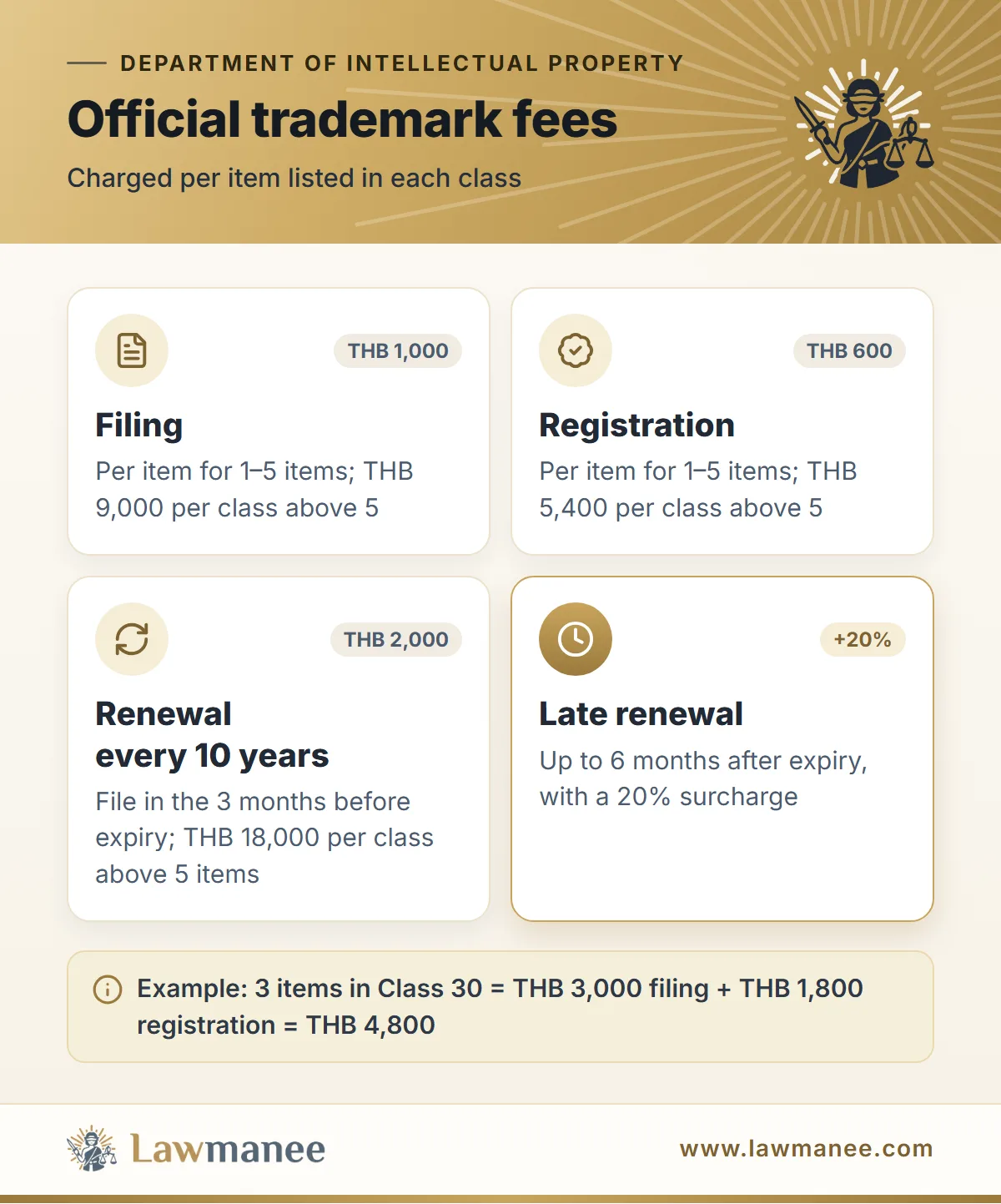
Fees depend on how many items you list in each class.
| Fee | 1–5 items per class | More than 5 items |
|---|---|---|
| Filing | THB 1,000 per item | THB 9,000 per class |
| Registration (after opposition) | THB 600 per item | THB 5,400 per class |
| Renewal | THB 2,000 per item | THB 18,000 per class |
A logo wider or taller than 5 cm costs an extra THB 200 per centimetre over that size, and an opposition costs THB 2,000.
Example: a bakery registers its name in Class 30 for 3 items (cookies, cakes, bread). Filing costs 3 × 1,000 = THB 3,000, and registration another 3 × 600 = THB 1,800, THB 4,800 in total. Listing 8 items in the same class would cost THB 9,000 to file and THB 5,400 to register, THB 14,400 in total, so list the goods you actually use or plan to use.
A 10-year term and renewal
A registration lasts 10 years from the registration date, which is the filing date (Section 53), and can be renewed for 10 years at a time.
- File the renewal and pay the fee within the 3 months before expiry (Section 54).
- If you miss that, you can still renew within 6 months after expiry, with a 20% surcharge on the renewal fee.
Note the filing date in your calendar and set a reminder well before the 10 years are up.
Foreign owners and protection abroad
A registration only protects the mark in the country where it is registered: a mark registered at home is not automatically protected in Thailand. Thailand has been a member of the Madrid Protocol since 7 November 2017, so a foreign owner can designate Thailand in an international application filed through their home office, and a Thai applicant or registrant can file an international application through the DIP to cover chosen member countries. The DIP charges THB 2,000 per international application for preparing and sending it, on top of the fees of WIPO and the designated countries. Applications and official letters in Thailand are in Thai.
If someone counterfeits your mark
For a mark registered in Thailand, the law provides criminal penalties:
- Counterfeiting the mark: up to 4 years in prison, a fine of up to THB 400,000, or both (Section 108).
- Imitating it to mislead the public: up to 2 years, a fine of up to THB 200,000, or both (Section 109).
- Importing, selling, offering for sale or holding for sale goods with a counterfeit or imitated mark: the same penalties (Section 110).
Keep evidence such as screenshots of the online shop and receipts for counterfeit goods you bought, and speak to a lawyer before filing a police complaint or sending a warning letter.
Talk to a trademark lawyer
An IP lawyer can run the search, choose classes and items, answer Registrar orders and handle an opposition within the 60-day deadlines. On Lawmanee you can describe your situation for free so that interested lawyers reply in the platform chat, or search lawyers by case type, province and language.