
Posting a photo, editing a clip or adding background music takes seconds. But almost every photo, song and video online has a copyright owner, so using it without permission can be an infringement even if you meant no harm and are not selling anything. This guide explains the Thai Copyright Act B.E. 2537 (1994), as amended, in plain terms. Works by foreign authors are protected in Thailand too, so the same rules apply whether the creator is Thai or not.
When does copyright arise?
Copyright exists as soon as the work is created; no registration is needed (Section 8). Notifying the Department of Intellectual Property (DIP) only records evidence, it is not a condition of protection.
As a rule, copyright lasts for the creator's lifetime plus 50 years after their death (Section 19). A photo without a watermark or a "copyright" notice is not free to use.
What counts as infringement?
Under Section 27, doing any of these to a copyright work without permission is an infringement:
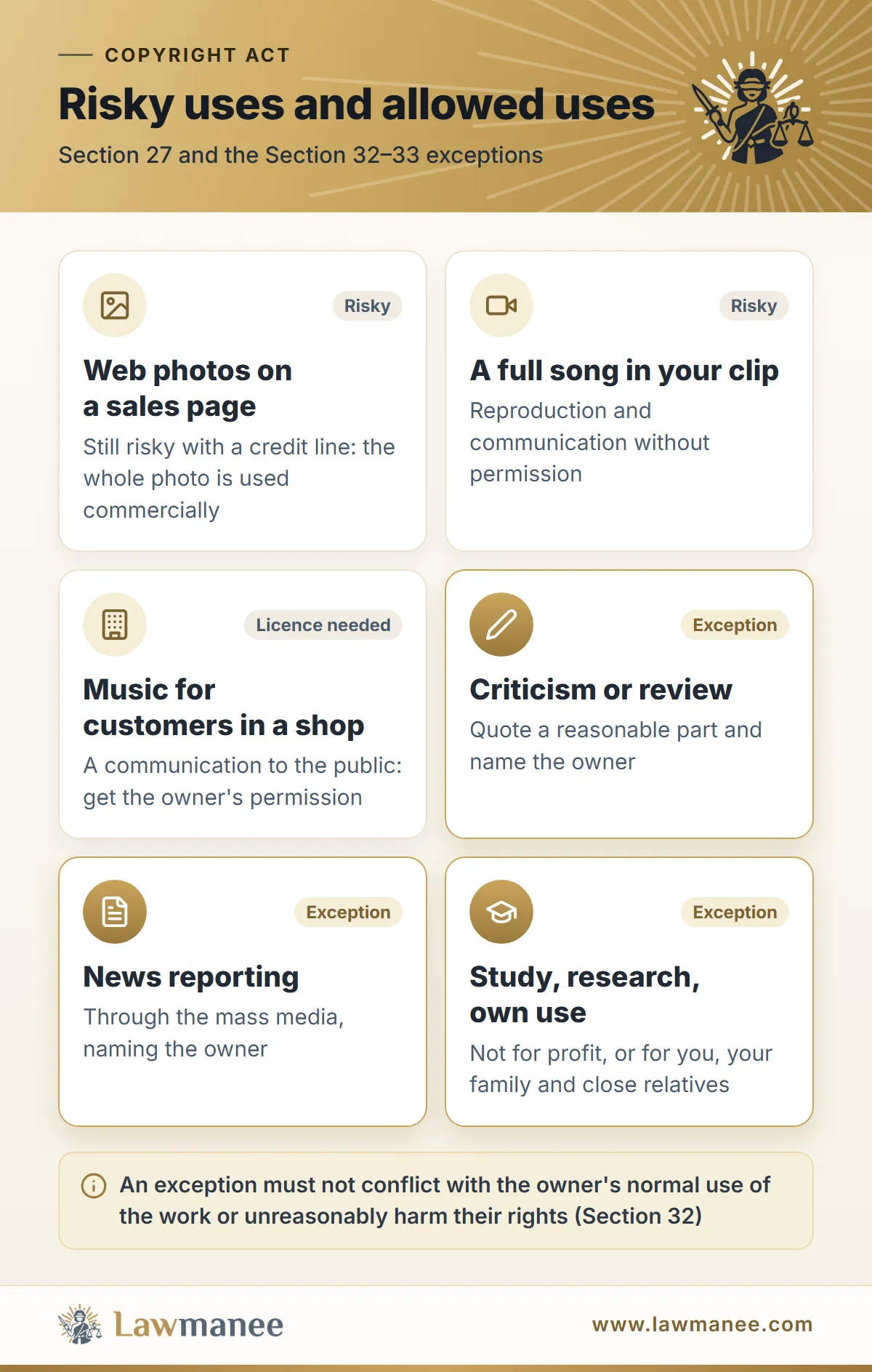
- Reproducing or adapting it: downloading a photo and putting it in your post, re-editing someone else's clip, cropping out a watermark, or editing a picture and passing it off as yours.
- Communicating it to the public: uploading a clip with someone else's full song, live-streaming with music in the background, or playing music to customers in a shop.
Section 31 also covers anyone who knows, or has reason to know, that a work was made by infringement and then sells, communicates, distributes or imports it for profit, for example selling files or goods printed with someone else's design.
Exceptions: uses that need no permission
Thai law has exceptions often called "fair use", but two conditions always apply: the use must not conflict with the owner's normal exploitation of the work and must not unreasonably prejudice the owner's legitimate rights (Section 32, first paragraph). When both are met, these uses are not infringements:
- Research or study, not for profit
- Your own use, or use for yourself and your family or close relatives
- Criticism, comment or review, acknowledging the owner
- News reporting through the mass media, acknowledging the owner
- A teacher's use for their own teaching, not for profit
Quoting or citing reasonable parts of a work with acknowledgement of the owner is also allowed if the two conditions are met (Section 33).
Remember: writing "photo credit: ..." does not make a use legal by itself. Putting a whole work on a sales page or in an advertisement can still take the owner's market.
Penalties
| Act | Ordinary case | For commercial purposes |
|---|---|---|
| Reproducing, adapting or communicating without permission (Section 27, penalty Section 69) | Fine of 20,000-200,000 baht | 6 months-4 years in prison or a fine of 100,000-800,000 baht, or both |
| Selling or communicating a work known to infringe, for profit (Section 31, penalty Section 70) | Fine of 10,000-100,000 baht | 3 months-2 years in prison or a fine of 50,000-400,000 baht, or both |
Half of any fine paid under a judgment goes to the copyright owner (Section 76), and the owner can also sue for civil damages. The court sets them by the seriousness of the harm, and can add up to twice that amount if the infringement was wilful and meant to spread the work widely (Section 64). A civil claim must be filed within 3 years of the owner learning of the infringement and the infringer, and no later than 10 years after the infringement (Section 63).
Copyright offences are compoundable (Section 66): the owner must file a complaint within 3 months of learning of the offence and the offender, and the parties can settle.
Do you need permission to play music in a shop?
Playing music to customers in a restaurant, café or shop is a communication to the public, so you need permission from the copyright owner or their authorised agent, unless the song's protection has expired or the owner allows free use.
The DIP runs a database of music managed for commercial use and a database of authorised royalty collectors. You can check which songs an agent really represents by scanning the QR code on the agent's card, or call the DIP hotline 1368.
Someone demands a royalty: what to do
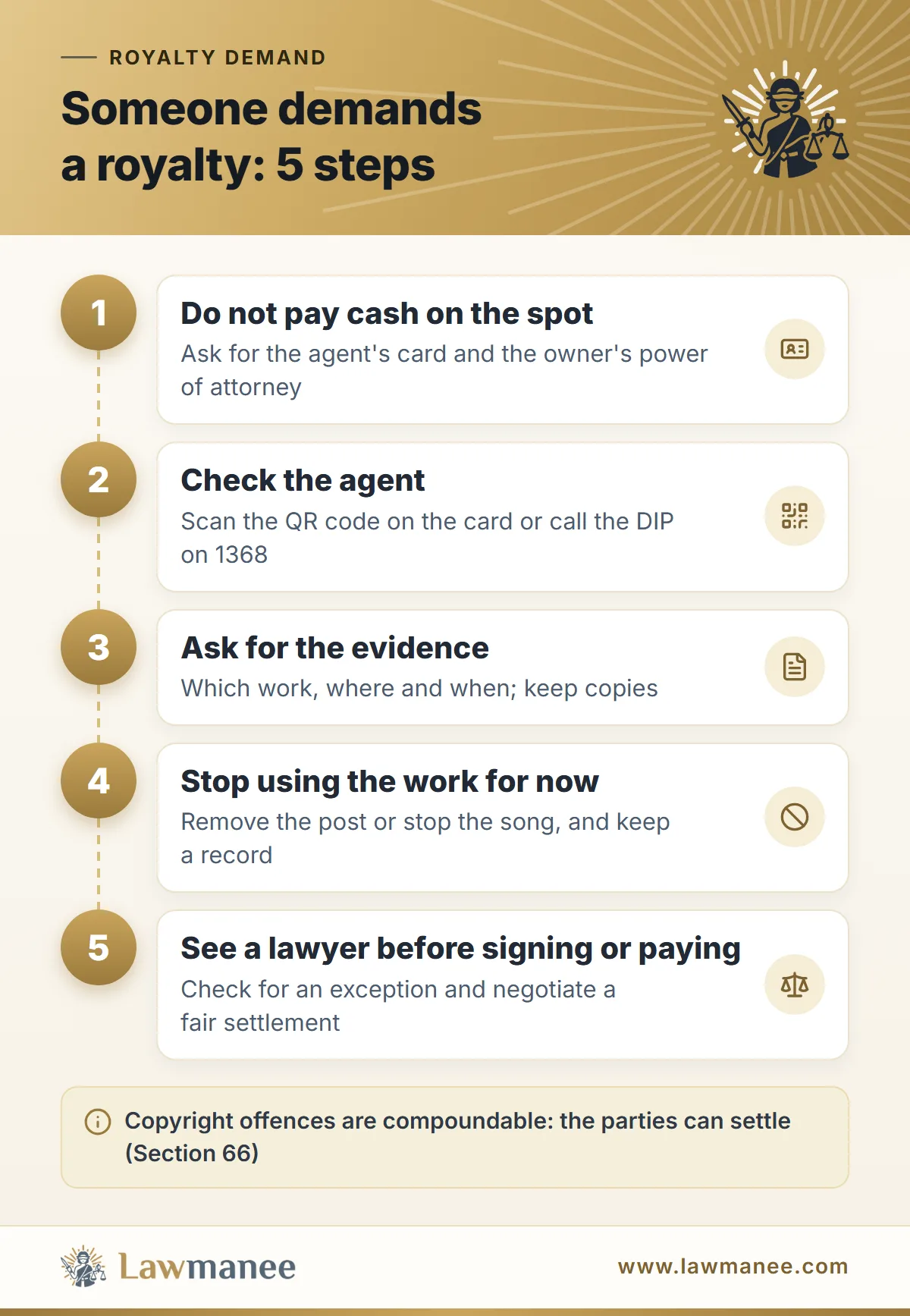
- Stay calm and do not pay cash on the spot. Ask to see the agent's card and the owner's power of attorney.
- Check the agent. Scan the QR code on the card or call the DIP to confirm the authorisation and that it covers that work.
- Ask for evidence of which work was used, where and when, and keep copies.
- Stop using the work for now, for example remove the post or stop playing that song, and keep a record.
- Talk to a lawyer before signing or paying, especially if the amount is large or you are taken to a police station. A lawyer can check whether an exception applies and negotiate a fair settlement.
If you are the creator and find your photo or clip being used, take screenshots with the link and the date, then ask the user or the platform to remove it. The Copyright Act (No. 5) B.E. 2565 (2022) sets out a procedure for owners to notify online service providers to take infringing content down.
Example
An online clothing shop uses 10 model photos from a foreign website to sell its products. Even with a credit line, this is reproduction and communication for commercial purposes, which risks 6 months to 4 years in prison or a fine of 100,000-800,000 baht under Section 69, second paragraph. The safer way is to take your own photos, use stock images with a proper licence, or get the owner's written permission.
Staying on the safe side
- Use photos, music and clips you made yourself, or from libraries with clear licence terms, and check whether commercial use is allowed.
- Use the music library a platform offers inside its app, under that platform's terms.
- Get permission in writing, such as an e-mail or chat message, and keep it.
- Quote only the part you need for a review or news report, and always name the owner.
Talk to a lawyer about copyright
Copyright questions turn on the facts: whether an exception applies, how to respond to a royalty demand, or how to protect your own work. On Lawmanee you can post your case for free and interested lawyers reply in the platform chat, or find a lawyer for intellectual property by province and language, including lawyers who speak English or Chinese.