
Selling cakes through a Facebook page, opening a small grocery at the front of your house, or making and selling your own products: many people wonder whether they have to register anything. The answer lies in the Business Registration Act B.E. 2499 (1956), usually called commercial registration (ทะเบียนพาณิชย์), and a new Ministry of Commerce notification of 2024 (B.E. 2567) that exempts many more very small shops than before. Here is who must register, where, what it costs and what happens if you do not.
What commercial registration is
Commercial registration records a business with the state: its trade name, type of business, address and owner. You receive a commercial registration certificate that shows the business exists, which customers, partners and authorities can ask to see.
It is not the same as forming a company, registering for tax or holding a business licence. Each of those comes under a different law.
Who must register: the 2024 rules
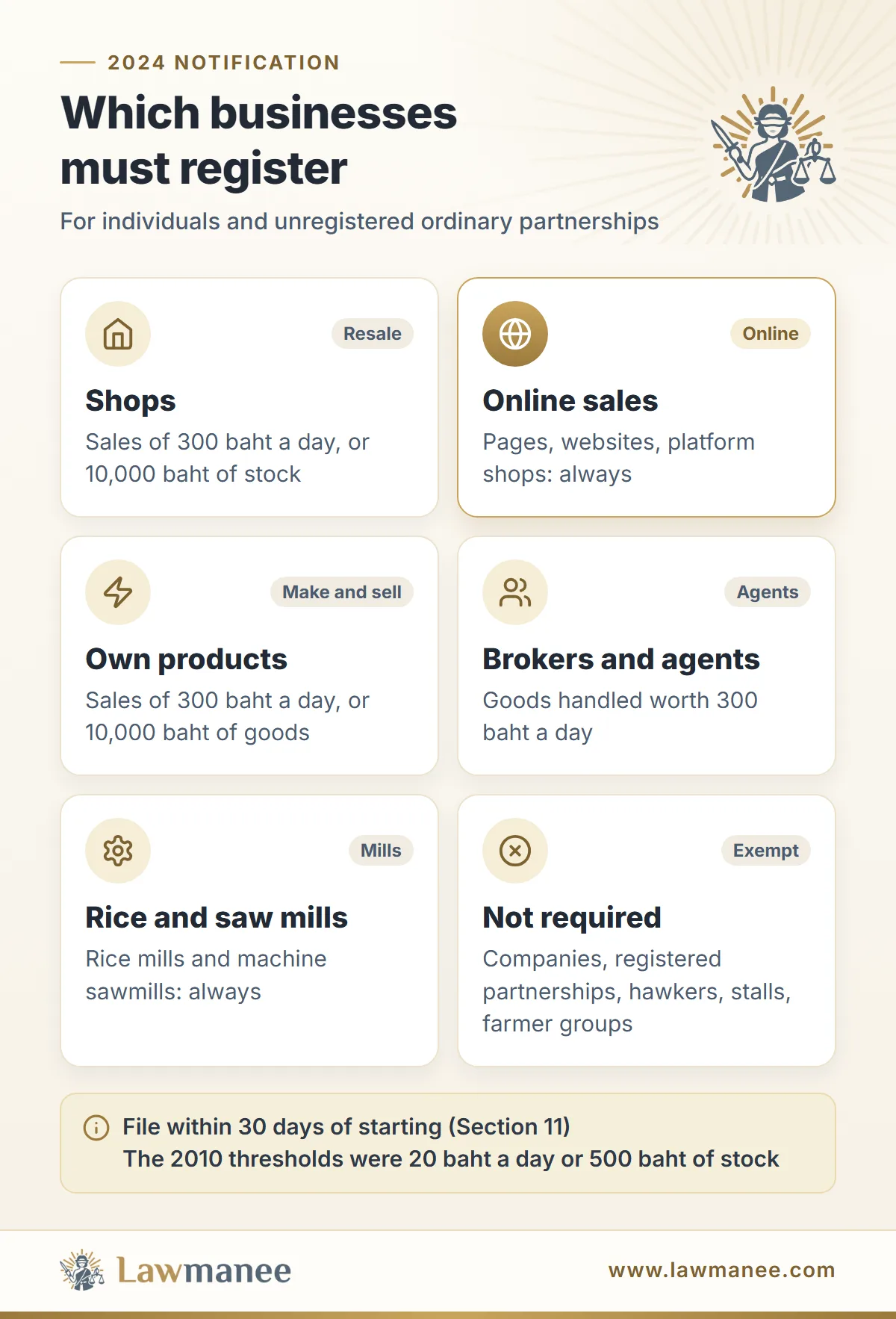
The 2024 notification repealed the earlier notifications No. 93/2520 and No. 11/2553. Only two groups now have to register:
- Natural persons running a business in their own name
- Ordinary partnerships that are not registered as juristic persons, including groups of persons, joint ventures and community enterprise groups
They must register when they carry on one of these five kinds of business:
| Kind of business | Must register when |
|---|---|
| Buying and reselling goods | Sales reach 300 baht a day, or goods held for sale reach 10,000 baht |
| Making and selling your own goods | Sales reach 300 baht a day, or goods produced reach 10,000 baht |
| Broker or sales agent for goods | The goods handled reach 300 baht a day |
| Selling goods or services online | Always, whatever the sales |
| Rice mill or machine-powered sawmill | Always |
Under the 2010 notification the thresholds were 20 baht a day or 500 baht of stock, so the new rules leave far more tiny shops outside. Selling over the internet, through a page, a website or a shop on an online platform, still has to be registered in every case.
Who does not have to register
- Juristic persons such as limited companies, limited partnerships and registered ordinary partnerships. Under the 2024 notification they no longer need a commercial registration, as they are already registered with the Department of Business Development (DBD).
- Farmer groups set up under the farmer groups law.
- Hawkers and market stalls, religious or charitable undertakings, and businesses of foundations, associations, co-operatives or government agencies, to which the Act does not apply at all (Section 7).
- A shop that sells only from its premises and stays below both thresholds: under 300 baht a day and under 10,000 baht of goods.
Example: a front-of-house grocery selling about 250 baht a day with roughly 8,000 baht of stock does not need to register yet. If the stock grows to 12,000 baht, it must register even though daily sales are unchanged.
Where and when to file
File within 30 days of starting the business (Section 11), at the commercial registration office for the area where the business's principal office is (Section 10):
- Bangkok: any of the 50 district offices, or the Fiscal Standards and Property Office of the Bangkok Finance Department
- Other provinces: the municipality, the Subdistrict Administrative Organization or Pattaya City, depending on where the business is
The owner may file in person or give someone a power of attorney. Online sellers without a shopfront usually use their home address as the principal office.
Documents
- Application Form ทพ.
- The owner's Thai national ID card
- If the owner is the head of the house, the house registration shown to the registrar; otherwise a letter of consent to use the premises with the consenting owner's title document, or a copy of the lease with the landlord's title document
- A simple map of the business location and nearby landmarks
- A power of attorney and a copy of the grantor's ID card if someone files for you
- For an unregistered ordinary partnership, the partnership agreement
Fees
- New registration 50 baht
- Registering a change of particulars: 20 baht each time
- Registering the closure of the business: 20 baht
- Replacement certificate: 30 baht
- Inspecting the file: 20 baht each time; certified copies: 30 baht each
After registering
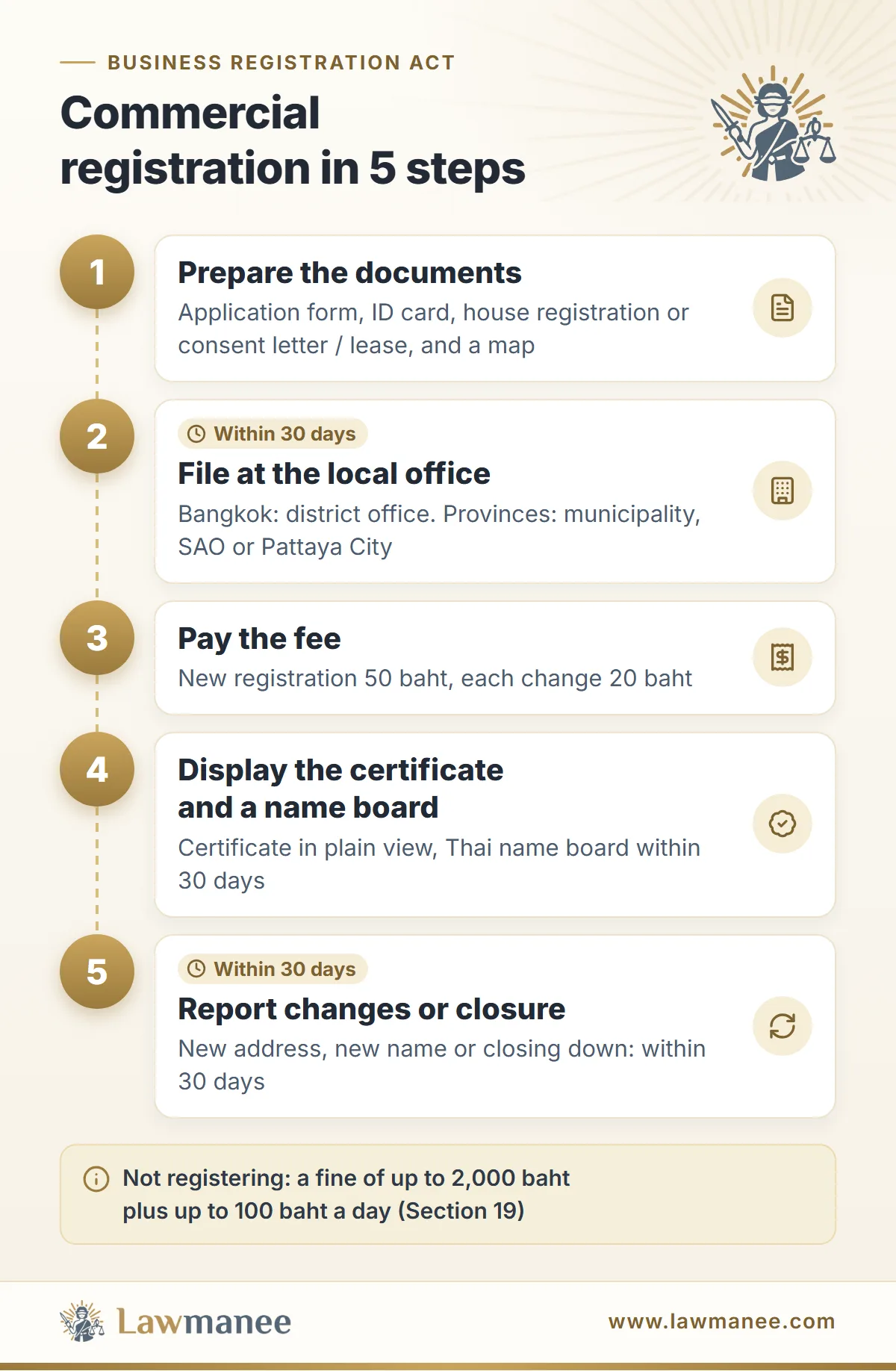
- Display the certificate in an open, easily seen place at the office (Section 14). The DBD says it may also be displayed electronically.
- Put up a name board at the front of the principal office and every branch within 30 days of registering. It must show the name in legible Thai characters (other languages may be added), match the registered name, and say "branch" (สาขา) on a branch (Section 15).
- Register changes or closure, such as a new address, a new trade name, new goods or closing down, within 30 days of the change or closure (Section 13).
- Lost certificate: apply for a replacement within 30 days of the loss (Section 14).
Registered online sellers can also apply to the DBD for the DBD Registered mark to show on their website or shop page, so customers can check the business is real.
Fines for not registering or filing late
| Offence | Fine |
|---|---|
| Not registering, giving false particulars, or not appearing when the registrar summons you | Up to 2,000 baht, plus up to 100 baht a day for each day you remain unregistered (Section 19) |
| Not displaying the certificate, not replacing a lost one, or no name board | Up to 200 baht, plus up to 20 baht a day until you comply (Section 20) |
Example: Mali starts selling homemade desserts through a Facebook page in her own name. Because she sells online, she must register whatever her sales. She files at the district office for her home address within 30 days of her first sale and pays 50 baht. When she later moves house, she registers the new address within 30 days and pays another 20 baht.
Foreigners starting a business
Commercial registration is only one piece. Foreigners doing business in Thailand also come under other laws, notably the Foreign Business Act B.E. 2542 (1999), which restricts many kinds of business for foreigners. Get legal advice before you invest or sign a shop lease.
Talk to a business lawyer
Not sure whether your business has to register, whether to trade in your own name or form a company, or how to set things up with a partner? On Lawmanee you can post your case for free and interested lawyers reply in the platform chat, or find a lawyer for business matters by province and by the language you speak.