
You bought a plot years ago and have not visited it since. Then you find that someone has fenced it, built on it or planted it, and says it is theirs because they have been there for more than 10 years. Under Thailand's rule on adverse possession (Civil and Commercial Code, Section 1382) that can really happen, but ten years on the land is not enough on its own. This guide explains the conditions, the procedure and how owners protect their land.
If you are a foreigner, keep in mind that Thai law generally does not allow foreigners to own land. The rules below matter most if your Thai spouse or family owns land that you help look after, or if you own a house on land held by someone else.
What adverse possession means
Section 1382 says that a person who possesses another person's property peacefully, openly and with the intention of owning it acquires ownership after 10 continuous years for immovable property such as land, or 5 years for movable property.
The idea is that land should be used. An owner who leaves land unattended and never objects to someone using it can lose it, even with their name on the title deed.
The conditions, all of which must be met
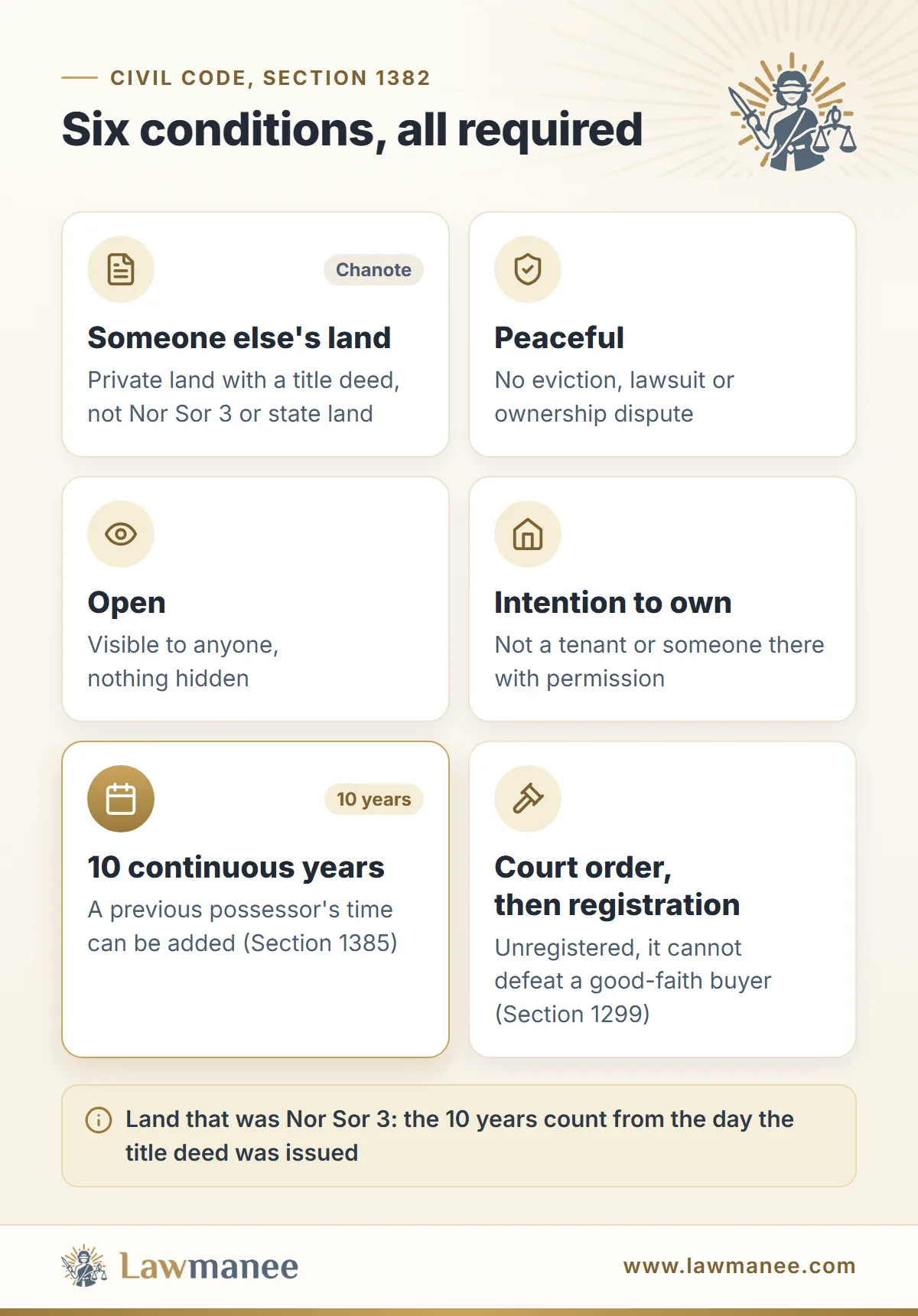
- The land belongs to someone else. Your own land, or an estate you are a co-heir of, does not count.
- Peaceful possession. No eviction, lawsuit or dispute over ownership during the period.
- Open possession. The use can be seen by anyone; nothing is hidden.
- Intention to own. You use and guard the land as your own, not by the owner's permission, and you do not acknowledge someone else's ownership.
- 10 continuous years. The period runs without a break.
The most common misunderstanding concerns tenants and people living there with the owner's permission. They hold the land on the owner's behalf, so they are never adverse possessors, however long they stay. Under Section 1381 a person holding on someone else's behalf can change that only by notifying the owner that they no longer hold for them, or by acquiring a new right in good faith from a third party. The 10 years can only start from then, not from the day the lease began.
Land that can never be acquired this way
| Type of land | Adverse possession? |
|---|---|
| Privately owned land with a title deed (chanote) | Yes, if Section 1382 is met |
| Nor Sor 3, Nor Sor 3 Kor, Sor Kor 1 or undocumented land | No: these carry possessory rights only, not ownership |
| Public domain, such as public-use land or riverbanks | No: Section 1306 bars prescription against the State |
If the land was a Nor Sor 3 and later received a title deed, the 10 years count from the date the title deed was issued; time spent possessing it as Nor Sor 3 land is not added.
Nor Sor 3 land follows the rules on dispossession instead: a possessor who is dispossessed must sue to recover it within 1 year (Section 1375), a much shorter window.
Counting the 10 years
- Taking over from someone else: when possession is transferred, the new possessor may add the previous possessor's time to their own (Section 1385).
- Losing it for a while: if the possessor loses hold of the land involuntarily and gets it back, or sues to get it back, within 1 year, possession is not treated as interrupted (Section 1384).
- The owner sues: Section 1386 applies the Code's prescription rules by analogy, so an eviction or recovery lawsuit filed by the owner before the 10 years are up interrupts the count, and the possession is no longer peaceful.
After 10 years: what the possessor must do
Once the conditions are met the law treats the possessor as owner, but this is an acquisition otherwise than by juristic act. Section 1299, paragraph two, says that until it is registered the land register cannot be changed, and the unregistered right cannot be raised against a third party who acquired the land for value, in good faith and registered it in good faith. The steps are:
- Collect evidence: photos of the use, fences, buildings, crops, land tax receipts and witnesses who saw it over the years.
- Petition the court where the land is located for an order that you acquired ownership by adverse possession.
- The court notifies the registered owner, who may object. An objection turns the matter into a full contested case.
- The court hears the evidence and, if the conditions are proven, orders that you are the owner.
- Register the order at the Land Office so the title deed shows the new owner.
How owners protect their land
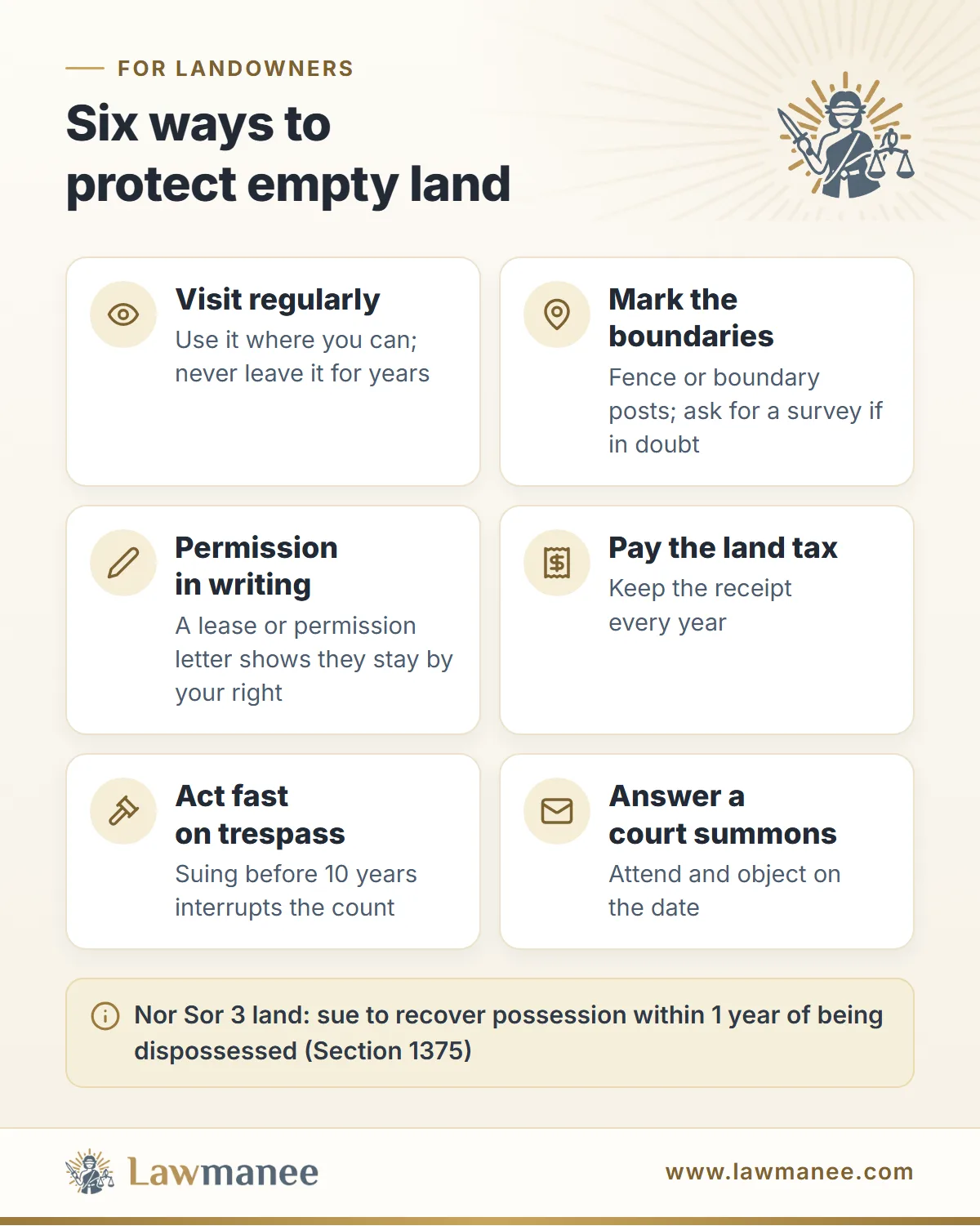
- Visit regularly and use the land where you can; do not leave it unattended for years.
- Mark the boundaries with a fence or boundary posts, and ask the Land Office for a boundary survey if you suspect encroachment.
- Put permission in writing: a lease or a letter of permission shows that the person stays by your right.
- Pay the land tax and keep the receipts every year.
- Act quickly against trespassers: report it to the police and talk to a lawyer about an eviction suit, because a lawsuit filed before the 10 years are up is what interrupts the count.
- Never ignore a court summons: attend and object, or the court may decide on the petitioner's evidence alone.
Example
Wipa holds the title deed to an empty plot upcountry and has not visited it since 2015. In January 2017 her neighbour fenced the plot into his orchard, planted fruit trees for everyone to see and told the village it was his.
- If Wipa discovers this in 2025 and sues for eviction at once, the neighbour has not yet reached 10 years, and the lawsuit interrupts the count.
- If she leaves it until after January 2027 with no one objecting, the neighbour may petition the court for an order that he owns the land.
- If instead the neighbour had rented the plot from Wipa and paid rent all along, he would be holding it by her right, so it would never be adverse possession, even after 10 years.
Talk to a lawyer about adverse possession
These cases are won and lost on facts and evidence: when possession started, the intention behind it and any objection along the way. Whether you are an owner who found someone on your land or a long-term occupier, on Lawmanee you can post your situation for free and interested lawyers reply in the platform chat, or find a lawyer for land and property by province and language right away.