
Someone beating a dog until it is injured, poisoning stray cats, or an owner who moves house and leaves a pet by the roadside: Thai law clearly prohibits all of this. This guide summarises the Prevention of Animal Cruelty and Provision of Animal Welfare Act B.E. 2557 (2014): what it forbids, what it allows, what owners must do, the penalties, and where to report cruelty. The Act applies to everyone in Thailand, including foreign residents.
Which animals the law protects
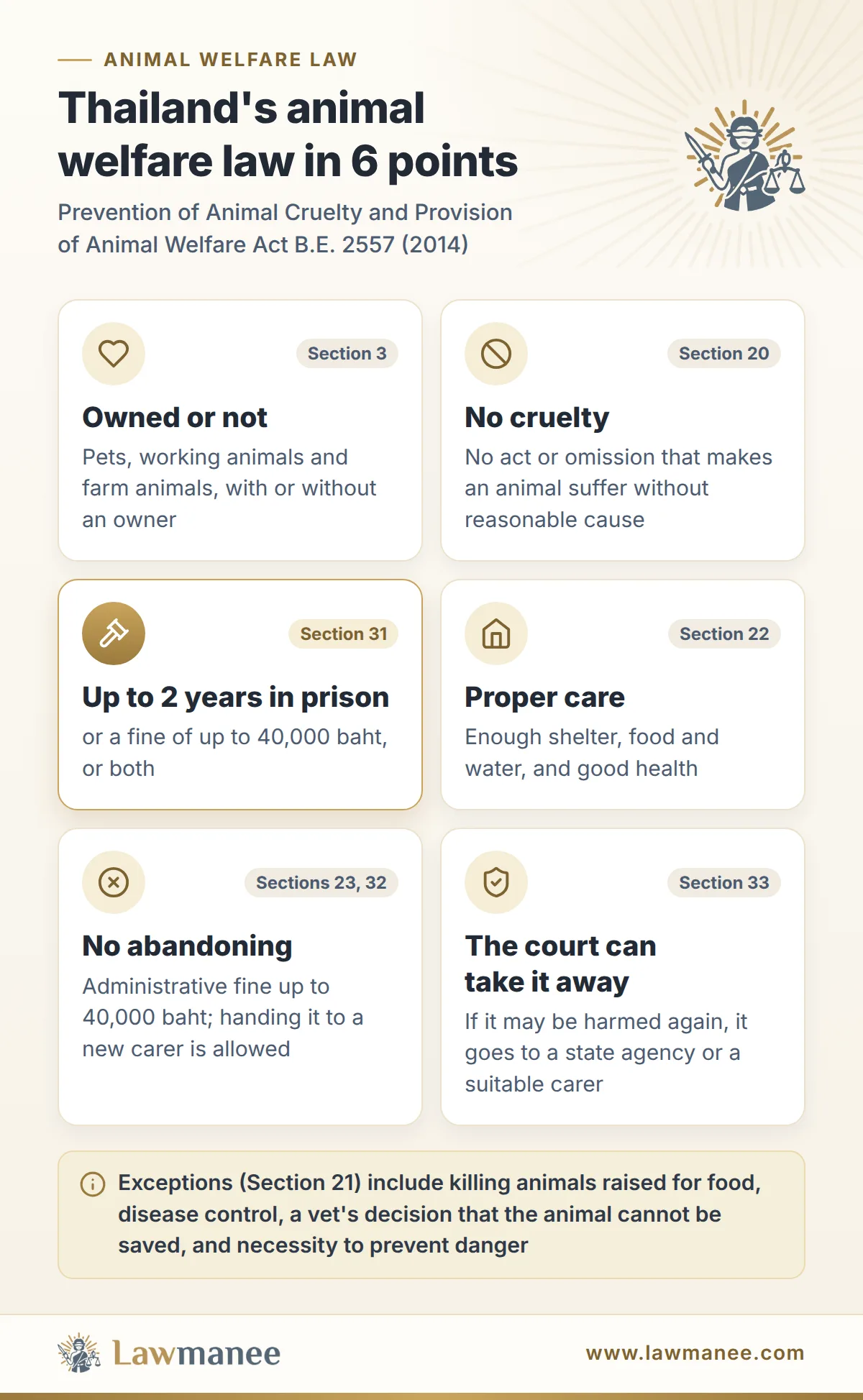
The Act was published in the Royal Gazette on 26 December 2014 and took effect the next day. An animal under the Act is one normally kept as a domestic animal, for work, as a means of transport, as a companion, for food, for performances or for any other purpose, whether or not it has an owner (Section 3).
So the law protects pet dogs and cats, stray dogs and cats, and farm animals alike. Hurting a stray animal can be an offence just as hurting someone's pet can.
What counts as cruelty
Section 20 forbids anyone to commit an act of cruelty to an animal without reasonable cause. Section 3 defines cruelty as any act or omission that makes an animal suffer physically or mentally, feel pain, fall ill or become disabled, or that may cause its death, including working an animal beyond what is reasonable.
The law covers both acts, such as beating an animal until it is injured, and omissions, such as keeping an animal locked up without food and water until it falls ill.
What the law does not treat as cruelty
Section 21 lists acts that are not cruelty under Section 20. The main ones are:
- killing an animal for food, but only animals raised for food
- killing an animal under the law on the control of slaughter and the sale of meat
- killing an animal to control an epidemic under the animal epidemics law
- killing an animal when a veterinarian finds it sick, disabled or injured and it cannot be treated to survive without suffering
- killing an animal in a religious ritual or according to religious belief
- killing an animal when necessary to prevent danger to the life or body of a person or another animal, or damage to property
The first exception covers only animals raised for food, and the last one requires a real necessity to prevent danger or damage.
Owners must care for their animals and must not abandon them
Section 22 requires owners to provide proper welfare for their animals, following the criteria, methods and conditions set by the Minister, which take into account the type, species, nature, condition and age of the animal. Animal welfare means keeping or caring for an animal so that it lives in suitable conditions, is in good health and has enough shelter, food and water (Section 3).
Section 23 forbids owners to release or abandon an animal, or to do anything that puts it beyond their care, without reasonable cause. Transferring ownership or possession to someone who wants to look after the animal is not abandonment under this section.
Example (hypothetical) Bee has to move into a condominium that does not allow pets and cannot take the two cats along. Leaving the cats outside a temple to be rid of their care is the kind of release or abandonment that Section 23 forbids, with an administrative fine of up to 40,000 baht. Giving both cats to a friend who wants to keep them is a transfer to a new carer, not abandonment. The same applies to a foreign resident who leaves Thailand and cannot take a pet along: find a new owner who wants the animal and hand it over.
Penalties
| Act | Sections | Consequence |
|---|---|---|
| Cruelty without reasonable cause | 20 and 31 | Up to 2 years in prison, a fine of up to 40,000 baht, or both |
| Not providing welfare as set by the Minister | 22 and 32 | Administrative fine of up to 40,000 baht |
| Releasing or abandoning an animal | 23 and 32 | Administrative fine of up to 40,000 baht |
The Act is listed in the schedule of Thailand's law on administrative fines, B.E. 2565 (2022), so its fine-only offences have become administrative fine (phinai) offences, which are not criminal penalties. Cruelty remains a criminal offence punishable by prison.
When a court convicts someone of cruelty and finds that the animal may again be treated cruelly or without proper welfare if it stays with its owner or the offender, the court may forbid that owner or offender to keep the animal and hand it to a state agency or another suitable person (Section 33).
If the animal that was hurt is yours
An animal with an owner is that owner's property. Anyone who intentionally hurts or kills someone else's animal therefore also commits the offence of damage to property under Criminal Code Section 358: up to 3 years in prison, a fine of up to 60,000 baht, or both.
Damage to property is a compoundable offence (Section 361). The owner must file a complaint within 3 months of learning of the offence and the offender, or the case on this charge is time-barred (Section 96). The owner can also sue the wrongdoer for damages in a civil case (Civil and Commercial Code Section 420).
What to do if you see animal cruelty
Anyone who sees an animal being treated cruelly can file a complaint with the police inquiry officer. You do not have to be the animal's owner.
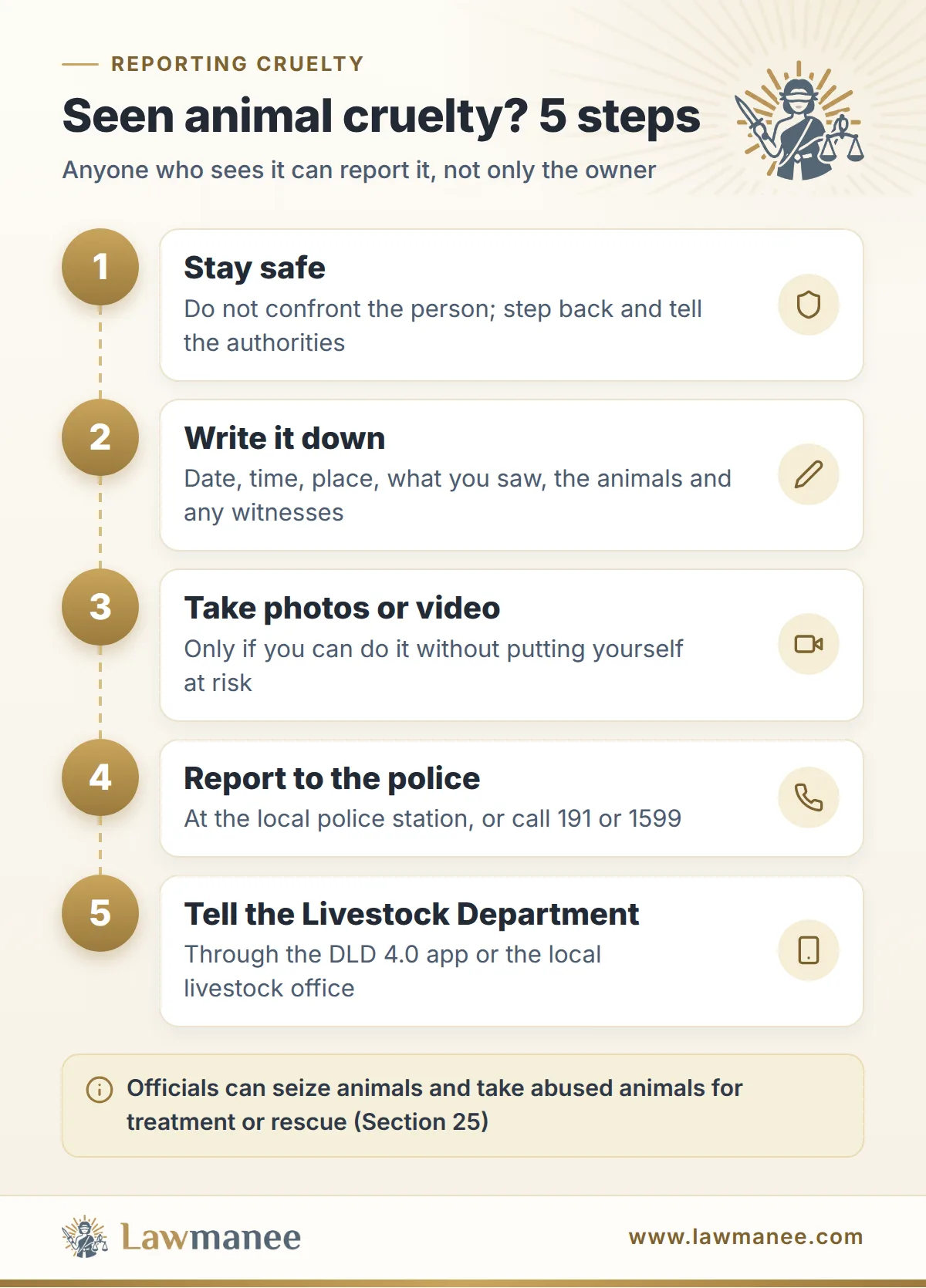
- Put your own safety first. Do not confront the person; step back and tell the authorities.
- Write down the details: date, time, place, what you saw, the species and number of animals, and the names and contact details of any witnesses.
- Take photos or video only if you can do so without putting yourself at risk.
- Report to the police at the local police station, or call the hotlines 191 or 1599.
- Report to the Department of Livestock Development through the DLD 4.0 app or at the local livestock office.
Officials under the Act, including officers of the Department of Livestock Development, have the power to inspect, to seize or attach animals, and to take abused animals for treatment or rescue (Section 25).
Get help from a lawyer
If your animal was hurt and you want to bring a case or claim damages, or if you are accused of cruelty or abandonment, a lawyer can assess the facts, the evidence and the deadlines that apply. On Lawmanee you can post your case for free and interested lawyers reply in the platform chat, or find a lawyer by case type, province and language.