

You have been cheated, someone has kept your property, your name has been smeared, or a person has moved onto your land. It is tempting to report it "later", but for some Thai offences the victim has only three months to act. Miss it and the case is time-barred for good. This guide sums up the deadlines in the Thai Criminal Code and the Criminal Procedure Code. They apply in the same way whether the victim is Thai or a foreigner living in Thailand.
Compoundable offences and offences against the State
Thai criminal law sorts offences into two groups with different rules on time.
- Compoundable offences (private offences) are those the Code expressly says may be settled. The police may not investigate them unless the injured person files a proper complaint (Criminal Procedure Code, Section 121).
- All other offences are offences against the State. The inquiry official may investigate on his own, and anyone, not only the victim, may report them (an "accusation", Section 2 (8)).
Common compoundable offences:
| Offence | Criminal Code section | Maximum prison term (basic form) |
|---|---|---|
| Defamation | 326 (compoundable under Section 333) | 1 year |
| Defamation by publication | 328 (Section 333) | 2 years |
| Fraud, except public fraud under Section 343 | 341 (Section 348) | 3 years |
| Embezzlement | 352 (Section 356) | 3 years |
| Damage to property | 358 (Section 361) | 3 years |
| Trespass, except the cases in Section 365 | 362 (Section 366) | 1 year |
The 3-month rule for compoundable offences
Under Criminal Code Section 96, if the injured person does not file a complaint within three months from the day they learned of the offence and of the offender, a compoundable case is time-barred.
- The clock starts only when you know both things: that an offence was committed, and who committed it.
- When you "knew" has to be proved and is often argued in court. The safe course is to file early, not near the end of the three months.
- Offences against the State have no 3-month limit, but the Section 95 time limits still apply.
- In defamation, if the victim dies before filing, their father, mother, spouse or child may file instead (Section 333).
- If you plan to leave Thailand, file before you go: the three months keep running.
A report "for the record" is not a complaint
In law, a complaint is an allegation by the injured person to the authorities that an offence has harmed them, made with the intention that the offender be punished (Criminal Procedure Code, Section 2 (7)).
Asking the police only to note an incident in the daily log as evidence, without asking for prosecution, has been held by the Supreme Court in several cases not to be a complaint. If the offence is compoundable and no valid complaint is made within three months, the case is time-barred even though you went to the police station.
So tell the inquiry official clearly that you want to file a complaint and have the offender prosecuted, and check that the written record says so before you sign.
Where to file and what to say
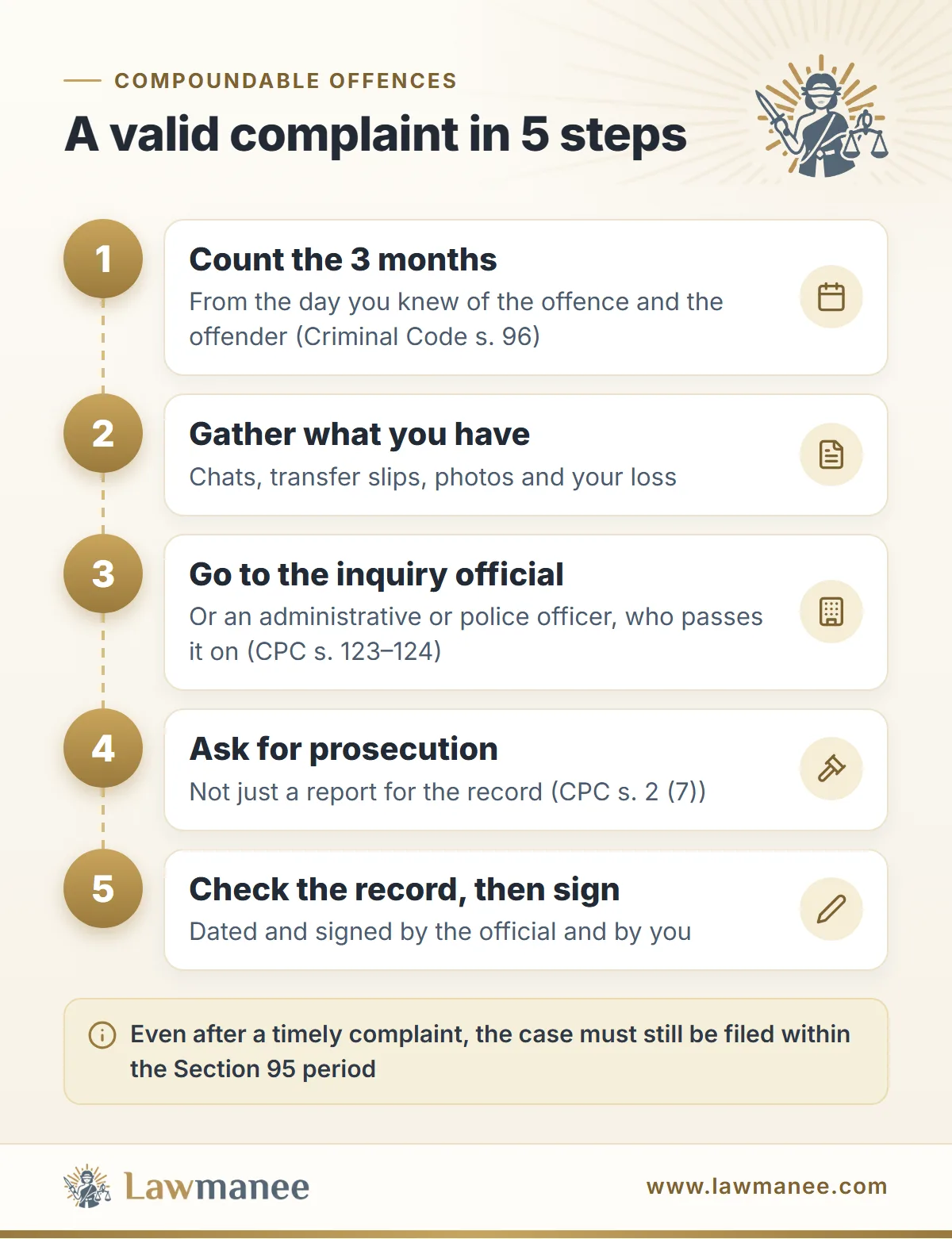
- Who takes it: an inquiry official at a police station (Section 123), or an administrative or police officer senior or junior to the inquiry official who keeps public order, who must pass it on to the inquiry official promptly (Section 124).
- Form: in writing or orally. A written complaint must be dated and signed. An oral complaint is written down by the inquiry official, dated, and signed by both the official and you.
- Content: your name and address, the nature of the offence, the circumstances, the damage you suffered, and the offender's name or description as far as you can give it (Section 123).
The record is in Thai, so read it through, with help from someone you trust if you need it, before signing. Bring what you have, such as chat messages, transfer slips or photos, so you can describe what happened and your loss in full.
Besides a prosecution by the public prosecutor, the injured person may also bring a criminal case to court directly (Section 28). A lawyer can tell you which route suits your case.
Time limits under Section 95
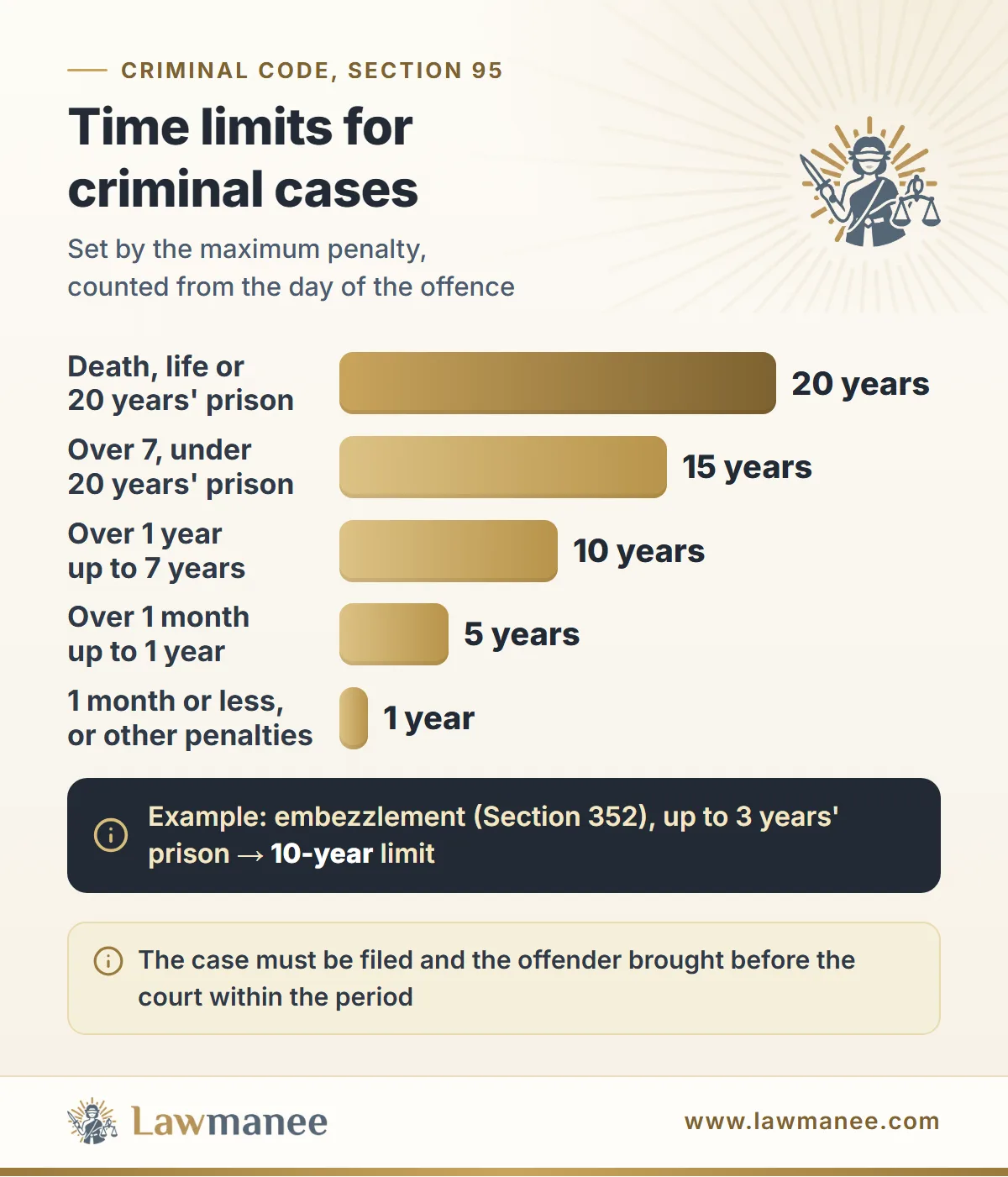
Every criminal case has a limitation period under Criminal Code Section 95, counted from the day of the offence. If the case is not filed and the offender brought before the court within that period, it is time-barred. The period depends on the maximum penalty:
- 20 years for offences punishable by death, life imprisonment or 20 years' imprisonment
- 15 years for more than 7 but less than 20 years' imprisonment
- 10 years for more than 1 year up to 7 years
- 5 years for more than 1 month up to 1 year
- 1 year for 1 month or less, or other penalties
What must happen in time is the filing of the case and bringing the offender before the court. A complaint alone does not stop this clock. If the offender is brought to court but then absconds or becomes insane and the court suspends the trial, the case also becomes time-barred once the same period has passed from the escape or the suspension.
A compoundable offence therefore has two hurdles: a complaint within three months, and filing with the offender before the court within the Section 95 period.
Example: a motorbike left in someone's care
Anna leaves her motorbike with Ben while she travels upcountry. Ben sells it himself on 5 January. Anna finds out when she returns on 10 January.
- Dishonestly taking for oneself property of another that one holds is embezzlement (Section 352), a compoundable offence (Section 356).
- Anna knew of the offence and the offender on 10 January, so she must file a complaint within three months of that day. If she waits until May, more than three months have passed and the case is time-barred.
- Embezzlement carries up to 3 years' imprisonment, so the Section 95 period is 10 years from 5 January, the day of the offence.
Withdrawing a complaint and settling
- Compoundable offences: once the complaint or the case is withdrawn, or the parties lawfully settle, the right to prosecute ends (Criminal Procedure Code, Section 39 (2)). Have a lawyer look at a settlement before you sign it, because the same matter cannot be prosecuted again afterwards.
- Offences against the State: you may withdraw your complaint, but that does not stop the inquiry official from investigating or the public prosecutor from prosecuting (Section 126).
Talk to a lawyer before time runs out
Timing is where many criminal cases are lost: when you knew who the offender was, and whether the offence is compoundable at all. On Lawmanee you can post your case for free in English, and interested lawyers reply in the platform chat. You can also search the directory for criminal lawyers by province and by the language they speak.