

When a family member is arrested or remanded, the first thing relatives ask is whether they can get bail. Thai law calls this provisional release, governed by Sections 106 to 119 bis of the Criminal Procedure Code. The starting point is that every suspect or accused should be allowed provisional release, and the official or court must decide an application promptly (Section 107).
This guide explains who can apply, where to apply at each stage, the forms of release, the security accepted and what to do if bail is refused. The rules are the same for Thai nationals and foreigners.
Who can apply
Under Section 106 an application may come from:
- the suspect (not yet charged in court) or the accused (already charged)
- a person with an interest, such as a parent, spouse, child or relative affected by the detention
You can apply whether the person is held by the police or detained under a court warrant.
Where to apply: police, prosecutor or court
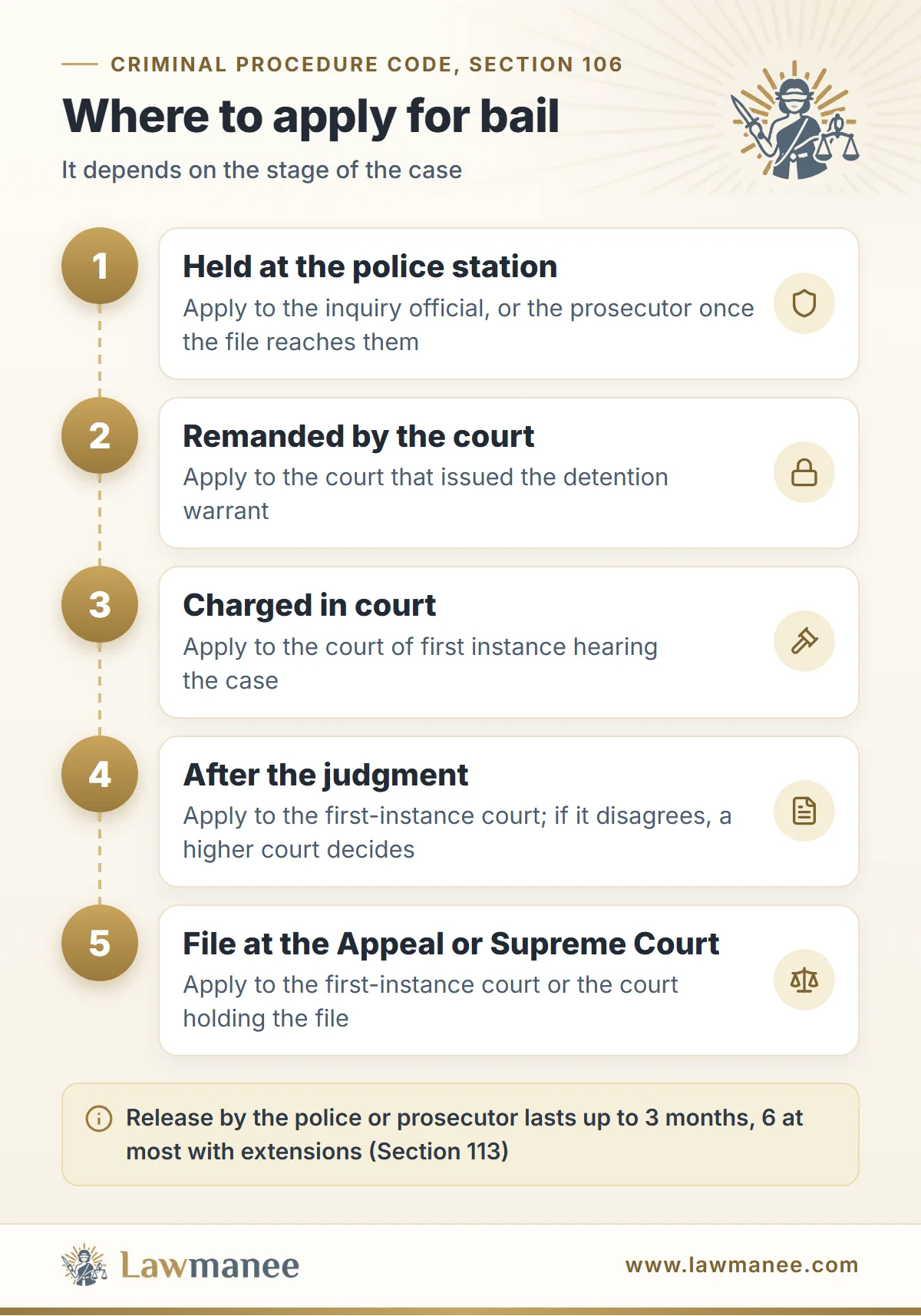
Where you file depends on the stage of the case (Section 106):
- Not yet charged, held at the police station: apply to the inquiry official, or to the public prosecutor once the file has reached them.
- Not yet charged, but the court has ordered detention (remand): apply to the court that issued the detention warrant.
- Charged in court: apply to the court of first instance hearing the case.
- After judgment is read: you may still apply to the court of first instance; if it does not think release is right, it sends the application to the Appeal Court or Supreme Court to decide.
- File sent up to the Appeal Court or Supreme Court: apply to the court of first instance or to the court that now holds the file.
Release granted by the police or the prosecutor is time-limited: no more than 3 months from the first day of release, extendable where the investigation genuinely cannot be finished, but never beyond 6 months in total (Section 113). If cash or other security was lodged at the investigation stage and has not been returned, you can ask the prosecutor or court to keep using it instead of lodging new security (Section 113/1).
Example: an inquiry official releases a suspect on security on 1 February. That release lasts at most 3 months, to early May. If the investigation cannot be completed for a necessary reason it may be extended, but no further than 6 months in total, to early August. If continued detention is needed, the suspect must be brought before the court for remand, and bail is then applied for at the court.
Three forms of release
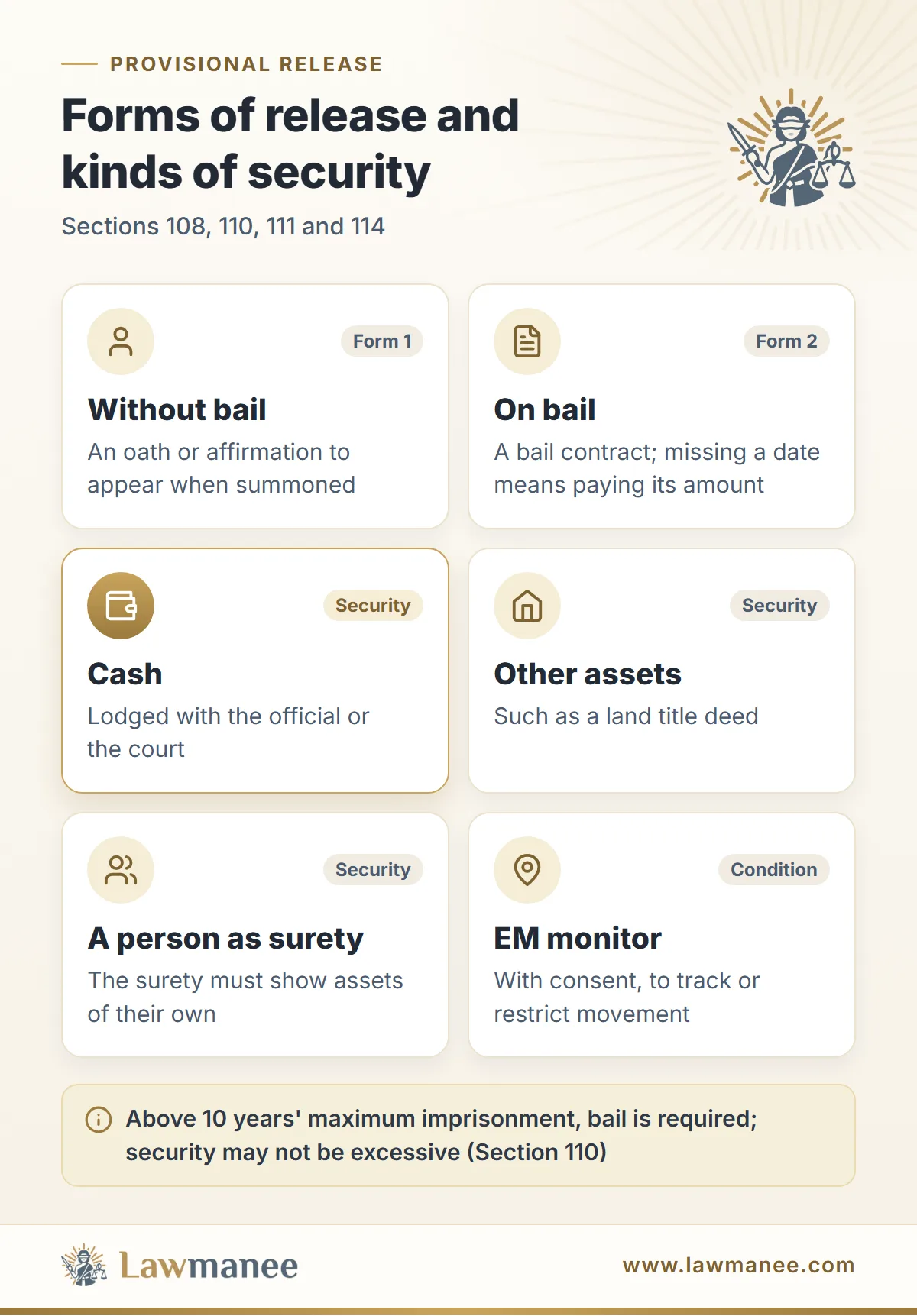
| Form | What it means |
|---|---|
| Without bail | Released on an oath or affirmation to appear when summoned (Section 111) |
| On bail | A bail contract promising appearance; breaking it means paying the contract amount |
| On bail with security | A bail contract plus security lodged |
Where the maximum penalty exceeds 10 years' imprisonment, release must be on bail. In other cases any form may be used, and bail or security may not be set higher than the case reasonably requires (Section 110).
What can be used as security
Section 114 lists three kinds:
- cash lodged with the official or court
- other assets, such as a land title deed
- a person as surety, who must show assets of their own
With the released person's consent, the official or court may also order an electronic device, such as an EM ankle monitor, to track or restrict movement, and may impose other conditions, such as living at a set address (Section 108). For anyone under 18 a device may be used only for good reason, for example a risk of serious harm to others.
If the bail amount later turns out to be too low or the security insufficient, it can be increased (Section 115).
What the court looks at and when bail can be refused
Section 108 lists the factors weighed together: how serious the charge is, the evidence so far, the circumstances of the case, how reliable the applicant and security are, whether the person is likely to flee, any danger or damage release may cause, and objections from the investigator, prosecutor, plaintiff or victim.
Bail may be refused only where there are reasonable grounds to believe one of the five reasons in Section 108/1:
- the person will flee
- the person will interfere with evidence
- the person will cause other danger
- the applicant or the security is unreliable
- release would obstruct or seriously harm the investigation or the court proceedings
A refusal must give reasons, and those reasons must be sent in writing promptly to the suspect or accused and to the applicant.
If bail is refused
- Apply again, addressing the reasons given in the order: more security, a different applicant, or accepting conditions such as an EM monitor.
- Appeal the order under Section 119 bis: a first-instance order goes to the Appeal Court, an Appeal Court order to the Supreme Court. The appeal is filed at the court of first instance, which must forward it quickly. If the Appeal Court upholds a refusal by the court of first instance, that order is final, but a fresh application can still be made.
People who cannot afford security or a lawyer and meet the criteria can ask the Justice Fund for help at a provincial justice office or the Justice Fund Office. It can cover lawyer's fees, court fees and bail security.
Foreigners who do not understand Thai are entitled to an interpreter (Section 13). Do not sign a bail contract or conditions you cannot read.
What a relative acting as surety should know
Signing a bail contract is a real commitment. If the released person flees or misses a court date:
- the court can enforce the bail contract directly, without a new lawsuit, against the security or the surety's assets (Section 119)
- the court may waive or reduce the amount, taking into account how hard the surety tried to bring the person back and the actual damage caused
- a surety who sees the person about to flee can ask the nearest police or administrative officer to arrest them, or make the arrest and hand them over if help cannot come in time (Section 117)
- if an EM monitor is destroyed or disabled, the law presumes the person has fled or is about to flee
Before you sign, be sure the person will attend every hearing, and keep the appointment slips safe.
What to prepare
- The stage of the case and where the person is held, so you apply in the right place
- The charge and case number, to see whether the maximum penalty exceeds 10 years
- The security available: cash, an original title deed or a person willing to act as surety
- Facts showing the person will not flee: a fixed address, family, regular work
- If bail was refused before, the reasons in the order, so the new application answers them
Talk to a criminal lawyer
A well-drafted bail application and the right security can get someone released sooner. On Lawmanee you can describe the situation for free and interested lawyers reply in the platform chat, or browse criminal lawyers by province and language, including English-speaking lawyers, and check their verification badges.