
When a child gets into a fight and someone is hurt, damages someone else's property, or is called in by the police for questioning, parents usually ask two things first: will my child go to prison, and what am I responsible for? Thai law treats children and teenagers differently from adults in sentencing, arrest, questioning and the court that hears the case. This guide sums up the key rules of the Penal Code, the Criminal Procedure Code, the Civil and Commercial Code and the Juvenile and Family Court and Procedure Act B.E. 2553 (2010).
At what age can a child be punished?
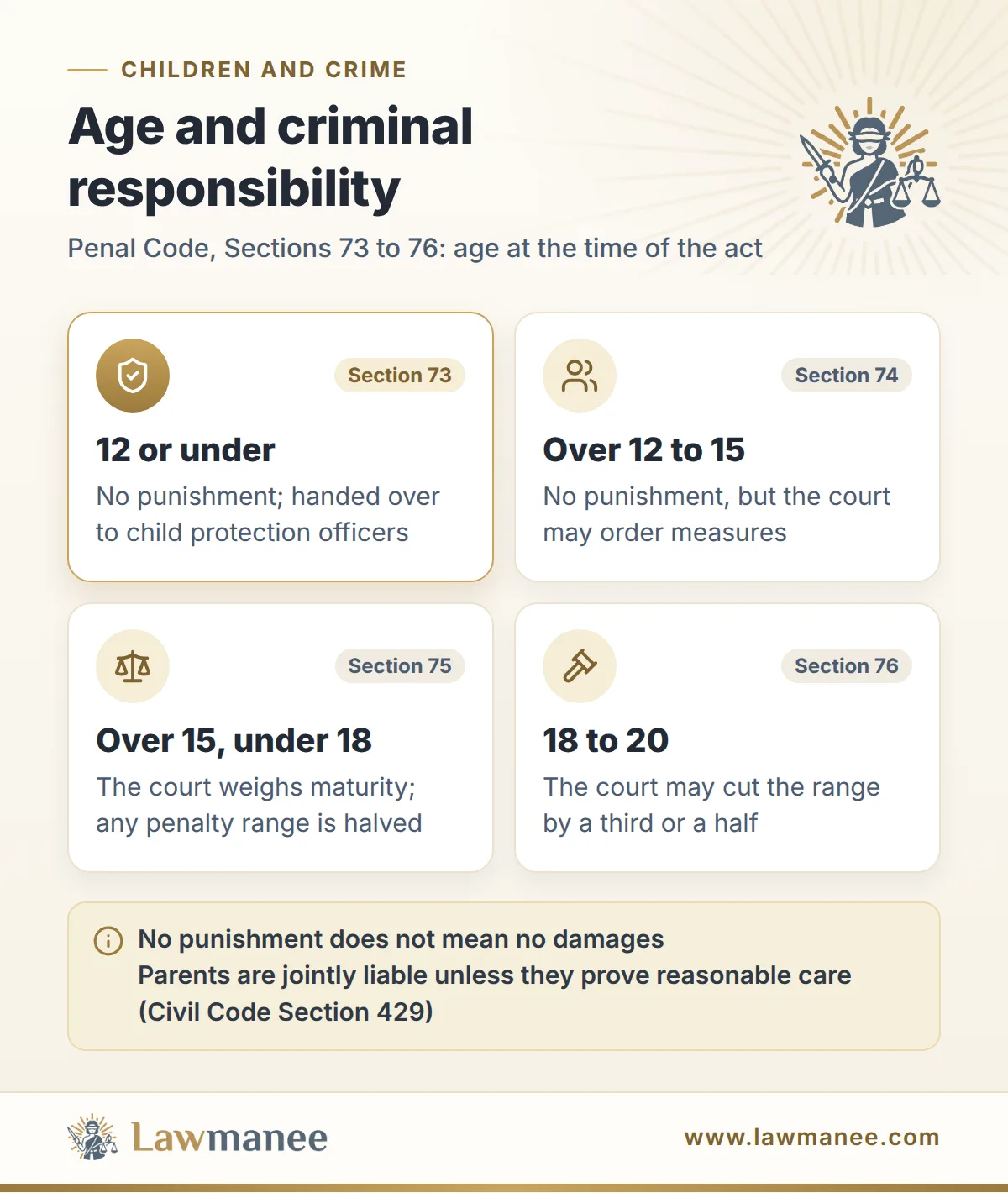
The Penal Code sets responsibility by the child's age at the time of the act. Since 2022 (B.E. 2565), the age limit in Section 73 has been 12 or under instead of 10 or under.
| Age at the time of the act | What the law says |
|---|---|
| 12 or under | No punishment; the investigating officer hands the child over to officers under the child protection law (Section 73) |
| Over 12, not over 15 | No punishment, but the court may order measures instead (Section 74) |
| Over 15, under 18 | The court weighs the young person's maturity and all other circumstances: it orders Section 74 measures, or, if it decides to punish, halves the range of penalties (Section 75) |
| 18 to 20 | The court may reduce the range of penalties by one third or one half (Section 76) |
No punishment does not mean no consequences: the damage still has to be paid for under civil law, and the parents may have to share that liability.
Measures the court can use instead of punishment
For children over 12 and not over 15, and for teenagers the court decides not to punish, Section 74 lets the court:
- warn the child and release them, and if it sees fit, call in the parents, the guardian or the person the child lives with to warn them too;
- hand the child over to the parents or guardian on condition that they keep the child from causing harm for a period set by the court of no more than 3 years, with a sum of up to 10,000 baht that the parents must pay to the court each time the child causes harm; the court can also set probation conditions under the supervision of a probation officer;
- send the child to a school or a training centre for a period set by the court, but not beyond the child's 18th birthday.
The court can change these orders if the circumstances change.
Example: a 16-year-old punches a classmate and injures them. Assault causing bodily or mental harm carries up to 2 years in prison, a fine of up to 40,000 baht, or both (Penal Code Section 295). If the court decides to punish, the range is halved to up to 1 year, a fine of up to 20,000 baht, or both. If it decides not to punish, it uses Section 74 measures instead. Because the maximum penalty is no more than 5 years, the case can also be considered for diversion (below) if the other conditions are met. The classmate's medical bills can be claimed from both the teenager and the parents, unless the parents prove they took reasonable care in supervising.
If your child is arrested or called in for questioning
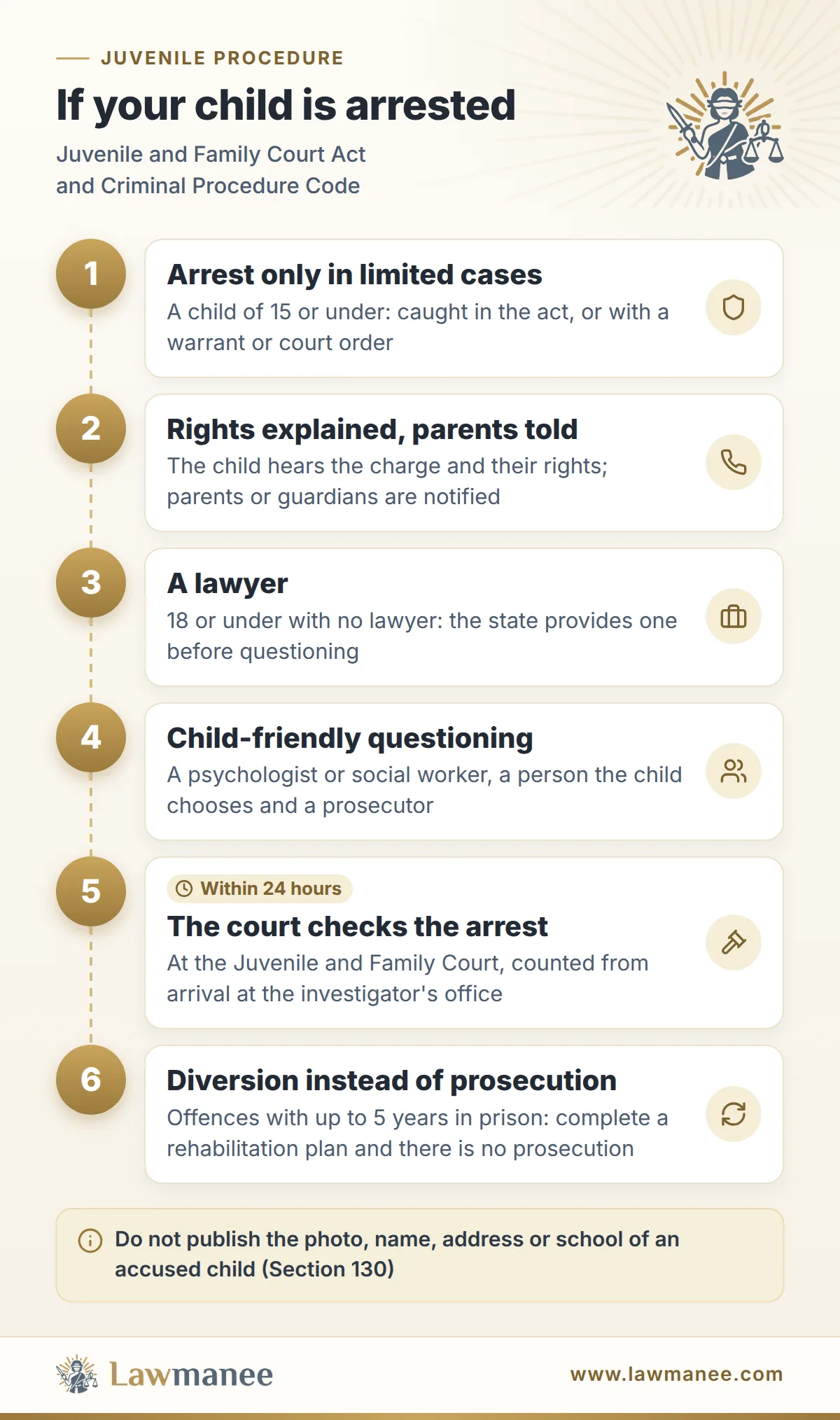
Cases in which a child or young person is accused of an offence go to the Juvenile and Family Court, and extra safeguards apply:
- Arrest only in limited cases: a child of 15 or under may be arrested only if caught in the act, or with an arrest warrant or court order (Juvenile and Family Court Act, Section 66). Older teenagers are arrested under the general rules of the Criminal Procedure Code.
- Charge, rights and parents: officers must tell the child the charge and their rights, and notify the parents or guardian.
- A lawyer: if the suspect is 18 or under on the day of the charge and has no lawyer, the state must provide one before questioning starts (Criminal Procedure Code Section 134/1).
- Child-friendly questioning: in sexual offences, offences against life and body other than brawls, and several other groups of offences listed in the law, questioning takes place in a suitable room with a psychologist or social worker, a person the child asks for and a public prosecutor present; for other offences punishable by imprisonment, the child can ask for this procedure (Sections 133 bis and 134/2).
- The court checks the arrest: the child must be brought to the Juvenile and Family Court within 24 hours of arriving at the investigating officer's office, so that the court can review the arrest (Juvenile and Family Court Act, Section 72).
It is also an offence to record or publish pictures, sound or text that could identify a child or young person accused of an offence, or to reveal their criminal record, address or school (Section 130). The penalty is up to 1 year in prison, a fine of up to 20,000 baht, or both (Section 192), so sharing a clip that shows the child's face on social media can itself be a crime.
Diversion instead of prosecution
Some cases can end without going to court, if they meet the conditions of Section 86 of the Juvenile and Family Court Act:
- the offence carries a maximum of no more than 5 years in prison;
- the child has never been sentenced to imprisonment by a final judgment, except for offences of negligence or petty offences;
- the child shows remorse before being prosecuted;
- the victim and the child consent to the rehabilitation plan.
The director of the Juvenile Observation and Protection Centre draws up the plan and proposes it to the public prosecutor, and the court must consider it as well. Once the child completes the plan, the prosecutor orders no prosecution and the right to prosecute ends. If the case has already been filed, the court can still use a rehabilitation plan instead of a judgment in some cases (Section 90).
What parents are liable for
- Civil liability together with the child: a minor is liable for their own wrongful acts, and the parents are jointly liable unless they prove they took the reasonable care their duty of supervision required (Civil and Commercial Code Section 429). This applies even when the child is too young to be punished.
- Teachers and other carers: anyone looking after the child, permanently or temporarily, is jointly liable for wrongful acts the child commits in their care if it is proved that they did not take reasonable care (Section 430). Unlike with parents, it is the injured party who has to prove the lack of care.
- Money under a court condition: if the court hands the child over to the parents under Section 74, they may have to pay up to 10,000 baht to the court each time the child causes harm during the set period.
- Time limit: the injured party must sue within 1 year of learning of the wrongful act and of who is liable, and no later than 10 years after the act; if the act is also a crime with a longer criminal limitation period, that longer period applies (Section 448).
Foreign children in Thailand
Anyone who commits an offence in Thailand is punishable under Thai law (Penal Code Section 4), so the age rules and safeguards above apply to foreign children too. If the child does not understand Thai, an interpreter must be used in the investigation and at court (Criminal Procedure Code Section 13).
Talk to a lawyer
Juvenile cases have their own procedure, from questioning and requests for diversion to settlements with the victim and the parents' civil liability. On Lawmanee you can describe your situation for free and interested lawyers will reply in the platform chat, or search lawyers for criminal and family cases by case type, province and language.