
People change their names for many reasons: the old one is long or often misspelt, they marry and want their spouse's surname, or they divorce and must go back to their own. In Thailand all of this falls under the Personal Name Act B.E. 2505 (1962), which says every Thai national must have a first name and a surname, and may also have a middle name (Section 5).
This guide covers where to apply, what to bring, the fees, which names the registrar will refuse, and how surnames work on marriage and divorce. If you are a foreigner married to a Thai, or a Thai family member is changing their name, the sections on spouses and on foreigners are the ones to read.
Changing a first name: where and how
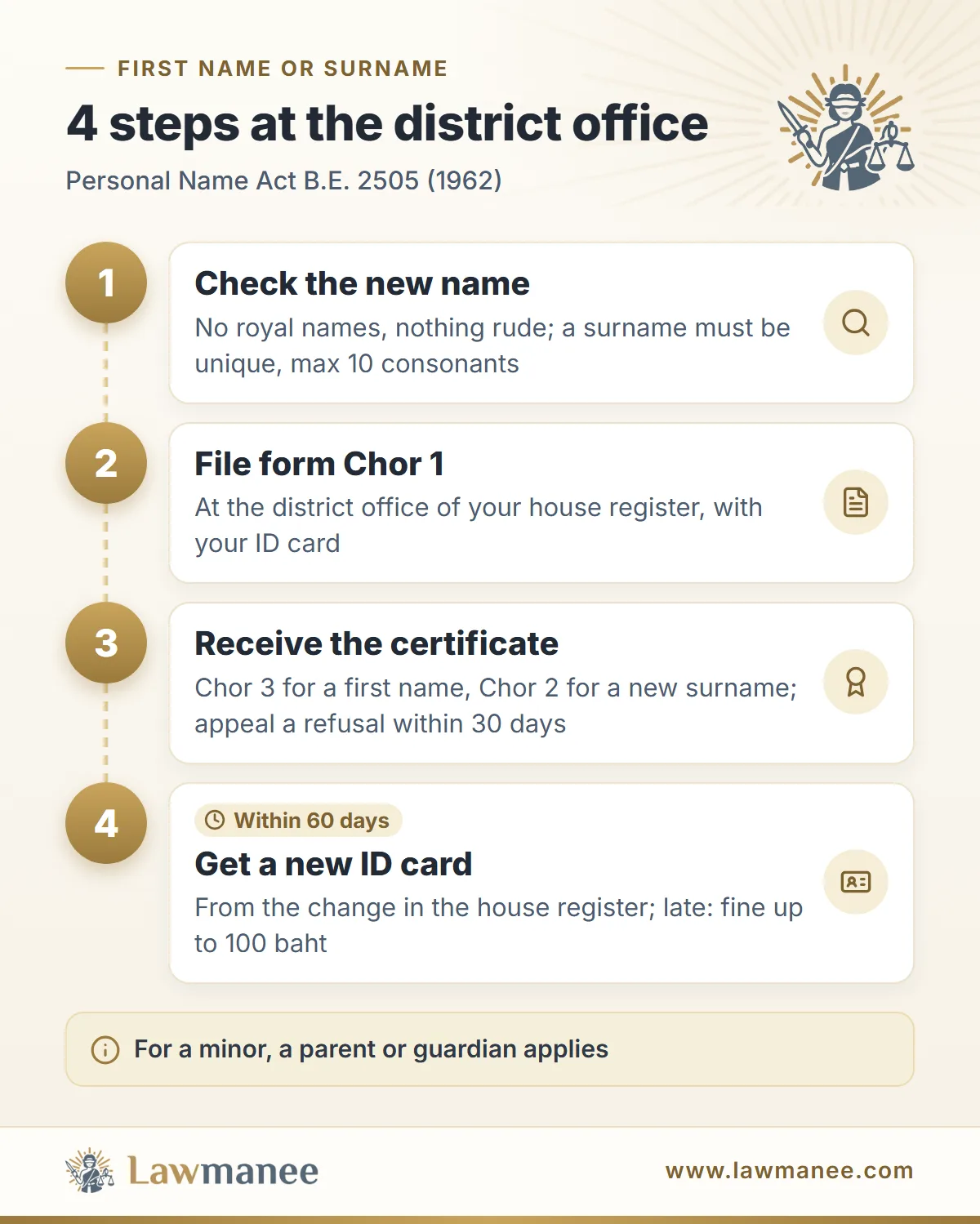
A Thai national who wants a new first or middle name applies to the local registrar at the district office (amphoe or khet) where they are listed in the house register (Section 16), using form Chor 1 (ช.1), the request form for every personal-name matter.
The officer checks the Thai ID card, the house-register entry and whether the new name is allowed. If it is, the registrar approves it and issues a certificate of change of first name (Chor 3). Bring the original ID card and have more than one name ready in case the first choice is refused.
For a child who is still a minor, a parent or guardian applies, bringing the child's birth certificate or ID card, the house register and their own ID card.
Names the law does not allow
First and middle names (Section 6) must:
- not be the same as, or intended to resemble, the name of the King or the Queen, or a royal-conferred title (rajatinnanam)
- not contain rude words or meanings
- for a middle name, not be another person's surname, unless a spouse uses the other spouse's surname with their consent, or a child uses the mother's or father's former surname
Surnames (Section 8) must:
- not be the same as, or intended to resemble, the name of the King or the Queen
- not resemble a royal-conferred title, unless it is your own, a parent's or ancestor's, or a descendant's
- not duplicate a royally granted surname or one already registered
- not contain rude words or meanings
- have no more than 10 consonants, unless a royal-conferred title is used as the surname
The Department of Provincial Administration also tells registrars to check that a change is not made in bad faith, for example to evade a court case.
A new surname, or sharing someone else's
Someone who already has a surname can register a new one at the same district office (Section 17). The registrar checks Section 8 and that nobody has registered the name before, then issues a certificate (Chor 2).
To use a surname someone else registered, such as a relative's, the owner of the surname must agree (Section 11). The owner first obtains a permission letter (Chor 6); you then file Chor 1 and receive a certificate of joint use (Chor 4). If the owner has died, the closest living descendants who still use the surname give permission instead.
If the registrar refuses, you can appeal within 30 days of learning of the decision (Section 18).
Fees
| Matter | Fee |
|---|---|
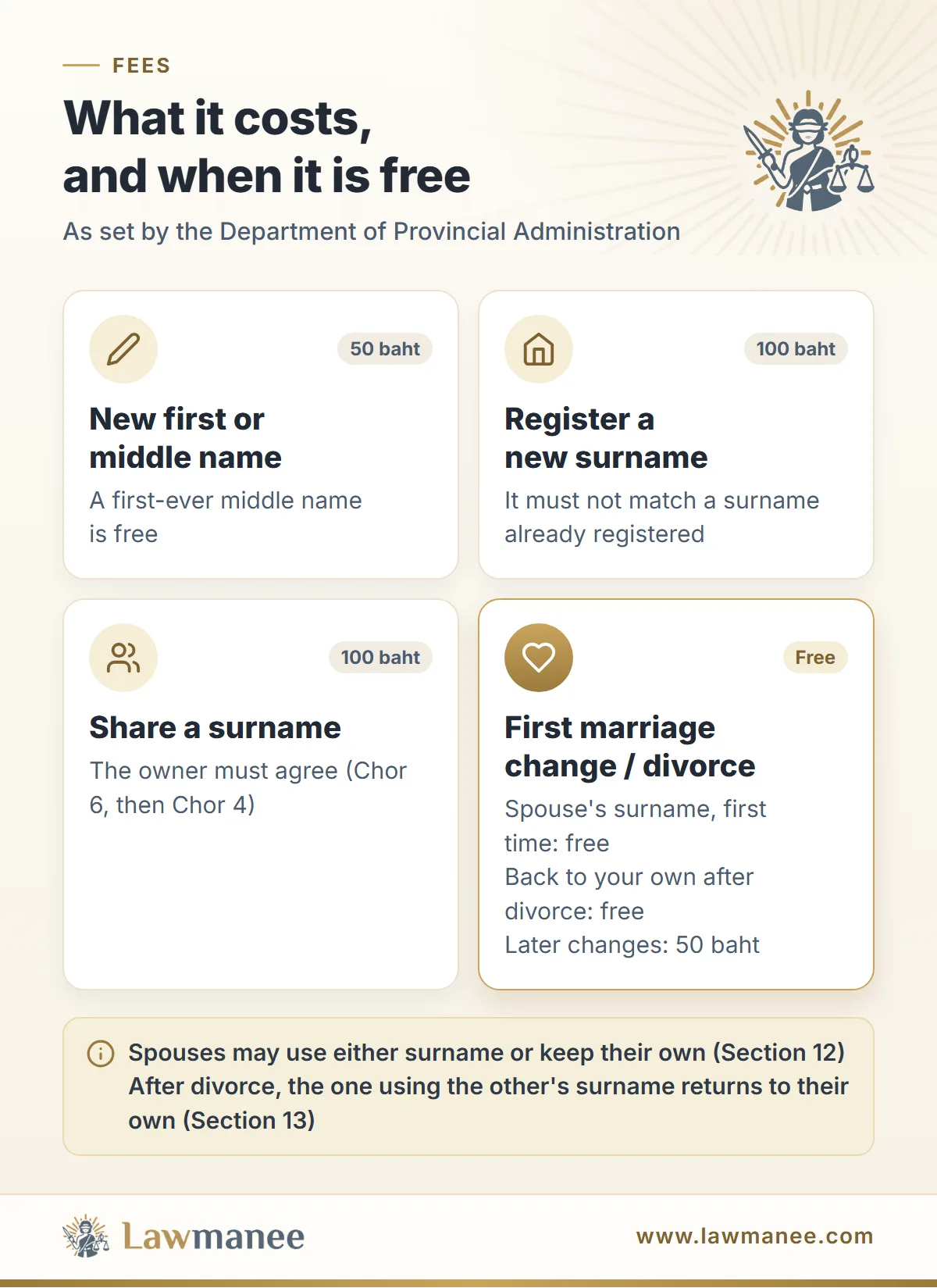
| New first name or middle name | 50 baht |
| First-ever middle name | Free |
| Registering a new surname | 100 baht |
| Joint use of a surname (Chor 4) | 100 baht |
| First surname change on registering a marriage | Free |
| Later surname changes during the marriage | 50 baht |
| Returning to your own surname when the marriage ends | Free |
Surnames on marriage, divorce or a spouse's death
Thai law no longer requires anyone to change surname on marriage. Spouses may use either spouse's surname as they agree, or each keep their own, decide this when they register the marriage or later, and change the agreement afterwards (Section 12). Foreign nationals note: this rule applies to the Thai spouse's registered name; your own name follows your passport.
When the marriage ends (Section 13):
- Divorce or a court annulment: the spouse who used the other's surname must return to their own. On 8 July 2025 the Constitutional Court ruled that this rule does not breach the Constitution, so it remains in force.
- Death of a spouse: the surviving spouse may keep the surname, but returns to their own on remarrying.
Under the Female Title Act B.E. 2551 (2008), a woman who registers a marriage may choose "Nang" (Mrs) or "Nangsao" (Miss), and may choose again when the marriage ends, by notifying the registrar.
Example
Mali registers her marriage and agrees to take her spouse's surname: no fee. Years later the couple register a divorce and Mali must return to her own surname: also free. If she changes her first name at the same time, that costs 50 baht. Once the house register shows the new name, she has 60 days to apply for a new ID card.
After the new name is registered
- Apply for a new ID card within 60 days of the change being entered in the house register; missing the deadline carries a fine of up to 100 baht. Bring the house register (Tor Ror 14), the old ID card and the name-change certificate.
- Keep the original certificate (Chor 2, 3, 4 or 5): it links your old and new names.
- Update documents that carry the old name, such as your passport, driving licence, property title documents and school or workplace records.
Foreigners
The Personal Name Act applies to Thai nationals. A foreigner applying for Thai nationality by naturalisation, or to recover Thai nationality, can obtain a certificate of a request to change first name (Chor 8) or to register a surname (Chor 9) to support the application, free of charge, and files Chor 1 again once nationality is granted.
When to ask a lawyer
A simple change can be done at the district office yourself. If the registrar refuses and you need to appeal, if property titles or an inheritance are still in your old name, or if there is a dispute over a surname after divorce, a lawyer can help. On Lawmanee you can post your case for free and interested lawyers reply in the platform chat, or browse lawyers by case type, province and language.