


When trouble comes, most people rush to find a lawyer and rush to pay, without checking that the person they are talking to really is a licensed lawyer. Checking takes little time, and it tells you that the person taking your case can actually stand up in a Thai court for you. This guide covers how to check a lawyer before you hire, what to get in writing, and your rights if a lawyer breaks the rules of professional conduct.
Why check first
Section 33 of the Lawyers Act B.E. 2528 (1985) forbids anyone who is not registered and licensed, whose licence has lapsed, or who has been barred from practice, from pleading in court or from drafting a complaint, an answer, an appeal or any petition or statement in court proceedings for another person. The penalty is imprisonment of up to 2 years, a fine of up to 40,000 baht, or both (Section 82).
So a person without a licence cannot act for you in court, however confident or convincing they sound.
Lawyer or legal consultant?
| Licensed lawyer | Person without a lawyer's licence | |
|---|---|---|
| Licence from the Lawyers Council | Yes | No |
| Pleading in court | Yes | No (Section 33) |
| Drafting court pleadings for others | Yes | No (Section 33) |
| Bound by the lawyers' code of conduct | Yes | No |
Only Thai nationals can apply for a lawyer's licence (Section 35). For foreigners this matters: a foreign legal consultant at a law firm can advise you, but the person who signs your court papers and appears at the hearing must be a Thai licensed lawyer, so ask who that will be. Licences come in two kinds: a 2-year licence that must be renewed, and a lifetime licence (Section 39).
Five steps to check a lawyer
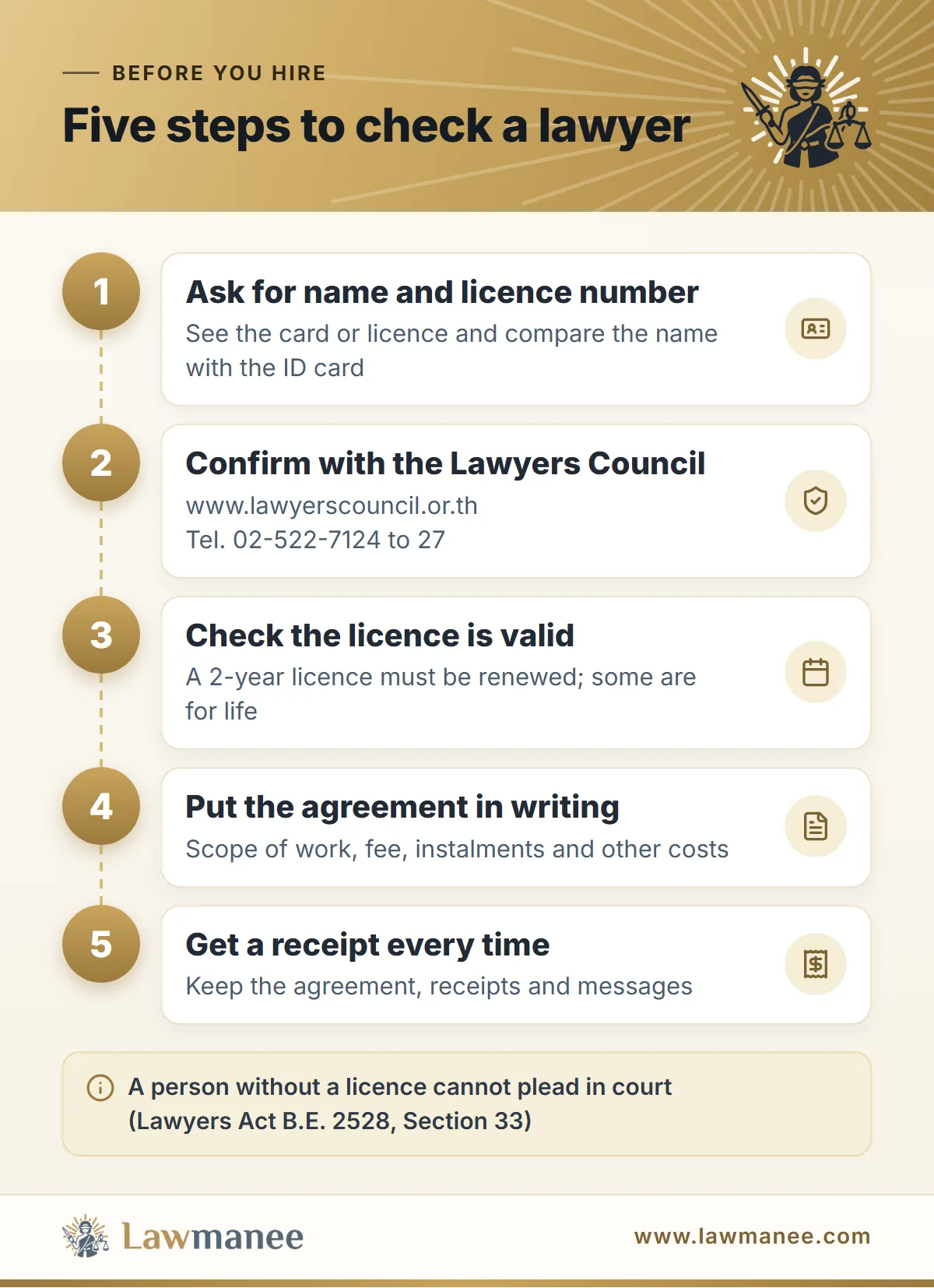
- Ask for the full name and licence number. A real lawyer can give them at once. Ask to see the lawyer's card or licence and compare the name with their ID card.
- Confirm with the Lawyers Council of Thailand. The Council registers and licenses every lawyer in the country. Contact it through www.lawyerscouncil.or.th or call 02-522-7124 to 27 with the lawyer's full name and licence number.
- Make sure the licence is still valid. For a 2-year licence, look at the expiry date. A person whose licence has lapsed, or who is suspended from practice, cannot plead in court either.
- Put the scope of work and the fee in writing. What work is covered, up to which court, how much, in how many instalments, and who pays other costs such as court fees.
- Pay in a way that leaves a record, and get a receipt every time. Keep the agreement, the receipts and all your messages.
Warning signs
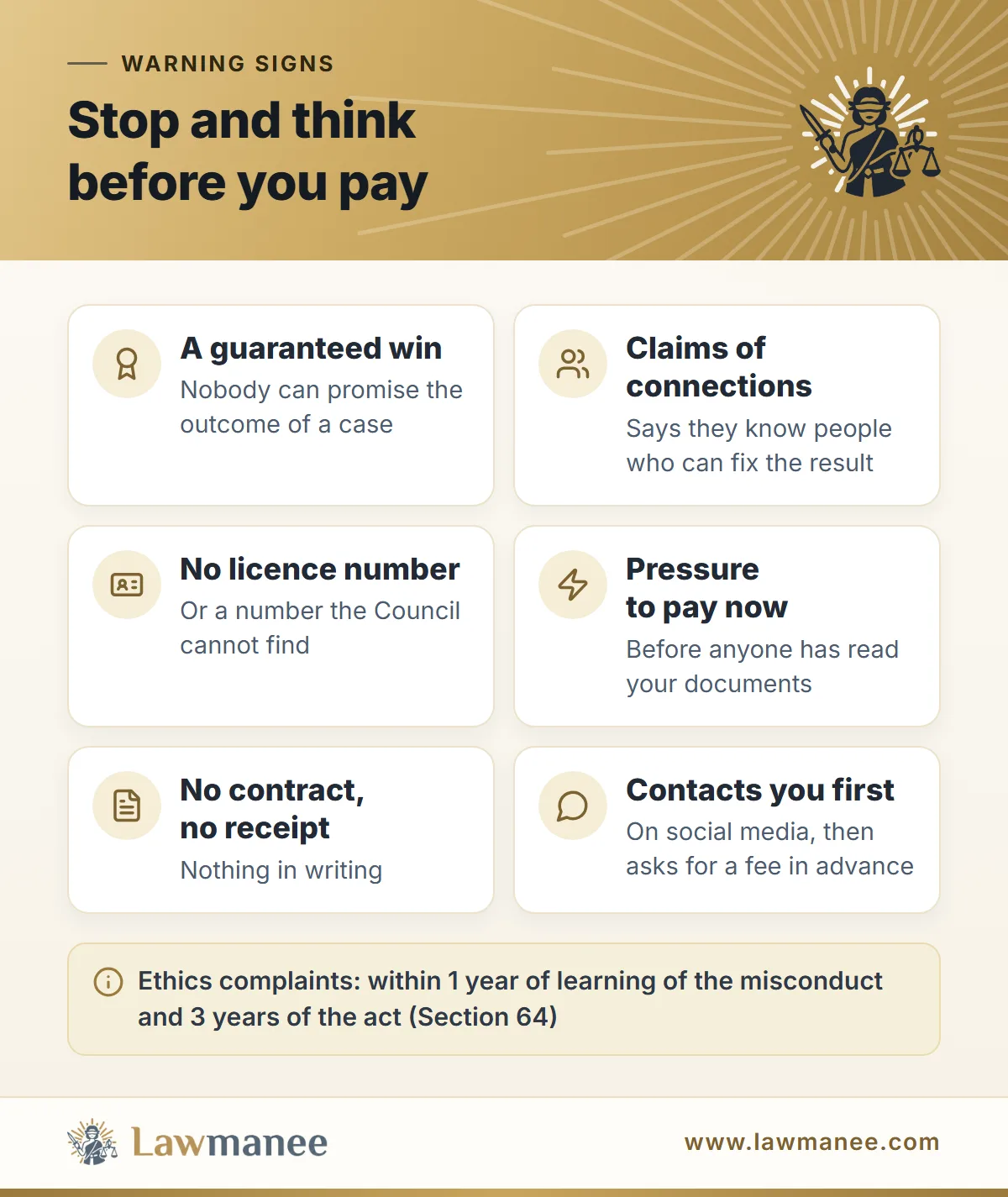
Clause 10 of the Lawyers Council Regulation on Lawyers' Conduct B.E. 2529 (1986) forbids a lawyer from using tricks to win a client: leading someone to believe a case will be won when the lawyer knows it will be lost, boasting of knowing more than other lawyers, or boasting of personal connections so that the client expects special results. So stop and think before you pay if you meet any of these:
- A guarantee that you will win
- Claims of knowing officials or powerful people who can fix the outcome
- No licence number, or a number the Lawyers Council cannot find
- Pressure to transfer money at once, before anyone has read your documents
- No written fee agreement, or no receipts
- Someone who contacts you on social media after you posted about your problem, then asks for a fee in advance
The lawyer appointment form: read before you sign
A lawyer is appointed for a case in writing, signed by the client and the lawyer and filed with the court (Civil Procedure Code, Section 61). In Thai this form is called a bai taeng thanai. It is in Thai, so ask for a translation or an explanation before you sign.
Once appointed, the lawyer may conduct the case for you as they see fit. But acts that dispose of your rights, such as admitting the other side's claim, withdrawing the case, settling, waiving a right or filing an appeal, need your express authority (Section 62). Read which of these powers the form gives, and ask about anything you do not understand.
If a lawyer breaks the rules of conduct
Lawyers must follow the Regulation on Lawyers' Conduct (Lawyers Act, Section 51). Among other things, it forbids:
- disclosing a client's secrets (Clause 11);
- deliberately missing court dates, abandoning a case or neglecting the duties owed in it (Clause 12);
- defrauding a client, embezzling, or holding on to a client's money or property for longer than is reasonable (Clause 15).
There are three penalties: probation, suspension from practice for up to 3 years, and removal from the register of lawyers (Section 52).
A person who has suffered damage may file a written accusation with the Lawyers' Conduct Committee at the Lawyers Council. The right ends 1 year after you learn of the misconduct and who committed it, and in any case 3 years after the misconduct (Section 64), so do not wait.
These are professional penalties. To recover money or claim damages you need a separate court claim. And if the person turns out not to be a lawyer at all, keep the messages and proof of payment and report the matter to the police.
Checking lawyers on Lawmanee
Lawyer profiles on Lawmanee carry a verification badge. Verified means the lawyer's licence has been checked by our staff; Verified Pro means the lawyer has also confirmed their identity with our staff at an appointment. You can post your case for free so that interested lawyers reply in the platform chat, or search lawyers by case type, province and language (Thai, English or Chinese). Then use the steps above once more before you agree to hire.