
In Thailand, defamation is not only something you can be sued for: it is a crime that can lead to imprisonment. And when the words appear on Facebook, TikTok, X, a shop review or a busy LINE group, they usually count as defamation by publication, which carries a heavier penalty. This guide explains where the line runs between legitimate criticism and a post that can be prosecuted.
What counts as defamation
Under Section 326 of the Thai Criminal Code, a person who imputes something to another person before a third person in a way likely to damage their reputation, or expose them to contempt or hatred, commits defamation.
- Imputing means asserting a fact about someone, such as saying they cheated, stole or had an affair, not just expressing a vague opinion.
- Before a third person means someone else must see or hear it. A message sent only to the person concerned, in a private chat, is not defamation.
- Identifiable: even without a name, it can be an offence if readers can tell who is meant.
Since the 2017 amendment, defaming a person online is no longer an offence under Section 14(1) of the Computer Crime Act, which now excludes defamation. It remains an offence under the Criminal Code.
One post, several possible offences
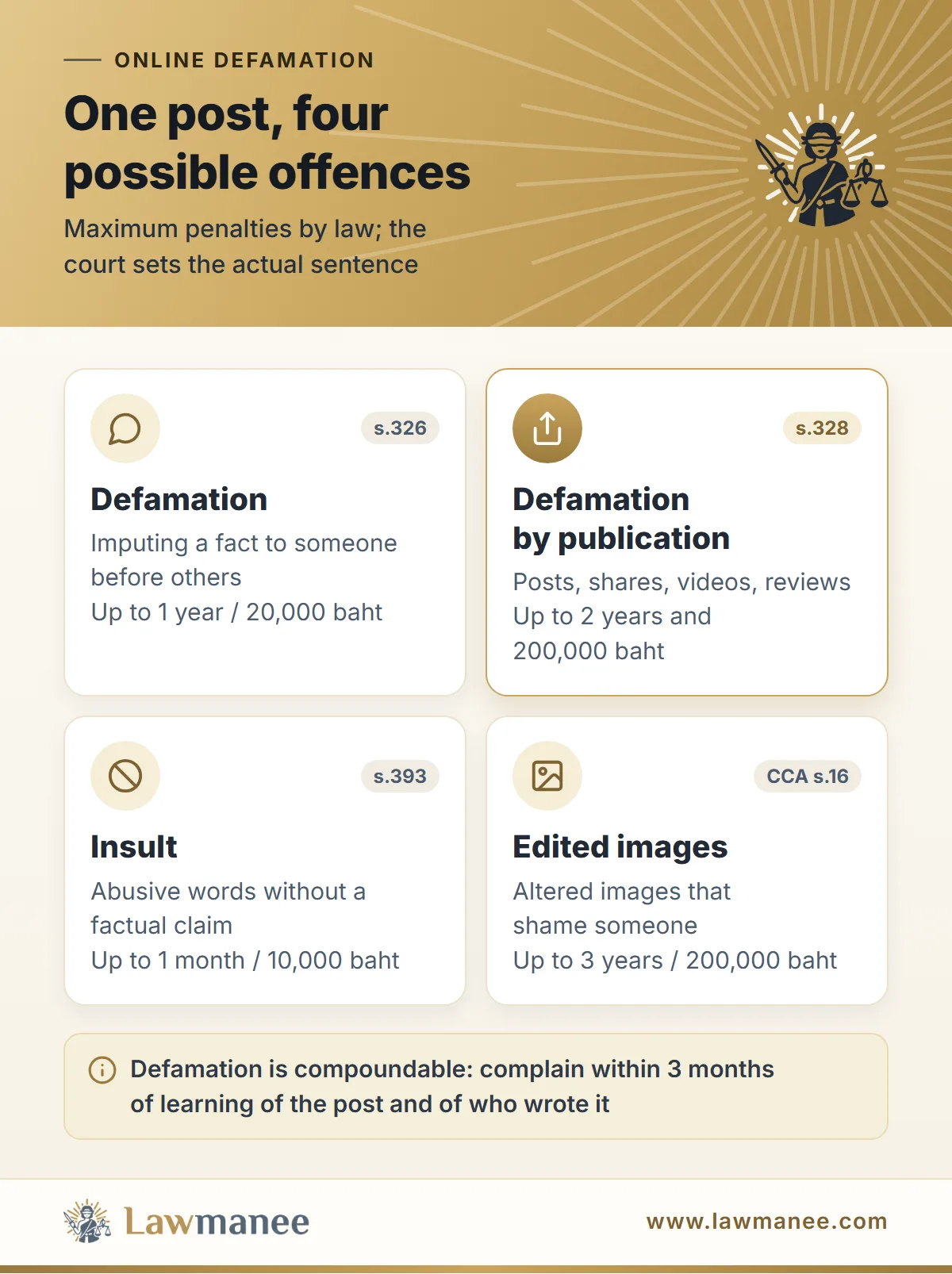
| Offence | Example | Maximum penalty |
|---|---|---|
| Defamation (Section 326) | Telling others that a neighbour steals | 1 year's imprisonment or a 20,000-baht fine, or both |
| Defamation by publication (Section 328) | A post, share, video or review seen by many people | 2 years' imprisonment and a 200,000-baht fine |
| Insult, face to face or by publication (Section 393) | Abusive words without any factual accusation | 1 month's imprisonment or a 10,000-baht fine, or both |
| Edited images (Computer Crime Act, Section 16) | An altered image that damages or shames someone | 3 years' imprisonment, 200,000-baht fine |
These are the maximum penalties set by law; the court decides the actual sentence on the facts of each case.
Defences: when you can speak without committing an offence
- Good-faith statements (Section 329), for example to protect your own legitimate interests, fair comment on a person or thing that is open to public criticism, or a fair report of open proceedings in court or at a meeting.
- Proven truth (Section 330): the accused is not punished, but truth may not be proved where the matter is private and proof would not benefit the public.
A practical rule for reviews of products and services: describe only what you actually experienced, keep your evidence, separate facts from opinion, avoid abusive language, do not accuse anyone of a crime without proof, and do not publish other people's personal information.
If you are defamed online
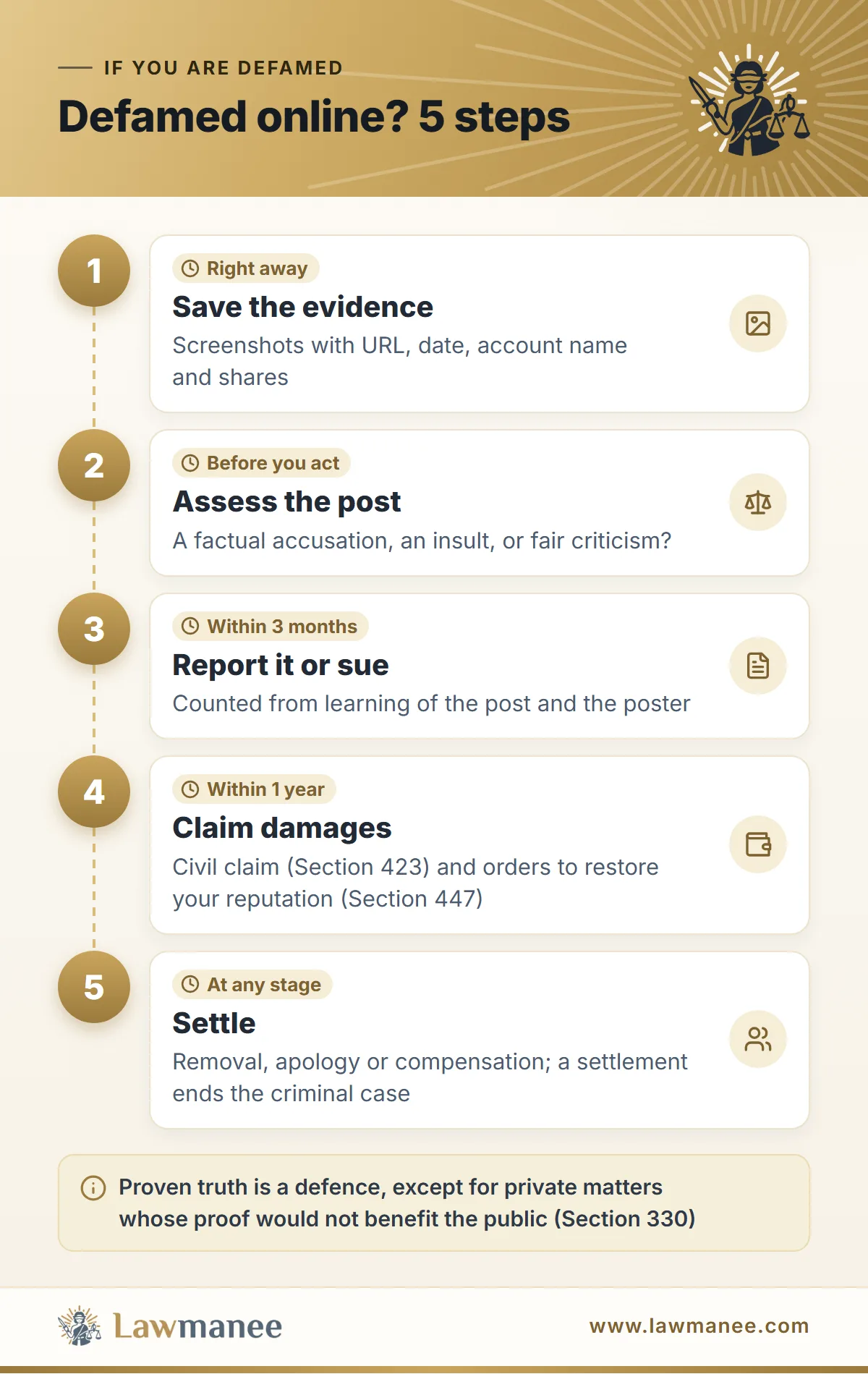
- Save the evidence right away: screenshots showing the text, the account name, the date and time and the number of shares, and copy the URL, because the post can disappear at any moment.
- Assess the post: is it a false factual accusation, an insult, or legitimate criticism?
- Report it or sue within 3 months: defamation is a compoundable offence (Section 333), so a complaint must be filed within 3 months of learning of the offence and of who committed it (Section 96), or the case is barred.
- Claim damages in a civil case: for a wrongful act under Section 423 of the Civil and Commercial Code, and ask the court to order measures that restore your reputation under Section 447. The claim must be filed within 1 year of learning of the wrongful act and of the person liable (Section 448).
- Negotiate or mediate: many cases end with the post removed, an apology or compensation, and once the parties settle, the criminal case ends.
Meanwhile, report the content to the platform, and do not reply with harsh words of your own, or you may end up as the one being sued.
If you are accused of defamation
- Do not ignore a summons: attend the interview with the inquiry officer with a lawyer. A suspect may choose whether or not to give a statement, and can apply for temporary release.
- Keep the whole context, such as earlier chats, receipts, or evidence that what you wrote is true or was fair comment in good faith, and talk to a lawyer before deciding whether to delete or edit the post.
- Check the deadline: if the complainant filed more than 3 months after learning of the post and the poster, the criminal case is barred.
- Consider an apology or settlement, especially where your statement would be hard to prove. Negotiating early usually saves more time and money than fighting the case to the end.
If you are not a Thai national, the same rules apply to what you post while in Thailand, and proceedings are conducted in Thai, so arrange an interpreter as well as a lawyer.
Talk to a lawyer about defamation
Defamation cases turn on the exact words, the context and the evidence, so a lawyer's assessment helps before you file a complaint or attend a police interview. On Lawmanee you can describe your situation for free, and interested lawyers will reply in the platform's chat. You can also search lawyers by case type, province and language.