

If you are going into business with friends or family in Thailand, a limited company is not the only option. The other is a partnership (ห้างหุ้นส่วน), but there are several kinds, and they differ sharply in how far each partner is personally liable: in some, every partner answers for the business with their own assets, without limit. This guide explains the rules of the Thai Civil and Commercial Code and the current registration procedure at the Department of Business Development (DBD).
What a partnership is, and the three kinds
A partnership contract is an agreement between two or more persons to carry on a business together in order to share the profits (Section 1012). Every partner must contribute something: money, other property or their own work (Section 1026).
Thai law recognises three forms: the ordinary partnership, the limited partnership and the limited company (Section 1013). An ordinary partnership may be registered or not (Section 1064); a limited partnership must be registered (Section 1078). Once registered, a partnership is a juristic person separate from its partners (Section 1015). A registered ordinary partnership is called ห้างหุ้นส่วนสามัญนิติบุคคล in Thai.
| Form | Juristic person? | Partners' liability |
|---|---|---|
| Unregistered ordinary partnership | No | All partners jointly and without limit |
| Registered ordinary partnership | Yes | All partners jointly and without limit |
| Limited partnership | Yes | Some partners limited, at least one unlimited |
An unregistered ordinary partnership does not register with the DBD, but if it runs a business covered by the commercial registration law, such as selling online, it needs a commercial registration. A partnership registered as a juristic person does not need a separate commercial registration.
How far each partner is liable
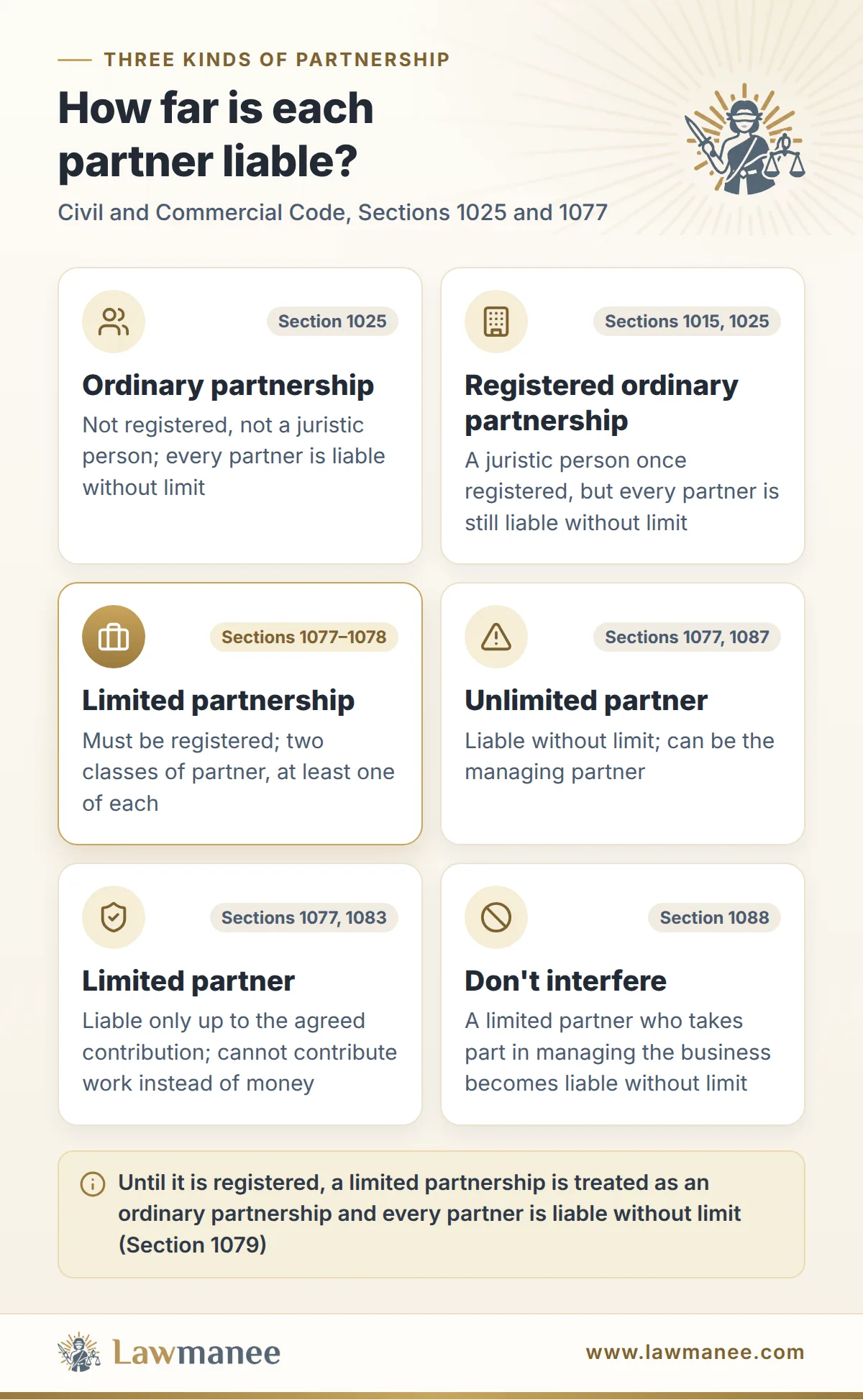
- Ordinary partnership: all partners are jointly liable, without limit, for all of the partnership's debts (Section 1025), for example goods it has ordered or damages it must pay, whether or not it is registered.
- Limited partnership: there are two classes of partner, with at least one of each (Section 1077). Limited partners are liable only up to the amount they have agreed to contribute; unlimited partners are jointly liable for all of its debts without limit.
- A limited partner must contribute money or other property, not work (Section 1083).
- Until it is registered, a limited partnership is treated as an ordinary partnership, and every partner is liable without limit (Section 1079).
- A limited partner's name must not be used in the partnership's name (Section 1081). A limited partner who allows it is liable to outsiders as if they were an unlimited partner (Section 1082).
Example: Phum, Fon and Ton form a limited partnership to run a café. Phum is the managing partner, so Phum must be an unlimited partner, and puts in 200,000 baht. Fon contributes work as the barista instead of money, so Fon cannot be a limited partner either. Ton puts in 300,000 baht as a limited partner. Later the partnership breaches a catering contract and has to pay 900,000 baht in damages, but its assets come to only 400,000 baht. Phum and Fon are jointly liable for the 500,000 baht shortfall out of their own assets, while Ton, who has paid the full 300,000 baht, owes nothing more.
Managing partners and other rules
- In a limited partnership, only unlimited partners can be managing partners (Section 1087). The names of the managing partners and any limits on their powers are part of the registered particulars (Section 1078).
- A limited partner who interferes in managing the business becomes liable for all of its debts without limit. Giving opinions or advice, or voting on appointing or removing managers where the partnership contract provides for it, does not count as interference (Section 1088).
- In an ordinary partnership, unless the partners have agreed otherwise, every partner may manage it, but no partner may enter into a contract that another partner objects to (Section 1033).
- New partners can be admitted only with the consent of all partners, unless agreed otherwise (Section 1040).
- Competition: a partner in a registered partnership may not run a similar, competing business without the consent of all the other partners (Section 1066). A limited partner may (Section 1090), and may also transfer their share without the others' consent (Section 1091).
Registering online through DBD Biz Regist
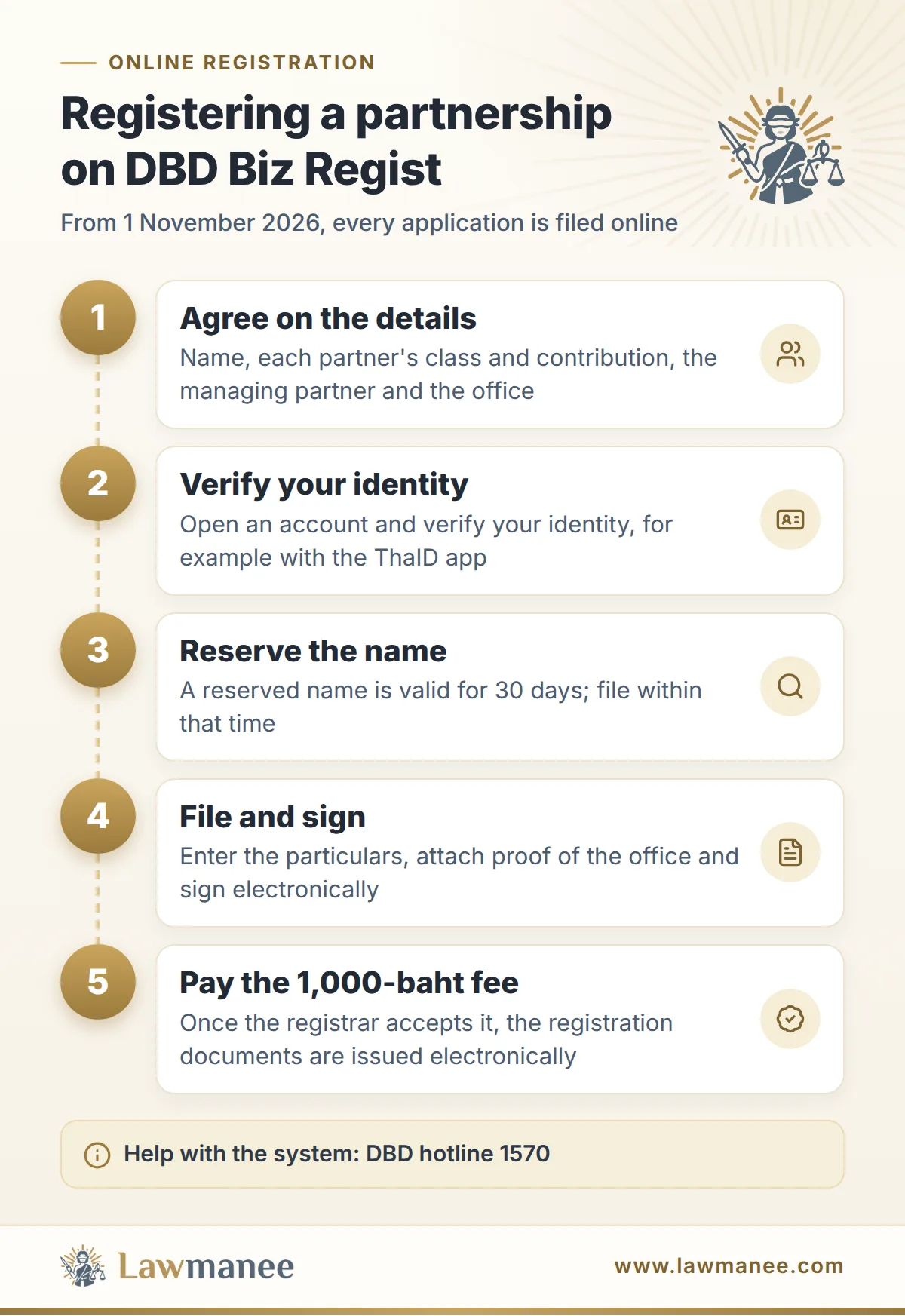
Since 1 July 2026 the DBD has accepted new registrations of partnerships and limited companies only through its digital registration system, DBD Biz Regist, and since 1 November 2026 every kind of application for partnerships and limited companies must be filed there. You reach it from the "จดทะเบียนนิติบุคคลดิจิทัล (DBD Biz Regist)" menu at www.dbd.go.th.
- Agree on the details: the name, the objectives, the head office, each partner's class and contribution, who the managing partners are and any limits on their powers. These are the registered particulars (Sections 1064 and 1078).
- Open an account and verify your identity in the system, for example with the ThaID app. Foreign partners without a Thai ID card should check which verification method applies to them before they start.
- Reserve the name: a reserved name is valid for 30 days, and you must file within that time.
- Fill in the application, attach the documents and sign electronically, for example proof of the office address or the owner's consent to use the premises.
- Pay the fee: registering a partnership costs 1,000 baht. Once the registrar accepts the registration, the registration documents are issued electronically.
For help with the system, call the DBD hotline 1570.
After registration
- Annual financial statements: a registered partnership files its financial statements through DBD e-Filing within 5 months of the end of its accounting year.
- Audit: a registered partnership with capital of no more than 5 million baht, total assets of no more than 30 million baht and total revenue of no more than 30 million baht does not need a certified public accountant; a tax auditor may audit and certify its accounts instead. Limited companies have no such exemption.
- Tax: limited partnerships and registered ordinary partnerships pay corporate income tax, like companies.
- Becoming a company later: a registered partnership can be converted into a limited company with the consent of all partners, following the steps in Section 1246/1.
Foreign partners
Foreigners can be partners in a Thai partnership, but the Foreign Business Act B.E. 2542 (1999) has rules aimed specifically at partnerships:
- A limited partnership or registered ordinary partnership whose managing partner or manager is a foreign national is itself a "foreigner" under the Act, even if Thais put in most of the capital (Section 4).
- So is a partnership in which foreigners have invested half or more of the total capital (Section 4).
- A partnership that counts as a foreigner cannot run many of the businesses listed in the Act at all, or only with a licence, and needs minimum capital of at least 2 million baht, or at least 3 million baht for a business that needs a licence (Section 14).
- A Thai who holds a share on behalf of a foreigner so that the foreigner can get around the Act, and the foreigner who allows it, face up to 3 years in prison, a fine of 100,000 to 1,000,000 baht, or both (Section 36).
Talk to a lawyer before you start
You can register on your own, but some things deserve a written agreement from day one: how profits are shared, the managing partner's powers, admitting new partners and leaving the partnership. A business lawyer can draft the partnership agreement and advise which form suits your business. On Lawmanee you can describe your plans for free and interested lawyers reply in the platform chat, or search lawyers by case type, province and language.