
The photos looked great, but what arrived is a different model, the fabric is thinner than advertised, or the device does not work out of the box. "Not as described" is one of the most common problems with online shopping in Thailand. The good news: buying through a screen is still a contract of sale, the seller has the same legal duties as a shop, and consumers have a route to court with no court fees. These rules apply to foreign residents buying in Thailand just as they do to Thai buyers.
Not as described vs scammed
- Not as described or defective: the seller is real and delivered something, but it does not match the deal or has a defect. This is a consumer and sales-contract matter, and this guide applies.
- Paid but nothing arrived and the seller vanished: the page is gone, the chat is blocked, no goods. This may be fraud. Report it promptly at thaipoliceonline.go.th or a police station, and use the consumer routes alongside.
The seller is liable for defects
Under Section 472 of the Thai Civil and Commercial Code, if the goods sold have a defect that reduces their value or their fitness for ordinary use, the seller is liable, and cannot escape by saying they did not know about the defect.
Section 473 sets out exceptions every online buyer should know. The seller is not liable if:
- the buyer knew of the defect when buying, or would have known by using ordinary care;
- the defect was obvious at delivery and the buyer accepted the goods without objecting;
- the goods were sold at auction.
Point 2 is why you should open and check the parcel as soon as it arrives. If something is wrong, message the seller straight away rather than keeping quiet and using the item.
Timing matters too. A claim for a defect must be filed within 1 year from when the defect was discovered (Section 474).
Keep evidence from before you order
Good evidence lets the seller, the OCPB and the court see what you saw.
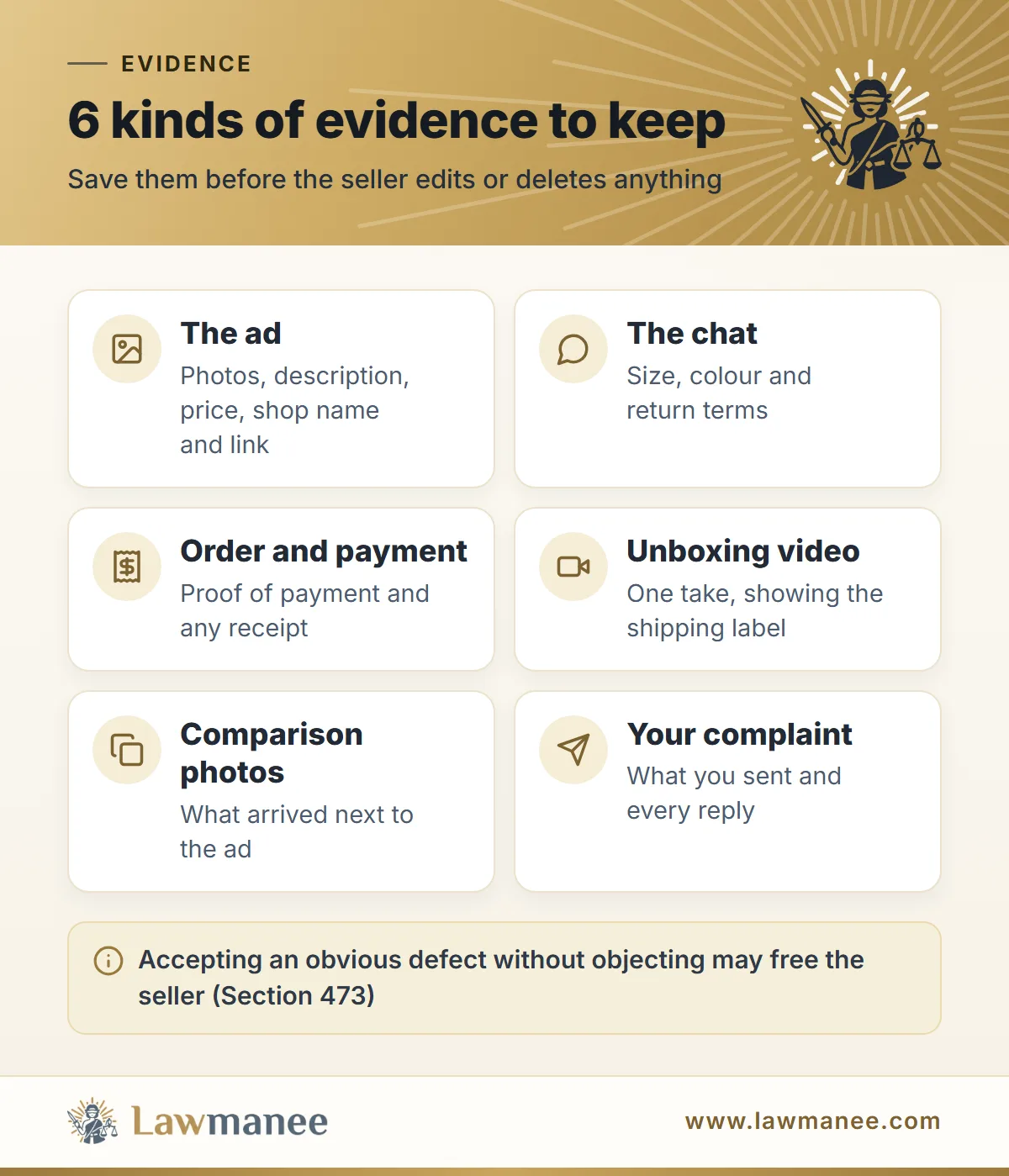
- Screenshot the post or product page: photos, description, price and the shop's name or link, before it is edited or deleted.
- Screenshot the chat about the product, size, colour and return terms.
- Keep the order, the proof of payment and any receipt.
- Film the unboxing in one take, showing the sealed box and the shipping label.
- Photograph what you received next to the advertised photo.
- Keep every message you send the seller and every reply.
How to claim your rights
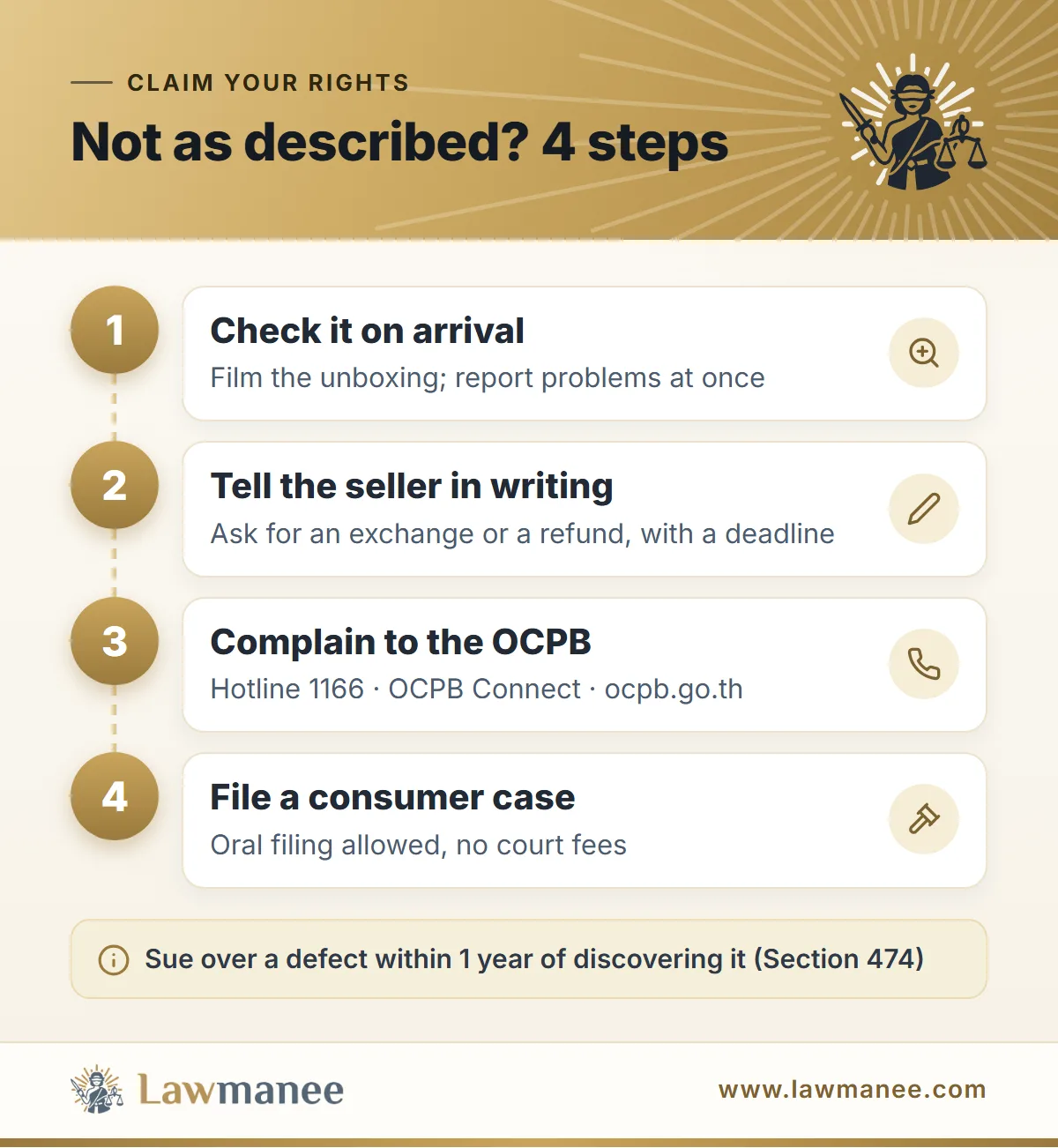
- Tell the seller in writing what is wrong and what you want, such as an exchange or a return and refund, with a reasonable deadline. If you bought on a platform with a return system, also use it within the platform's time limit.
- Complain to the OCPB (Office of the Consumer Protection Board) through hotline 1166, the OCPB Connect app, ocpb.go.th or its provincial offices. The OCPB can call the seller in to negotiate, even if the seller has no physical shop.
- File a consumer case if negotiation fails, under the Consumer Case Procedure Act B.E. 2551 (2008).
A consumer case without court fees
| Point | Consumer case |
|---|---|
| Court fees | Waived for a consumer who sues (Section 18) |
| How to file | In writing or orally; a court case officer records the complaint (Section 20) |
| Lawyer | Not required; consumers can file themselves |
| Court | Claims up to 300,000 baht go to the Kwaeng (district) Court, larger claims to the Provincial Court |
Note that if the court finds the claim excessive or unreasonable, it may order the consumer to pay the waived fees. Claim what you actually lost and can prove. Court proceedings are in Thai, so a foreign buyer may want help from a Thai speaker or a lawyer.
Example (hypothetical) Fon orders a leather jacket from a social media shop for 1,890 baht. What arrives is faux leather in a different colour. She filmed the unboxing, messaged the shop the same day with comparison photos and asked to return it for a refund. The shop reads the message but never replies. Fon complains to the OCPB with screenshots of the post, the chat and the payment proof. If negotiation through the OCPB fails, she can go to the competent district court, tell the case officer her claim orally and sue for the 1,890 baht without paying a court fee.
Before your next order
- Check that the shop has a name, address and contact details you can verify before you pay.
- Be wary of shops that only take payment in advance and push you to decide fast.
- Ask about exchanges and returns in writing before ordering.
- Use a platform with a complaint and return system when you can.
Get help from a lawyer
If the item is expensive, the seller is a company that denies responsibility, or your loss goes beyond the price, a lawyer can assess and prepare the case. On Lawmanee you can post your case for free and interested lawyers reply in the platform chat, or find a lawyer by case type, province and language.