
Whether you are busy, upcountry or abroad, you may need a relative or someone you trust to act for you: transfer land, file papers or collect something from a government office. The tool is a power of attorney (POA), and Thai law treats the relationship as a contract of agency. This guide summarises the rules of the Civil and Commercial Code (CCC) and the practical points to know before you sign.
Principal, agent and the power of attorney
The person who gives authority is the principal; the person who acts is the agent or attorney (Section 797). An agent can be appointed expressly or by implication, but where the law requires the act itself to be in writing, such as a sale of land, the appointment must also be in writing (Section 798).
The key effect: what the agent does within their authority binds the principal as if the principal had done it (Section 820). Acts without or beyond authority do not bind the principal unless the principal ratifies them later (Section 823). The wording of the POA therefore decides what your attorney can do in your name.
Specific vs general authority
| Specific POA | General POA | |
|---|---|---|
| Scope | The matters named, e.g. transferring one plot | General management of the principal's affairs |
| Power | Only what is needed to complete that matter (Section 800) | All acts of management, except the 6 in Section 801 |
| Suits | One-off tasks, land transactions, high-value matters | Looking after ongoing affairs for a period |
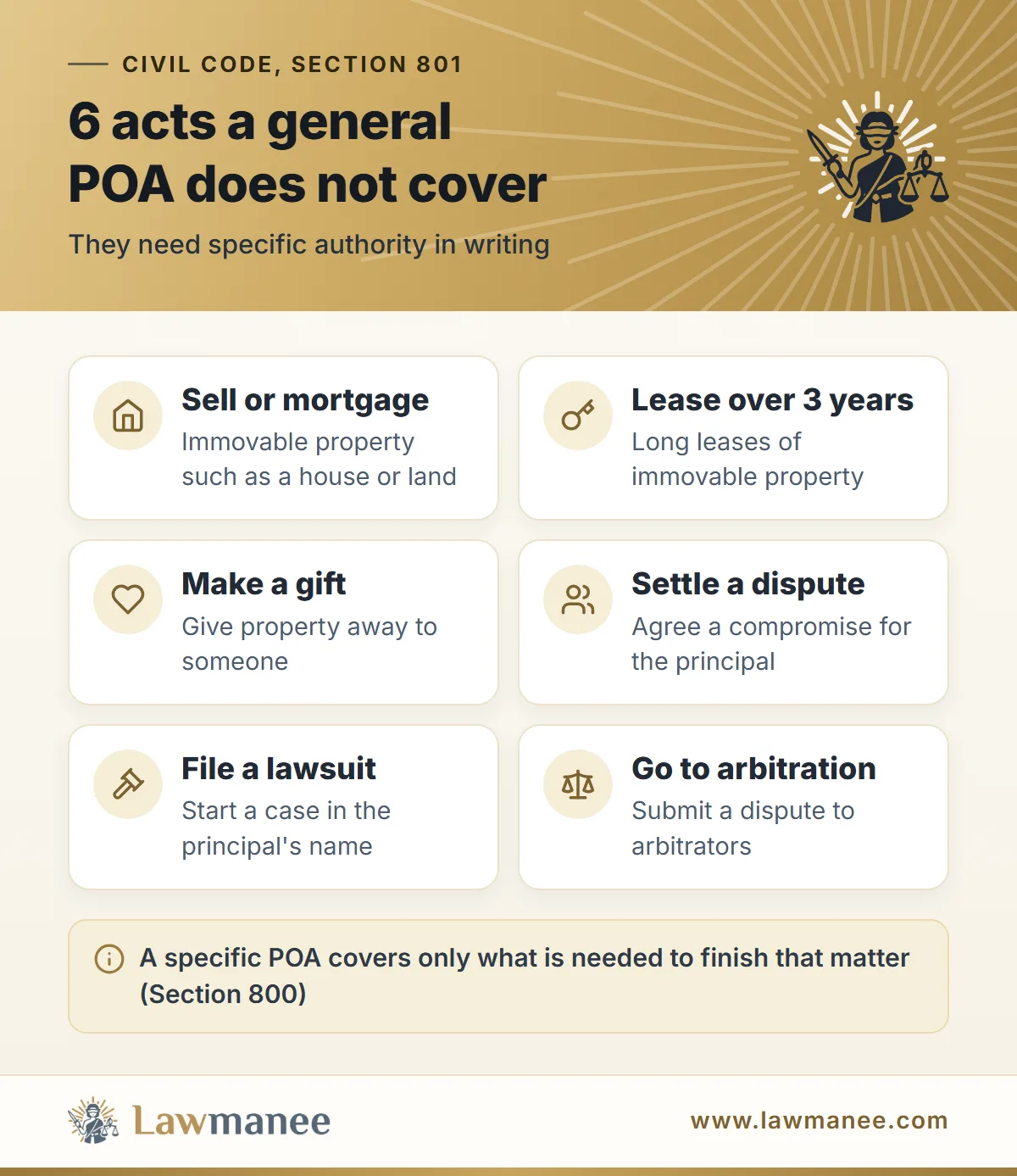
Even with a general POA, the attorney cannot do these 6 things unless the document specifically authorises them (Section 801):
- Sell or mortgage immovable property
- Lease immovable property for more than 3 years
- Make a gift
- Settle a dispute by compromise
- File a lawsuit
- Submit a dispute to arbitration
In short, any major act affecting property or rights in a case must be spelled out.
The attorney's duties
- Follow the principal's instructions (Section 807).
- Act personally; a sub-agent may be used only if that is authorised (Section 808).
- Keep the principal informed and render an account at the end (Section 809); hand over money or property received for the principal (Section 810).
- Be liable for damage caused by their own negligence (Section 812).
- Not enter into a transaction with themselves on the principal's behalf, or act for the other side in the same matter, without the principal's consent (Section 805). If one person is to act for both seller and buyer, the POA must say so.
How much stamp duty?
A POA is a dutiable instrument under item 7 of the Thai stamp duty schedule.
| Type of authority | Duty |
|---|---|
| One or more persons, a single act | 10 baht |
| One or more persons acting jointly, more than one act | 30 baht |
| Several persons who may each act separately, more than one act | 30 baht per person |
Example: you authorise your brother and/or your sister to act for you several times, each able to act alone, so the duty is 2 × 30 = 60 baht. In Supreme Court judgment 7275/2543 a POA of this kind carried only 30 baht; the court held it insufficiently stamped and inadmissible as evidence in a civil case (Revenue Code, Section 118). Cancel the stamps as well: uncancelled stamps also count as insufficient.
POAs for land and condominium units
The Land Department recommends its own forms: Tor Dor 21 (ท.ด.21) for titled land, Tor Or 4 (ท.อ.4) for land without a title deed or for buildings, and Or Chor 21 (อ.ช.21) for condominium units. Any other paper must contain the same essential details.
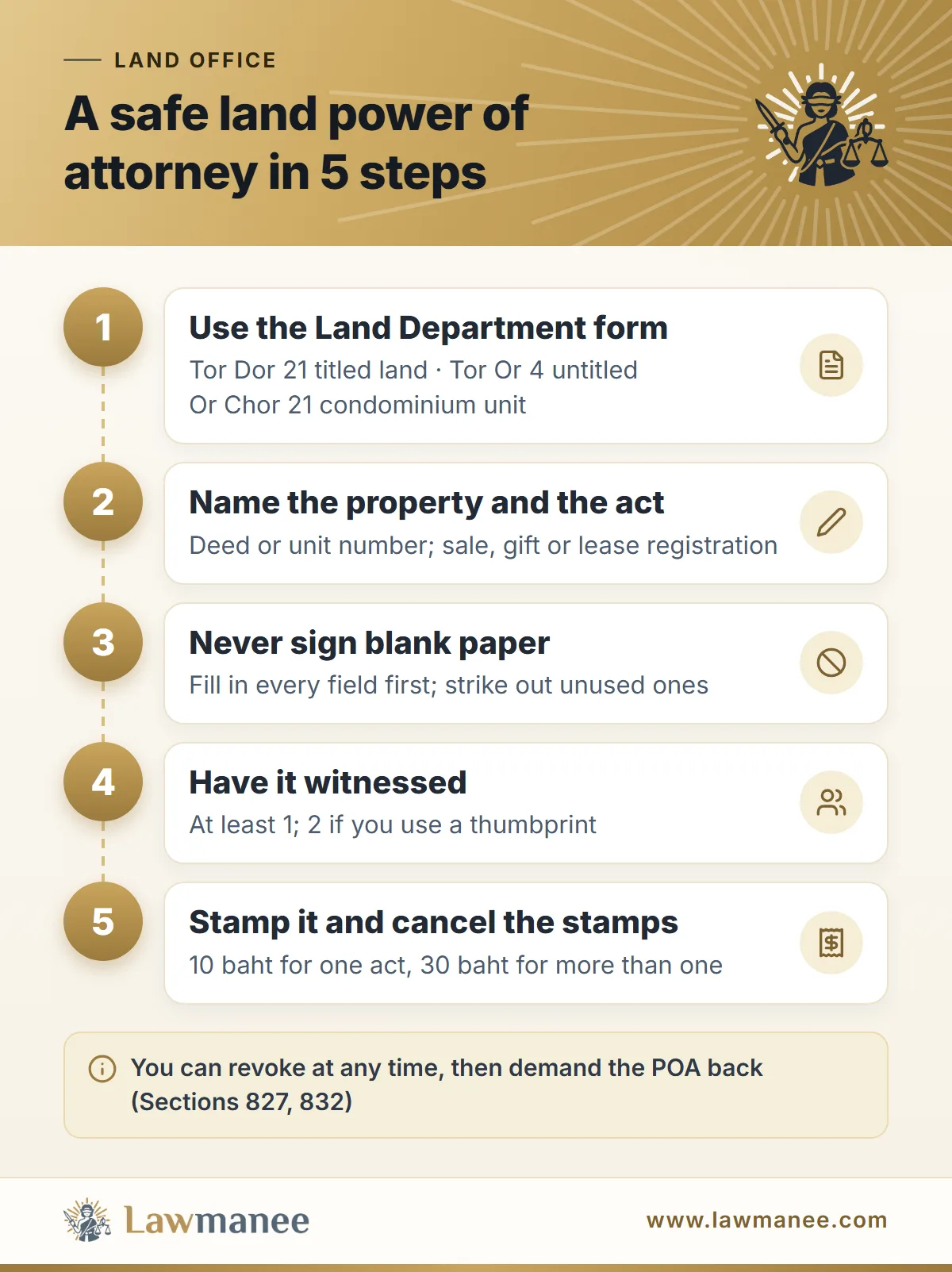
The warnings printed on the forms:
- Identify the property clearly (title deed or unit number) and the act authorised (for example sale, gift or lease registration).
- Never sign blank paper, and never sign before every field is filled in; strike through unused fields.
- Use the same handwriting and ink throughout; any erasure or addition must state the number of words and be initialled by the principal.
- At least 1 witness; if the principal uses a thumbprint instead of a signature, 2 witnesses.
The Land Department warns that what the attorney does has the same effect as the owner acting in person. If the land officer doubts that the principal is alive or genuinely intends the transaction, the officer may question people or ask for more documents. Buyers should also check that the real owner exists and truly wants to sell.
Signing from abroad
A POA made outside Thailand should be signed before an officer of a Thai embassy or consulate, or certified by a notary public. Each embassy has its own procedure and appointments, so check with both the embassy and the land office where the papers will be filed.
Revoking a POA and when it ends
- The principal may revoke, and the agent may resign, at any time, but doing so at an inconvenient time can mean paying for the other side's damage (Section 827).
- Agency ends on revocation or resignation, or when the principal or agent dies or becomes incompetent, among other causes (Section 826).
- The end of the agency cannot be raised against a third party acting in good faith, unless that party's ignorance came from their own negligence (Section 831). After revoking, tell the people involved and demand the POA back, which the principal is entitled to do (Section 832).
Talk to a lawyer about a power of attorney
For high-value land, several principals, signing abroad, or a POA you suspect is being misused, have a lawyer check it first. On Lawmanee you can describe your situation for free and interested lawyers reply in the platform chat, or search lawyers by case type, province and language.