


Many people start by selling online, freelancing or running a small shop, and then reach the point where they want a limited company: to keep personal assets apart from the business, to issue receipts in the company's name and to look more credible to customers and partners. The good news is that the legal steps are simpler than most people expect, and with the information ready the registration can be done in one day. This guide follows the manual of Thailand's Department of Business Development (DBD).
A company versus trading in your own name
A limited company is a juristic person separate from its shareholders, and a shareholder is liable only up to any unpaid amount on their shares. Trading in your own name means you answer for the business's debts with everything you own.
A company also has more duties: it must keep accounts, have its financial statements audited by a licensed auditor, file them with the DBD and file corporate income tax every year. Weigh this before you decide.
How many people, and how much capital
- At least 2 promoters, down from 3 under the amended Civil and Commercial Code in force since 7 February 2023. The company must keep at least 2 shareholders.
- At least 1 director, who does not have to be a shareholder.
- Registered capital is divided into shares of equal value, at least 5 baht each (Section 1117). The law sets no minimum capital for a Thai-owned company.
- At least 25% of every share must be paid up before registration (Section 1110); the company can call the rest later.
If the registered capital is over 5 million baht, the registrar asks for extra evidence, such as proof that the shares have been paid for.
Registering in 6 steps, in one day
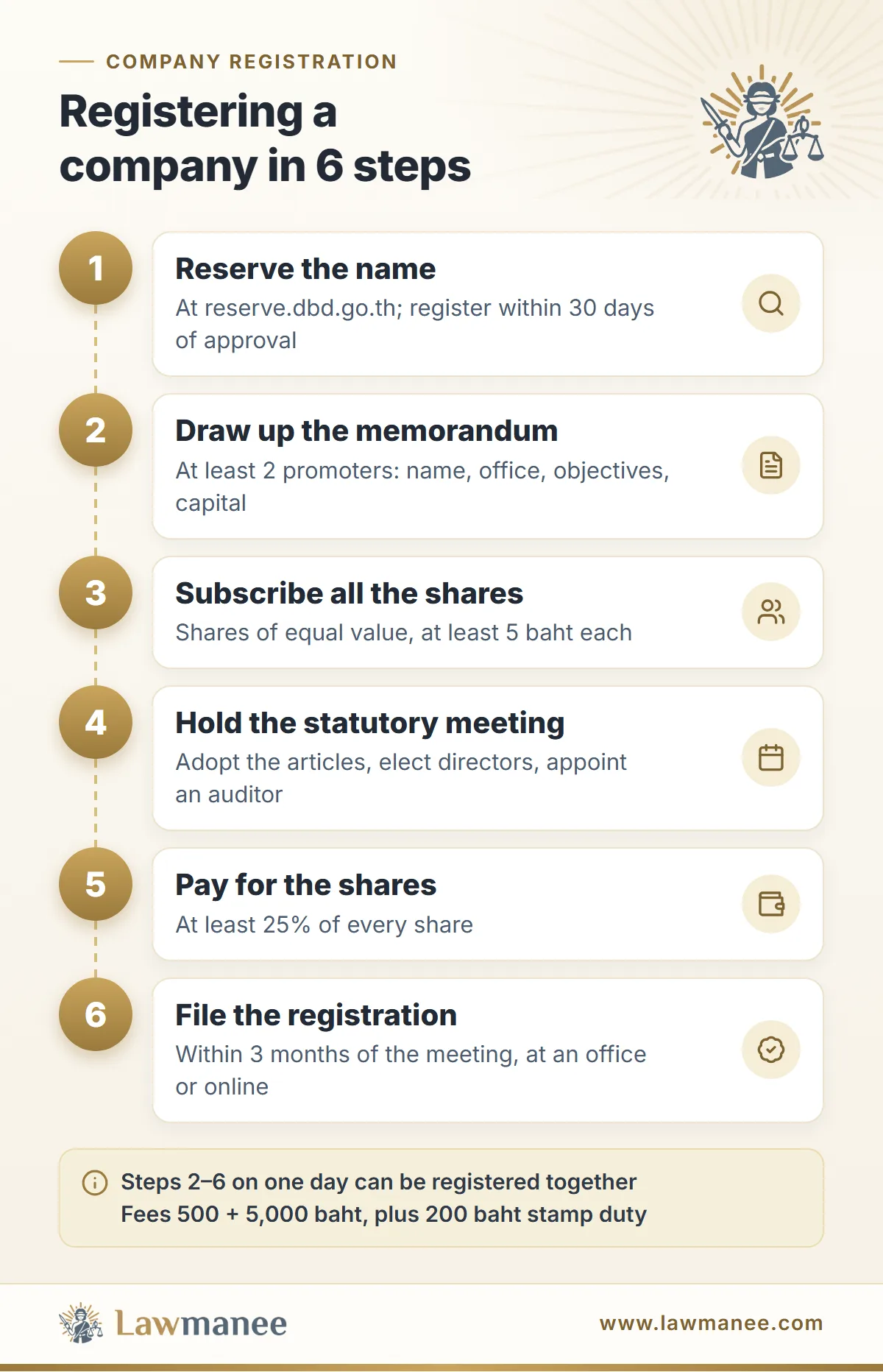
- Reserve the name on the DBD's name reservation system (reserve.dbd.go.th). Have several names ready; once approved, the name must be registered within 30 days.
- Draw up the memorandum of association, signed by at least 2 promoters: company name, head office, objectives, registered capital and the shares each promoter takes.
- Have all the shares subscribed.
- Hold the statutory meeting to adopt the articles (if any), elect the directors and appoint an auditor. If every promoter and subscriber agrees on every item, no formal notice of meeting is needed.
- Pay for the shares: at least 25%, as the meeting decides.
- File the registration within 3 months of the statutory meeting, at a DBD office in Bangkok, a provincial commerce office, or online through DBD Biz Regist.
If steps 2 to 6 happen on the same day, the directors can register the memorandum and the company together. The DBD manual gives about 1 hour 25 minutes of service time in a normal case, or about 2 working days when another agency has to approve the business first.
Documents to prepare
- The name reservation result, still valid
- The registration application, memorandum of association, registration particulars, objectives form and directors' details
- The list of shareholders, the minutes of the statutory meeting and the articles (if any)
- The company's receipts for the share payments
- A map of the head office, and copies of the ID cards of all promoters and directors; foreigners use a passport copy
- The name, licence number and fee of the licensed auditor
Fees and stamp duty
| Item | Amount |
|---|---|
| Registering the memorandum of association | 500 baht |
| Registering the limited company | 5,000 baht |
| Stamp duty on the memorandum | 200 baht |
| Stamp duty on the articles (if any) | 200 baht |
| Company affidavit (certificate) | 40 baht per item |
| Certificate of registration | 100 baht per copy |
Example: two sisters form a company with registered capital of 1,000,000 baht, divided into 100,000 shares of 10 baht, half each. By registration day at least 25%, or 250,000 baht, must be paid up. The registration fees are 5,500 baht plus 200 baht stamp duty on the memorandum, 5,700 baht in total (another 200 baht if there are articles), not counting any accountant's or lawyer's fees.
After you get the registration number
- The 13-digit registration number is also the company's tax ID.
- VAT registration is required once turnover goes over 1.8 million baht a year; apply within 30 days of passing that level.
- Business licences: get any licence your line of business needs, for example food, import and export, or tourism.
- Annual accounts: close the books every year, have them audited by a licensed auditor and file the financial statements with the DBD.
Foreign shareholders: what to watch
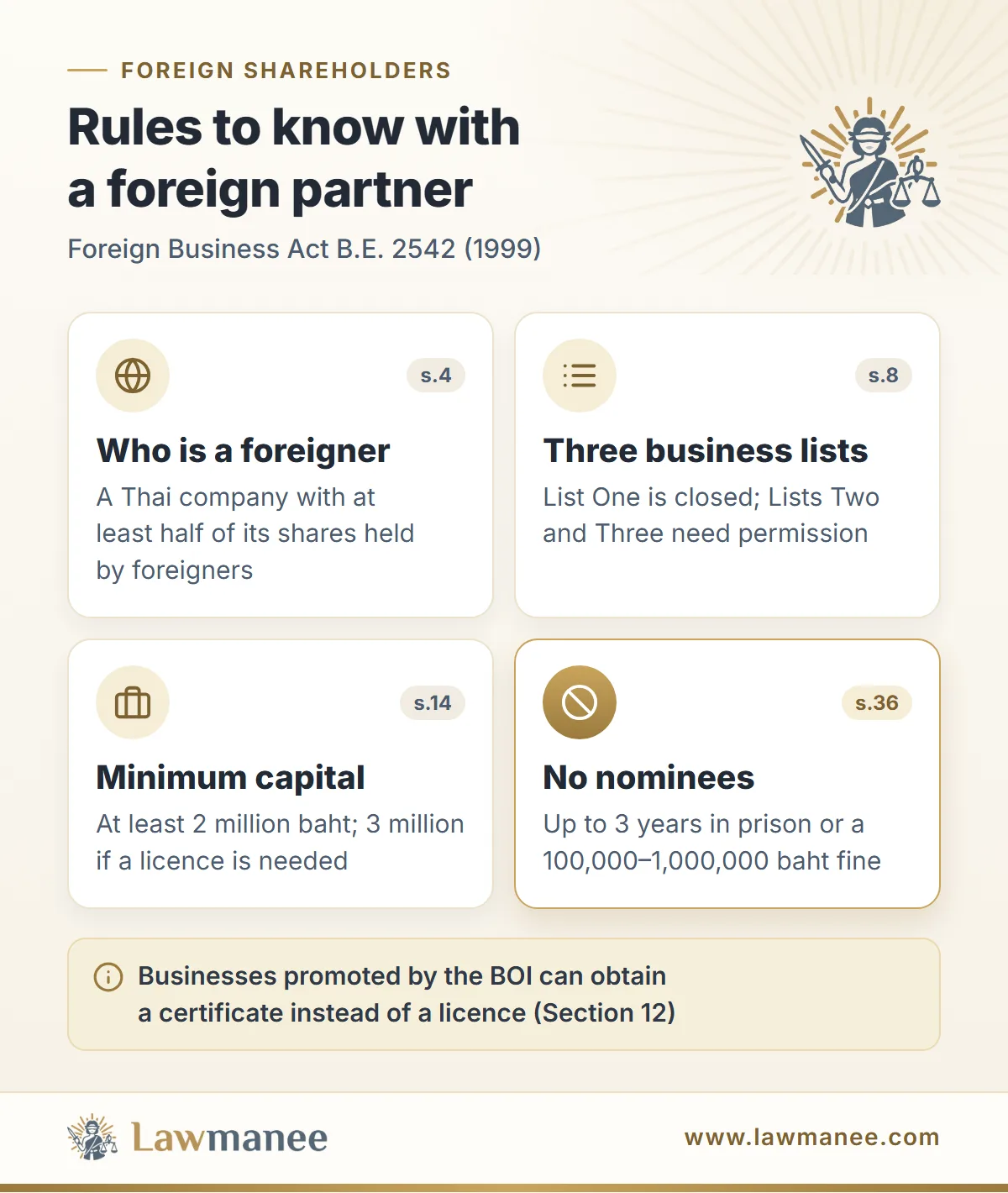
Foreigners can be shareholders or directors of a Thai company, but the Foreign Business Act B.E. 2542 (1999) applies:
- A Thai company can itself be a "foreigner" if foreigners hold at least half of its capital shares (Section 4). It is then restricted in the same way as a foreign person.
- Businesses are split into three lists (Section 8): List One is closed to foreigners; List Two needs permission from the Minister with Cabinet approval; List Three needs a licence from the DBD Director-General. List Three covers many service businesses and some forms of retail and wholesale trade.
- Minimum capital: a foreigner must start with at least 2 million baht, or at least 3 million baht for a business that needs permission (Section 14).
- BOI promotion: a business promoted by the Board of Investment can obtain a certificate instead of a licence for List Two or Three activities (Section 12).
Even when foreigners hold less than half, or a foreigner is an authorised director, the registrar may ask for extra documents to check that the Thai shareholders really invested.
Nominee shareholding is a crime. A Thai who holds shares on behalf of a foreigner so that the foreigner can run a restricted business, and the foreigner who allows it, face up to 3 years in prison, a fine of 100,000 to 1,000,000 baht, or both. The court orders the arrangement to end, and ignoring that order costs a further 10,000 to 50,000 baht a day (Section 36). Directors who knowingly allow it are also liable (Section 41).
Talk to a lawyer before you incorporate
Filing the registration yourself is easy, but some things deserve careful thought from day one: the shareholding split, the directors' signing powers, rules on transferring shares, a shareholders' agreement, and a lawful structure when a partner is a foreigner. A business lawyer can set this up correctly from the start. On Lawmanee you can describe your plans for free and interested lawyers reply in the platform chat, or search lawyers by case type, province and language.