
Adoption makes two people who are not parent and child by birth into parent and child in law. It covers adopting an orphan, a relative's child, a spouse's child or an adult you have cared for over many years. Thai law sets several conditions to protect children, and an adoption takes effect only once it is registered. This guide follows the Civil and Commercial Code, Sections 1598/19 to 1598/37, and the Child Adoption Act B.E. 2522 (1979).
Who can adopt
The adopter must be at least 25 years old and at least 15 years older than the person adopted (Section 1598/19). A 40-year-old, for example, can adopt someone aged 25 or younger.
The law does not require the adopter to be married, so a single person can adopt. When the adoptee is a child (a minor), officials also assess the family's readiness: health, income, housing, time to care for the child and criminal record.
Whose consent is needed
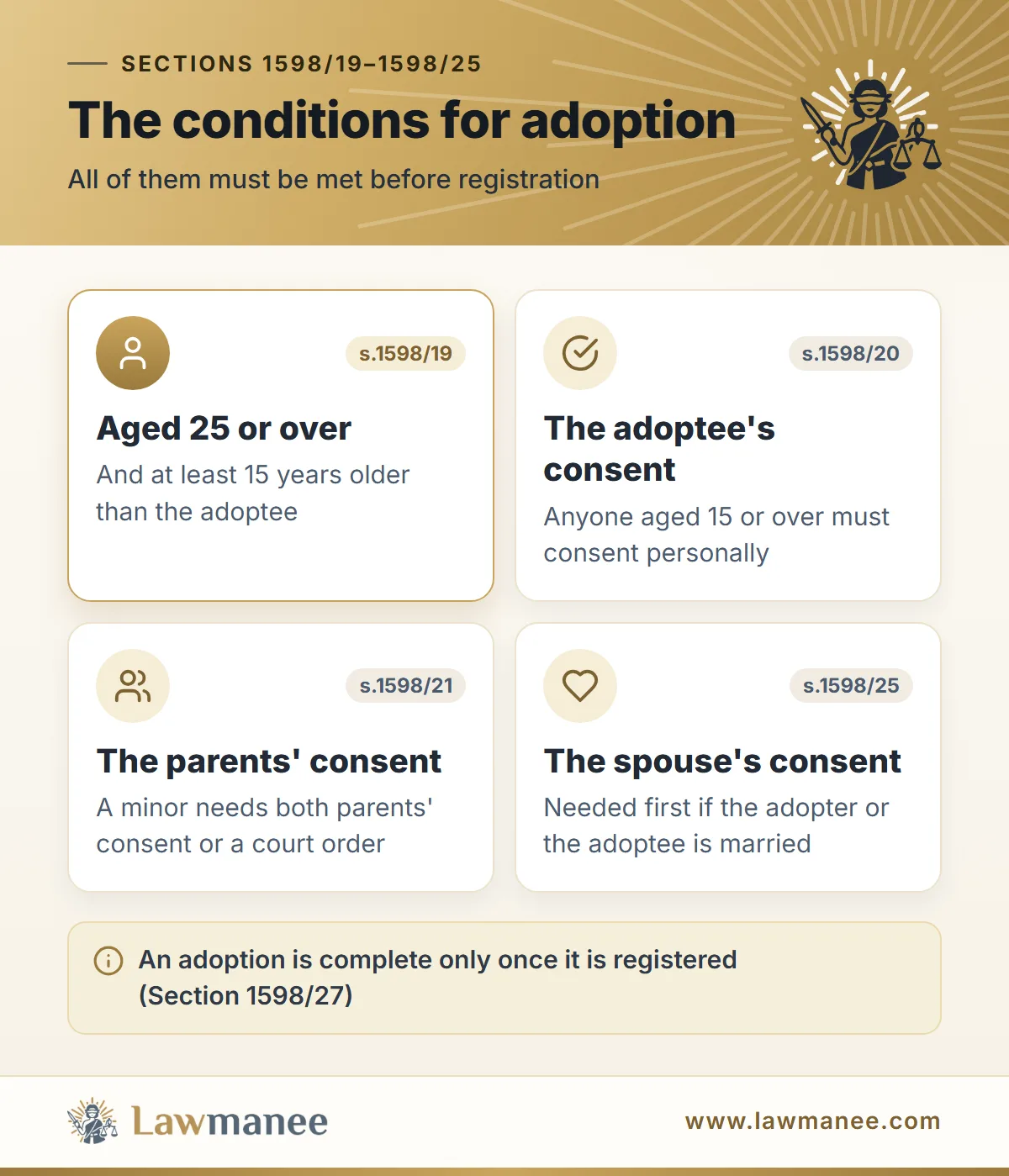
- The person being adopted, if aged 15 or over, must consent personally (Section 1598/20).
- The child's father and mother must both consent to the adoption of a minor. If one has died or lost parental power, the consent of the parent who still holds parental power is needed (Section 1598/21).
- When no one can consent, or the parents refuse without good reason and against the child's welfare, a parent, the prospective adopter or the public prosecutor can ask the court to authorise the adoption instead (Section 1598/21).
- An abandoned child in a child welfare institution: the institution consents in place of the parents (Section 1598/22).
- Spouses: if the adopter or the adoptee is married, the spouse must consent first. If the spouse cannot consent or has been missing for at least 1 year, a court order is needed instead (Section 1598/25).
A minor who is already someone's adopted child cannot be adopted by another person at the same time, except by the spouse of the first adopter, with the first adopter's consent (Section 1598/26).
Since Thailand's marriage equality law took effect in January 2025, registered same-sex spouses can adopt jointly in the same way as other married couples.
Adopting a child versus adopting an adult
An adoption is complete only when registered. If the adoptee is a minor, the procedure under the Child Adoption Act must be completed first (Section 1598/27).
| Adopting a minor | Adopting an adult | |
|---|---|---|
| Where to apply | Bangkok: the Child Adoption Center, Department of Children and Youth / other provinces: the Provincial Office of Social Development and Human Security | Directly at a district registration office |
| Trial care | At least 6 months under official supervision, unless the law exempts the case | Not required |
| Approval | The Child Adoption Board | None |
| Registration | District office, with the approval letter | District office |
| Registration fee | None | None |
The steps to adopt a child
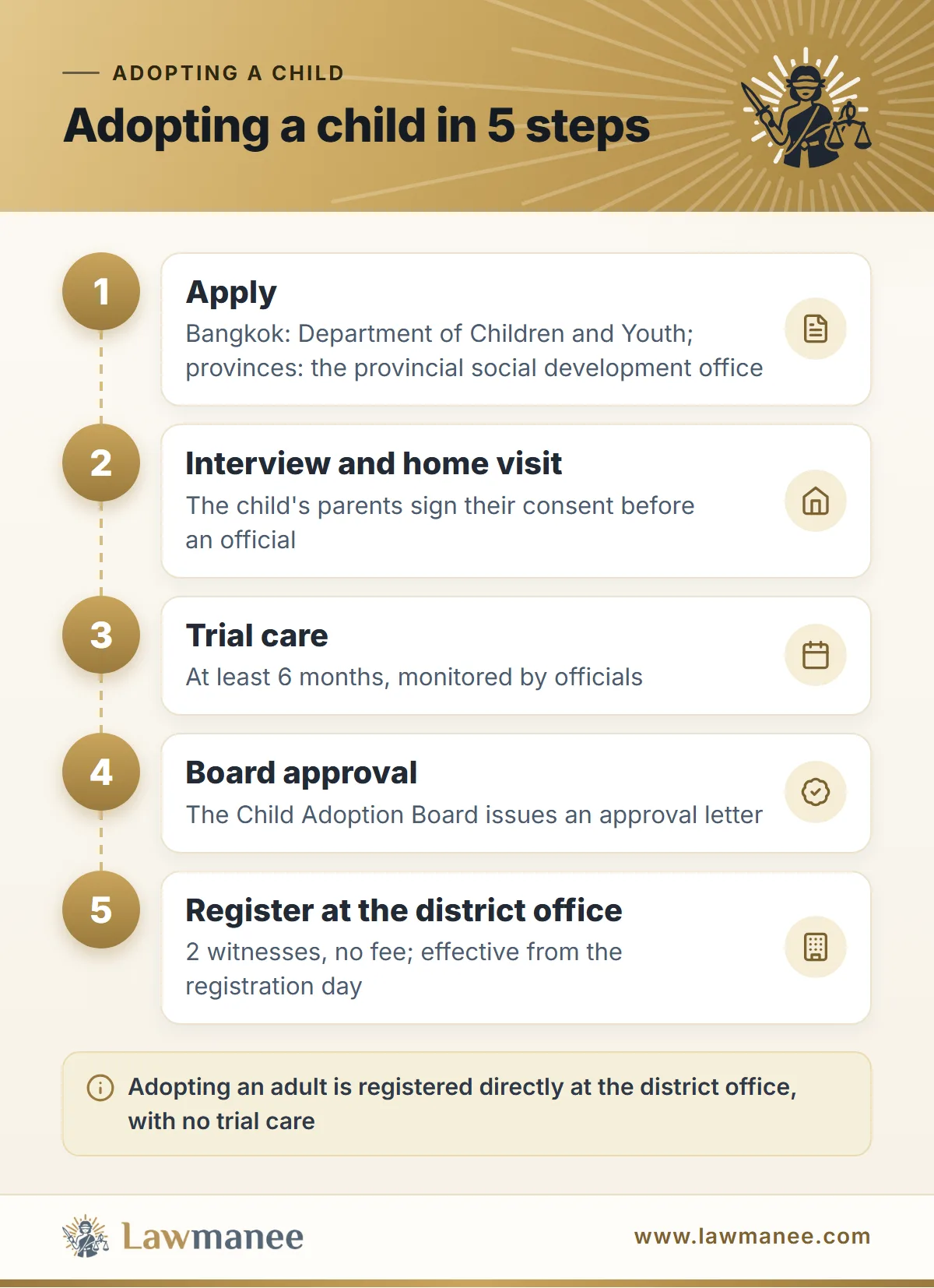
- Apply at the Child Adoption Center (Bangkok) or the Provincial Office of Social Development and Human Security where you are domiciled. The main documents are ID cards, house registrations, marriage or divorce certificates, medical certificates, criminal record checks, photos and the child's birth certificate.
- Interview and home visit: officials assess the family, and the child's parents sign their consent in front of an official.
- Trial care of at least 6 months, monitored by officials to see how the child and the family settle together.
- Board approval: if the placement is suitable, an approval letter is issued for the registration.
- Register the adoption at the district office with 2 adult witnesses, free of charge. From that day the child is your adopted child in law.
For first questions, the Ministry of Social Development and Human Security runs the 1300 hotline.
Do not adopt informally. Taking a child in and registering the birth as your own, or raising a child for years without registration, does not make the child your adopted child in law and can cause legal trouble later.
The adopted child's rights after registration
- The same status as a legitimate child of the adopter, while keeping the rights and duties in the birth family (Section 1598/28).
- Parental power passes to the adopter: the birth parents lose it from the day of the adoption (Section 1598/28).
- Inheritance from the adopter: the adopted child counts as a descendant, the first class of statutory heirs (Sections 1627 and 1629), and still inherits from the birth parents.
- The adopter does not inherit from the adopted child as a statutory heir (Section 1598/29). If an adopted child with no spouse or children dies first, the adopter may reclaim property they gave to the child from what remains of the estate after its debts, within 1 year of learning of the death and no later than 10 years after it (Section 1598/30).
Example: Mr A has no spouse, his parents have died, and he has one child by birth and one registered adopted child. He dies without a will, leaving 4 million baht. Each child receives 2 million baht, because heirs in the same class share equally (Section 1633).
A tax point: the income tax exemption when parents transfer real estate to a child without payment, up to 20 million baht per tax year (Revenue Code Section 42 (26)), applies to legitimate children who are not adopted.
Can an adoption be ended?
- By agreement: once the adopted child is an adult, both sides can agree to end it at any time. For a minor, the birth parents must consent, and some cases need a court order. The ending is complete only when registered (Section 1598/31).
- By a lawsuit on the grounds in Section 1598/33, for example a serious criminal assault, serious defamation or insult, failure to provide support, wilful desertion for more than 1 year, or an adopter's breach of parental duties seriously harming the child.
- Time limit: within 1 year of knowing, or when one should have known, of the ground, and within 10 years of the event (Section 1598/34).
- Marriage between them: if the adopter and the adopted child marry in breach of Section 1451, the adoption ends (Section 1598/32).
When the adopter dies or the adoption ends while the child is still a minor, parental power returns to the birth parents unless the court orders otherwise (Section 1598/37).
Foreigners adopting a Thai child
Foreigners applying to adopt an orphan in the care of the Department of Children and Youth must qualify under Thai law and under the law of the country where they are domiciled, live in a country with diplomatic relations with Thailand, have been registered as married for at least 1 year on the application date, and provide a Home Study Report from an authorised agency in their country. The Department's manual puts the wait for the board to match a family with a child at about 2 years. A foreigner adopting a stepchild or a relative's child in Thailand still has to meet the age and consent rules above.
Talk to a lawyer before you start
An adoption involves consents from several people, sometimes a court order, and affects inheritance in both families. On Lawmanee you can describe your situation for free, without personal details, and interested lawyers reply in the platform chat, or search lawyers for family matters by province and language.