
Not every heir ends up inheriting. Thai law has three different ways an heir can lose out, and they are often confused: exclusion because of the heir's own misconduct, disinheritance by the deceased, and renunciation by the heir. Each is made in a different way and has a different effect on the heir's own children. This guide explains them under Book VI (Succession) of the Thai Civil and Commercial Code.
Excluded, disinherited or renounced: the differences
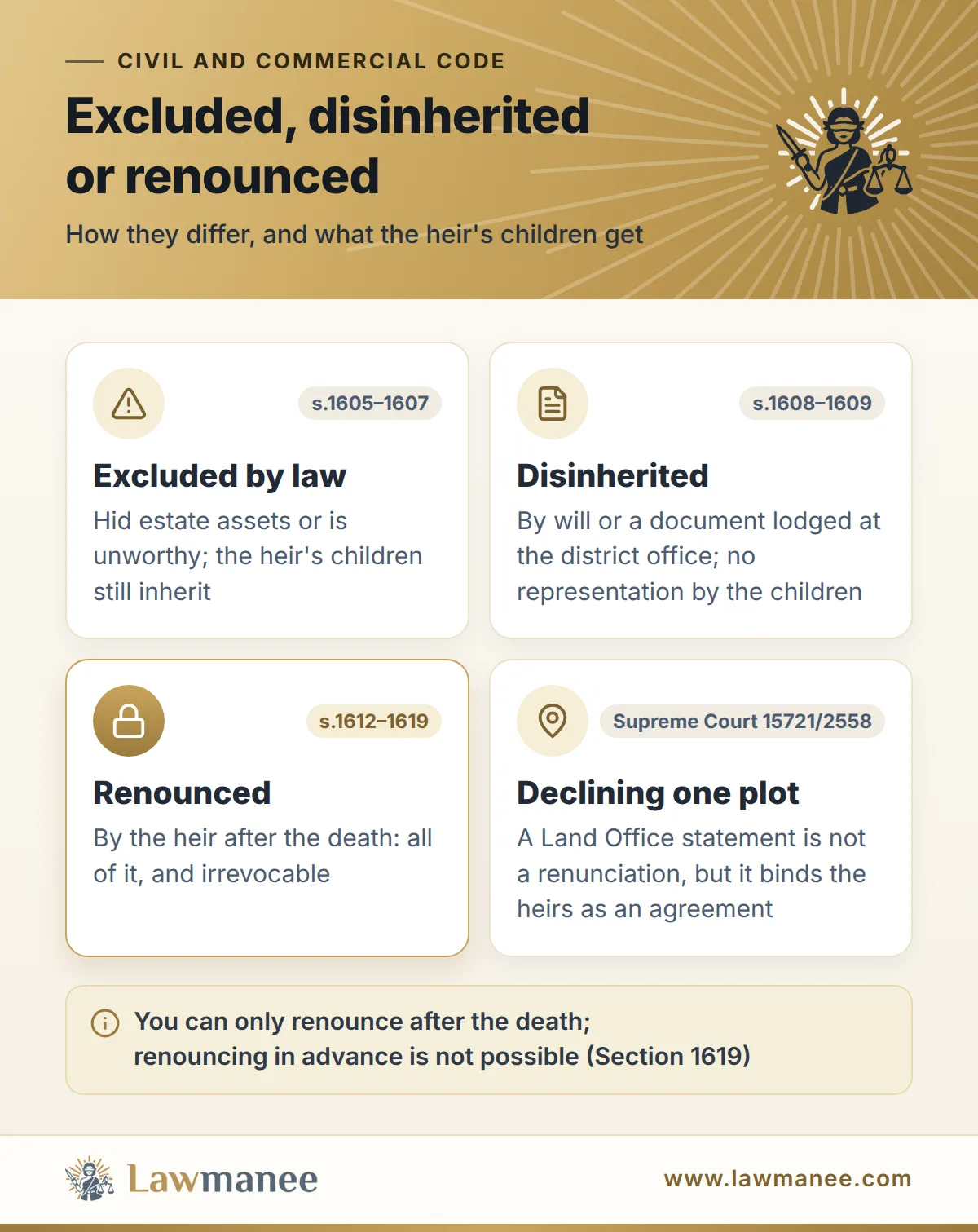
| Topic | Excluded | Disinherited | Renounced |
|---|---|---|---|
| Caused by | the heir's misconduct, as defined by law | the deceased's express wish | the heir's own choice |
| How | by operation of law | by will, or a document lodged with the competent official | after the death, by a document lodged with the competent official or a compromise agreement |
| The heir's children | still inherit | cannot inherit by representation | take the share, if the renouncer is a statutory heir |
| Sections | 1605–1607 | 1608–1609 | 1612–1619 |
Heirs excluded by law
Hiding estate assets (Section 1605). An heir who moves away or hides estate property fraudulently, or knowing that it harms the other heirs:
- loses the whole inheritance if the amount equals or exceeds their own share;
- loses only the property they moved or hid if the amount is less than their share.
This rule does not apply to a beneficiary who was left a specific item under a will, as far as that item is concerned.
Unworthy heirs (Section 1606). The following are excluded:
- A person finally convicted of intentionally causing, or attempting to cause, the unlawful death of the deceased or of a person entitled to inherit before them
- A person who accused the deceased of an offence punishable by death and was then finally convicted of false accusation or false testimony
- A person who knew the deceased had been intentionally killed but did not report it so that the offender could be punished, unless they were under 16, of unsound mind and unable to tell right from wrong, or the killer was their spouse, ascendant or direct descendant
- A person who used fraud or duress to make the deceased make, revoke or change a will, or to stop them from doing so
- A person who forged, destroyed or concealed a will
The deceased can lift an exclusion for unworthiness by a written pardon.
Exclusion is personal: the excluded heir's descendants inherit as if that heir had died, but the excluded heir has no right to manage or use the property they receive (Section 1607).
Disinheriting an heir: two ways
The deceased may disinherit any statutory heir, but only by an express declaration (Section 1608):
- In a will, which must follow one of the legal forms
- In a written document lodged with the competent official: the district chief (nai amphoe) or, in Bangkok, the district director
The disinherited heir must be clearly identified. And if a will disposes of the entire estate, every statutory heir who receives nothing under it is treated as disinherited.
A disinheritance can be withdrawn (Section 1609). If it was made by will, it can only be withdrawn by a will; if it was made by a document lodged with the official, it can be withdrawn by will or by another such document.
Unlike exclusion, disinheritance also shuts out the heir's children: they cannot inherit by representation, because Section 1639 allows representation only when an heir has died or been excluded before the deceased. If you want your grandchildren to receive something, leave it to them directly in your will.
Representation applies only to heirs in the classes of descendants, brothers and sisters, and uncles and aunts (Section 1639), and only among statutory heirs, never for beneficiaries under a will (Section 1642).
Renouncing an inheritance: how it works
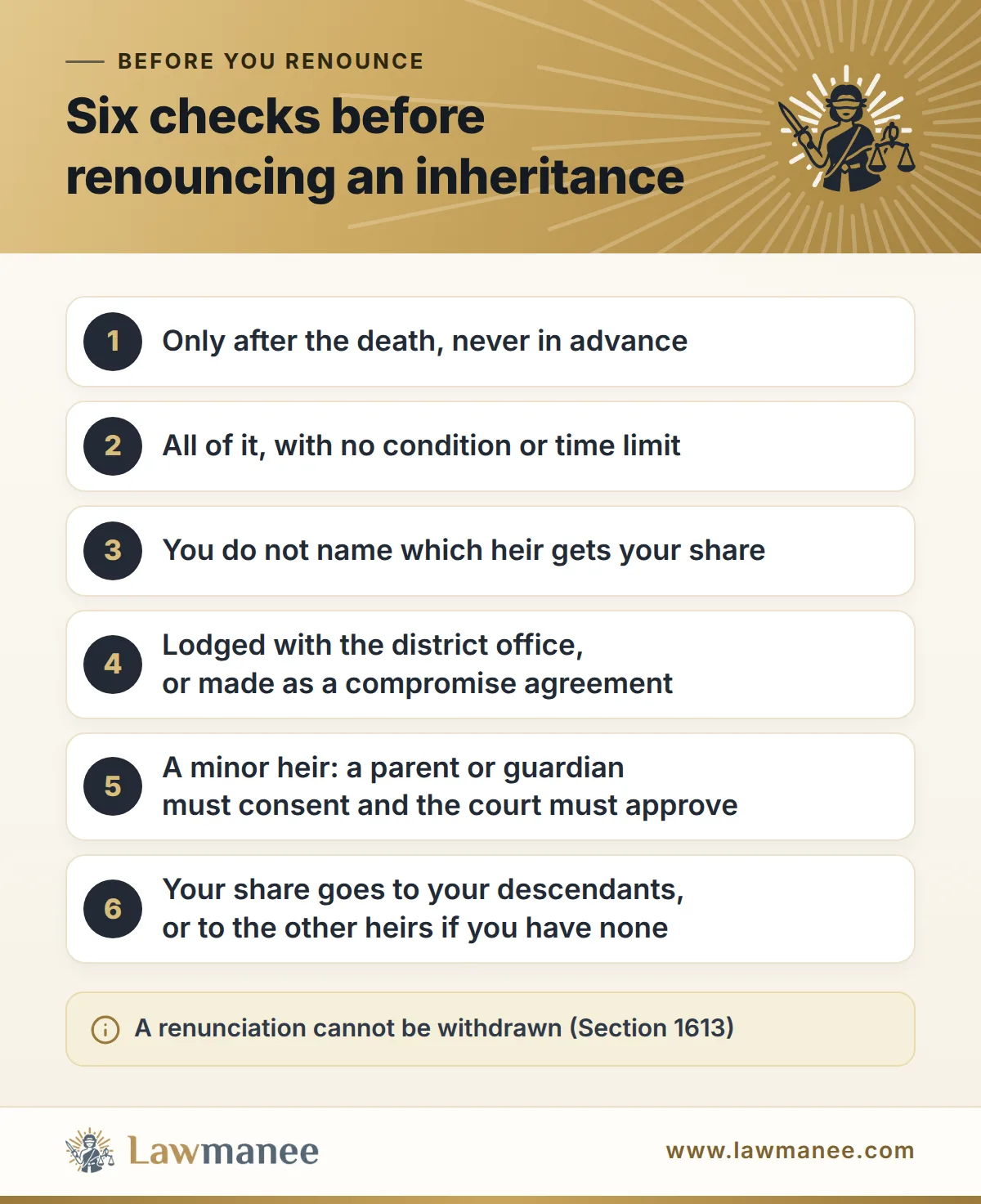
- Only after the death. Nobody can renounce or transfer a future right to inherit from a living person (Section 1619), so a waiver a child signs while the parents are alive is not a renunciation.
- In the legal form: an express declaration in a written document lodged with the competent official, or a compromise agreement (Section 1612). The Supreme Court has held that the competent official is the district chief or, in Bangkok, the district director, not a Land Office officer (Supreme Court Decisions 1250/2538 and 5895/2538, both from 1995).
- All or nothing: a renunciation cannot be partial, conditional or limited in time, and it cannot be withdrawn (Section 1613).
- Without choosing who benefits: renouncing means giving up your own share without naming which heir is to receive it (Supreme Court Decision 15721/2558, from 2015).
- Minors, persons of unsound mind and quasi-incompetent persons can only renounce with the consent of their parents, guardian or curator, as the case may be, and the approval of the court (Section 1611).
Who takes a renounced share
A renunciation takes effect retroactively from the moment of death (Section 1615). The renounced share then goes:
- to the renouncer's descendants, if the renouncer is a statutory heir: they receive the same share the renouncer would have received (Section 1615), and the renouncer has no right to manage or use that property (Section 1616);
- to the other heirs of the deceased, if the renouncer has no descendants who can inherit, or if the renouncer was a beneficiary under a will (Section 1618). A beneficiary who renounces, and their descendants, have no further right to the renounced property (Section 1617).
For example, a father dies without a will, leaving personal property worth 3 million baht. His wife and his own parents died before him, so his three children inherit a share worth 1 million baht each. The middle child lodges a renunciation at the district office.
- If the middle child has one child, that grandchild takes the 1-million-baht share; the other two children still receive 1 million baht each.
- If the middle child has no children, the share is divided between the other heirs: the other two children receive 1.5 million baht each.
If the siblings simply want to agree on who takes which asset, that is a division of the estate between heirs, not a renunciation.
Declining one plot at the Land Office is not a renunciation
When inherited land is transferred, heirs often sign a statement at the Land Office that they do not wish to receive a plot and agree that a sibling or the estate administrator takes it. Two things to know:
- A Land Office officer is not the competent official under Section 1612, so a document made there is not a renunciation document (Supreme Court Decision 1250/2538).
- In one case, heirs told the Land Office that they did not wish to receive inherited land and agreed that the administrator should take it alone. The Supreme Court held that this was not a renunciation but a compromise agreement between the heirs, binding on those who signed, so they could not claim their part of that land later (Supreme Court Decision 15721/2558).
Read such a statement carefully before you sign it. If you really mean to renounce the whole inheritance, follow the form in Section 1612.
If the deceased was a foreign national
The rules above are Thai law. Under the Act on Conflict of Laws B.E. 2481 (1938), succession to land and buildings in Thailand is governed by Thai law, because immovable property follows the law of the place where it is located (Section 37), while succession to movable property is governed by the law of the deceased's domicile at the time of death (Section 38). If the deceased was domiciled abroad, check that country's rules for their movable assets as well.
Talk to a lawyer about an estate
A renunciation cannot be undone, and a document in the wrong form does not work. Before you sign anything about an inheritance, have a lawyer check it. On Lawmanee you can describe your situation for free so that inheritance lawyers can reply in the platform chat, or search lawyers by case type, province and language.