
A mother with advanced Alzheimer's who no longer recognises her children, a father bedridden after a stroke, a spouse who cannot communicate after an accident: the family has to pay for care and manage money and property, sometimes even sell land to fund it. Yet children and spouses do not own that property and cannot sign for it. The legal route in Thailand is to ask the court to declare the person incompetent and appoint a guardian to act for them. This guide covers the conditions, who may apply, the documents, the steps and what a guardian still needs court permission for.
The rules apply to anyone whose case is heard by a Thai court, Thai or foreign. Court papers are filed in Thai, so a foreign spouse or child will usually need a lawyer or a translator to help.
Incompetent and quasi-incompetent persons
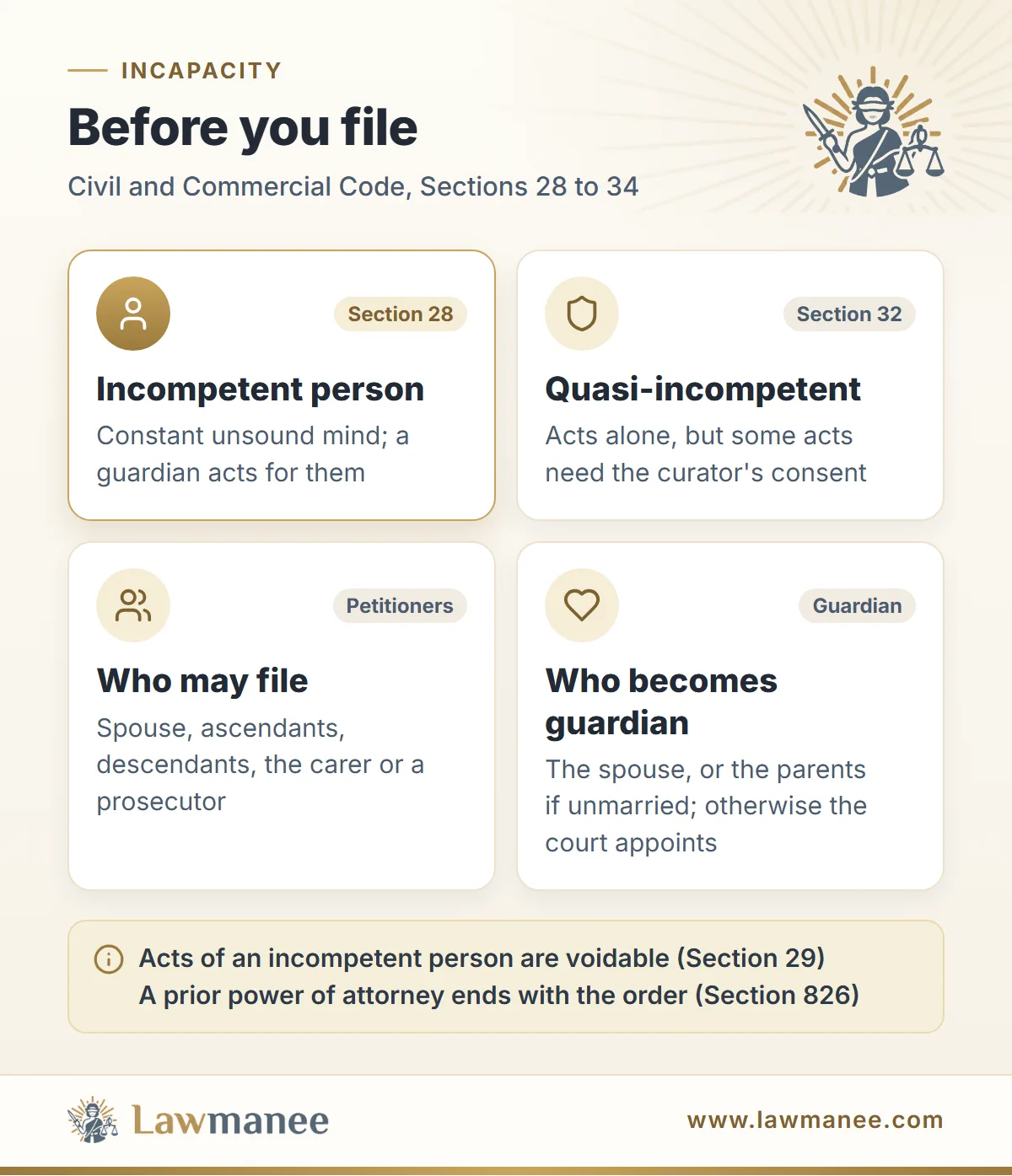
The Civil and Commercial Code has two levels:
| Incompetent person | Quasi-incompetent person | |
|---|---|---|
| Grounds | Unsound mind as a constant condition, not occasional, such as a bedridden patient or severe dementia (Section 28) | Physical disability, mental infirmity, habitual prodigality or addiction to drink or drugs, so that the person cannot manage their affairs or manages them to the detriment of their property (Section 32) |
| Court-appointed carer | Guardian | Curator |
| Own legal acts | Not valid on their own: acts are voidable (Section 29), and the guardian acts for them | Allowed, but some acts need the curator's consent first (Section 34) |
Acts that need a curator's consent include renting out real estate for more than 3 years, giving property away, suing or defending a case in court and settling a dispute.
This guide focuses on incompetency, the situation of a patient who can no longer make decisions.
Who may apply
Under Section 28, the petition may be filed by:
- The spouse
- Ascendants: parents, grandparents, great-grandparents
- Descendants: children, grandchildren, great-grandchildren
- The person's guardian or curator
- The person who is taking care of them
- The public prosecutor
A relative who is not on this list and does not care for the patient, such as a sibling living elsewhere, can contact the provincial Office of the Attorney General's legal aid and rights protection office and ask a public prosecutor to file the petition.
Who becomes the guardian
- The patient is married: the spouse is the guardian, but for an important reason the court may appoint someone else at the request of an interested person or the prosecutor (Section 1463)
- The patient is an adult without a spouse: the parents are the guardians unless the court orders otherwise (Section 1569/1)
- The common case: a widowed parent falls ill, and the child who cares for them asks the court in one petition to declare the parent incompetent and to appoint the child as guardian
Where to file and what to bring
File with the Juvenile and Family Court for the area where the matter arose or where the petitioner is domiciled. The court fee is 200 baht, plus service costs at the court's rates.
The Office of the Attorney General recommends preparing:
- For the patient: copies of the ID card, birth certificate, house registration, marriage or divorce certificate, name-change certificate and disability card (if any)
- For the petitioner: copies of the ID card and house registration, proof of the family relationship
- For the heirs: a consent letter signed by every heir, and death certificates of heirs who have died (if any)
- A doctor's report or medical certificate that clearly states the illness or condition
- Photographs of the patient
The petitioner signs and certifies every copy.
Steps at the court
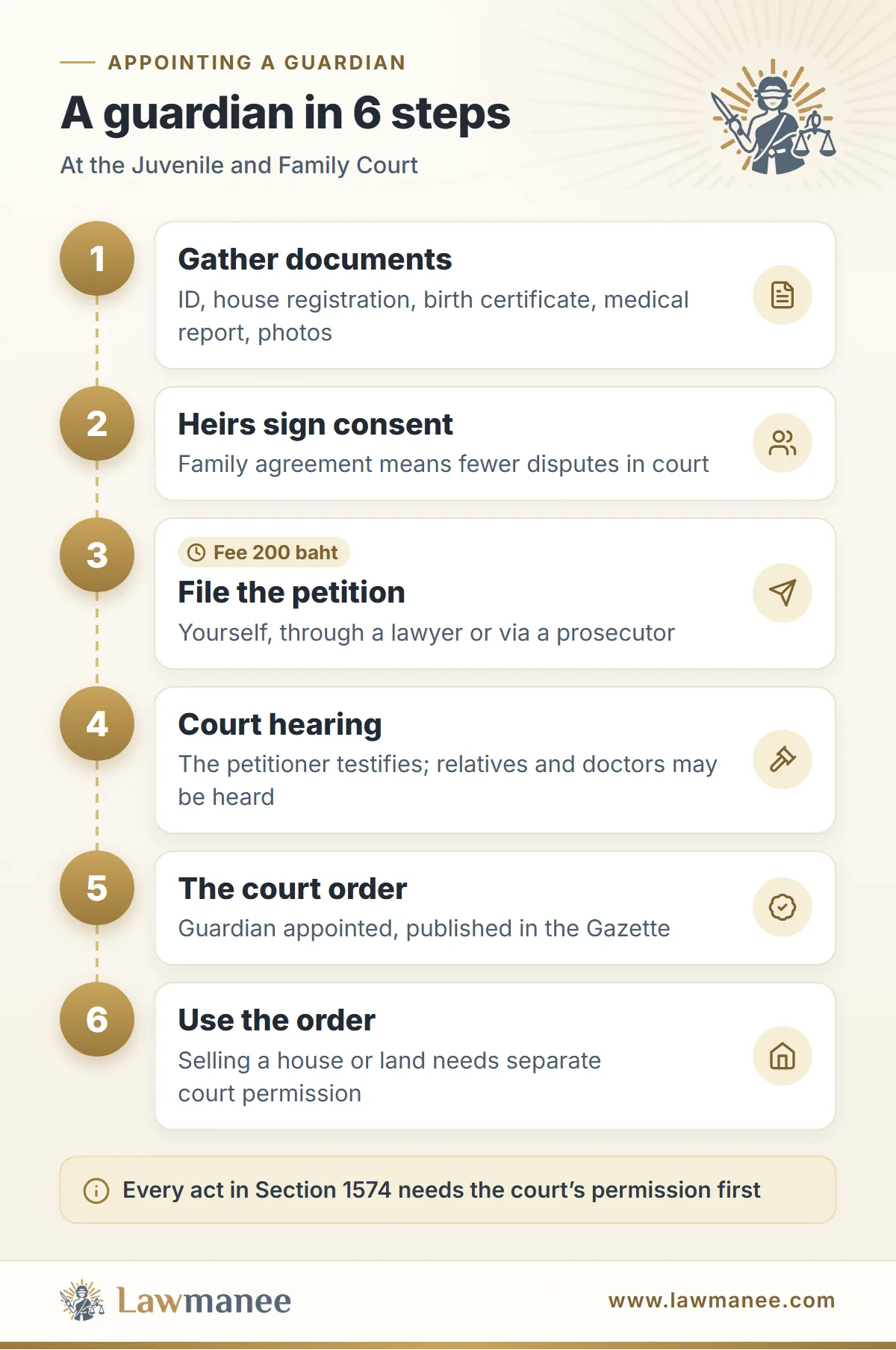
- Prepare documents and the medical certificate, with the treating doctor stating the illness and condition clearly
- Have the heirs sign their consent: agreement within the family reduces disputes in court
- File the petition with the Juvenile and Family Court, yourself, through a lawyer or through a public prosecutor
- Court hearing: the petitioner testifies, and the court may also hear witnesses, relatives and doctors
- Court order declaring the patient incompetent and appointing the guardian, published in the Government Gazette (Section 28)
- Use the order with hospitals, the Land Office and other agencies on the patient's behalf
What a guardian can do, and what needs court permission
The guardian acts for the incompetent person and must manage the property in that person's interest. The major acts listed in Section 1574, however, always need the court's permission first. The rule reaches a spouse-guardian through Section 1598/15 and other guardians through Sections 1598/18 and 1598/3. Examples:
- Selling or exchanging the patient's house or land
- Creating a servitude, right of habitation or usufruct over real estate
- Renting out real estate for more than 3 years
- Giving property away
- Settling a dispute or referring it to arbitration
Becoming a guardian therefore does not mean you can sell a parent's land straight away: you file a second petition for permission and explain how the sale benefits the patient.
Why an existing power of attorney is not enough
- Agency ends when the principal becomes incompetent (Section 826), so a power of attorney the parent signed earlier stops working after the court order, unless the contract or the nature of the matter says otherwise.
- Signatures given without awareness: an act by a person of unsound mind who has not yet been declared incompetent is voidable if done while of unsound mind and the other party knew it (Section 30), so documents signed in that state can be challenged later.
If the patient recovers, the patient or anyone listed in Section 28 may ask the court to revoke the order, and the revocation is also published in the Government Gazette (Section 31).
Example
A 78-year-old mother has advanced Alzheimer's and is bedridden. Her husband has died and she has three children. The eldest cares for her and wants to sell one of her plots of land to pay for long-term care.
- The eldest child may file as a descendant and carer; the two siblings sign consent letters.
- The petition goes to the Juvenile and Family Court with the 200-baht fee and a medical certificate stating the condition clearly.
- After the court declares the mother incompetent and appoints the eldest child as guardian, selling the land still needs a second petition for permission under Section 1574.
- With permission granted, the court orders are taken to the Land Office for the transfer.
Talk to a lawyer about guardianship
A clearly written petition, complete medical evidence and agreement within the family make the hearing smoother. If relatives disagree about who should be guardian, or you need permission to sell property, it pays to have a lawyer from the start. On Lawmanee you can post your situation for free and interested lawyers reply in the platform chat, or find a lawyer for family matters by province and language right away.