
When a baby is born in Thailand, the first legal step is to register the birth. Registration gives your child a Thai birth certificate (sut-ti-bat) and, for a Thai child, a place in the house registration — the documents behind an ID card, school enrolment and much more. This guide summarises the Civil Registration Act B.E. 2534 (1991) and the Nationality Act B.E. 2508 (1965), with notes for foreign parents.
The deadline and who reports
Section 18 of the Civil Registration Act requires a birth to be reported within 15 days of the birth:
- Born in a house: the householder, the father or the mother reports to the registrar of the area where the child was born.
- Born outside a house: the father or the mother reports to the registrar where the child was born or where a report can be made. If there is a necessary reason they cannot make the 15 days, they may report later, but no later than 30 days after the birth.
The report must include the child's name, so choose it before you go. The registrar is the district registration office (amphoe), a district office (khet) in Bangkok, or a local registration office such as a municipality.
If your family's house registration is in a different area from the birthplace, the law lets you report to a registrar elsewhere (last paragraph of Section 18), for example where the parents are registered. The Department of Provincial Administration lists a fee of 20 baht for registering a birth in another area.
Documents
- The hospital's birth certificate (Tor Ror 1/1) — whoever delivers the baby must issue it (Section 23).
- The householder's copy of the house registration where the child will be listed.
- The ID card of the person reporting, and the parents' ID cards if available.
A foreign parent should bring their passport. Documents in a foreign language need a certified Thai translation.
The steps
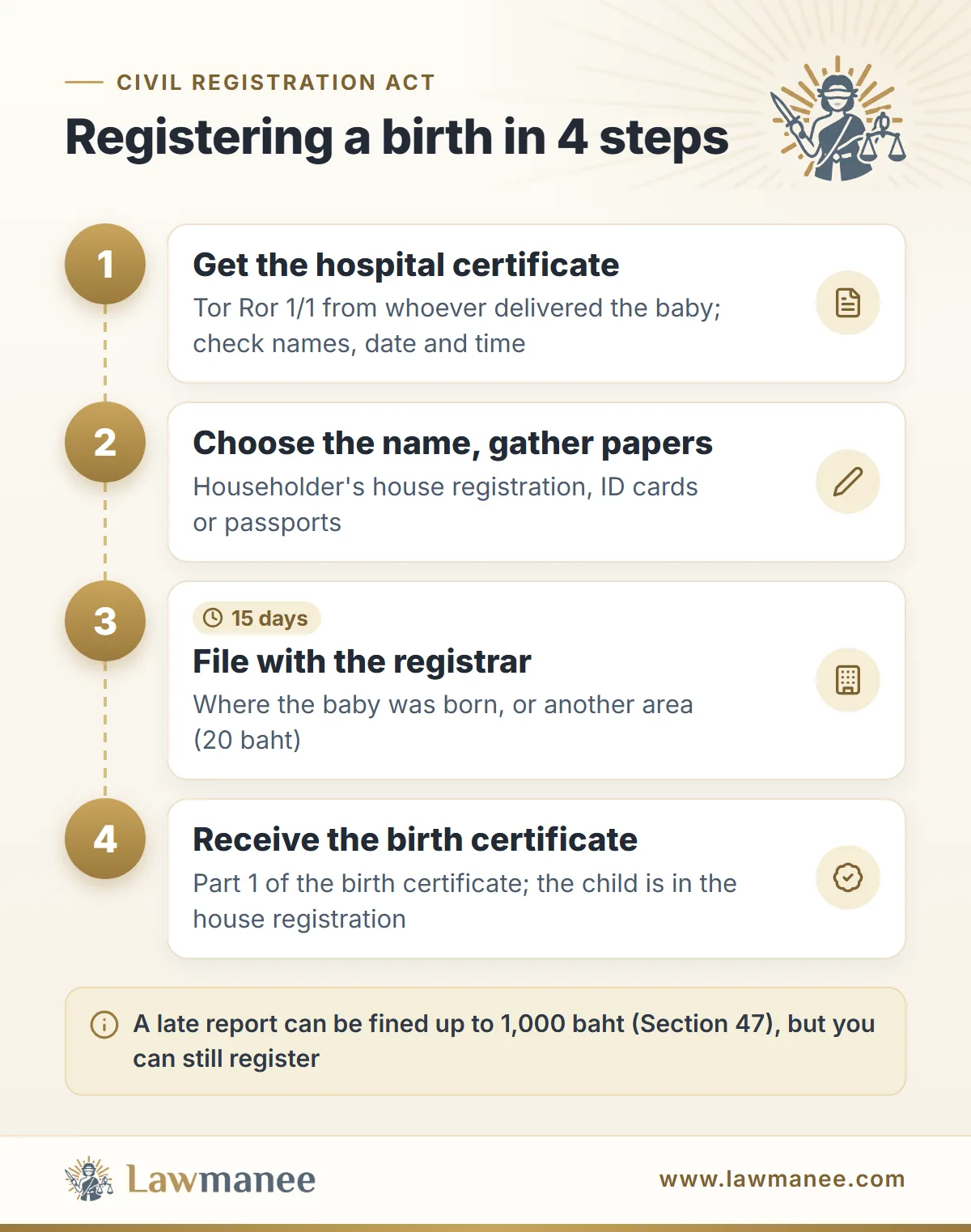
- Get the birth certificate from the hospital and check the parents' names and the date and time of birth.
- Choose the name and gather the documents: the house registration and ID cards or passports.
- File with the registrar within 15 days. The registrar checks the papers, records the birth on the Thai birth certificate and adds the child to the house registration.
- Collect the birth certificate and house registration. You receive part 1 of the birth certificate (Section 20). Keep the original safe: you will need it many times.
Registering late
Not reporting a birth on time is punishable by a fine of up to 1,000 baht (Section 47), but the birth can still be registered — and the longer you wait, the harder it is to prove who the child is.
For a late registration the Department of Provincial Administration asks for:
- the householder's copy of the house registration;
- the ID card of the person reporting, and the parents' if available;
- witnesses with their ID cards;
- one photo of the child if the child is over 7;
- the hospital birth certificate, if you have it.
The registrar settles the fine, questions the reporter and the parents about the delay, and sends the case to the district chief for approval before issuing the birth certificate. For a late registration in another area you need the hospital birth certificate and at least two witnesses who can confirm the parent–child relationship; without the certificate, a DNA result from a reliable institution can be used instead.
A Thai national who was never registered can apply as an adult (Section 19/3). For a minor, a parent or guardian applies, and a parent must first pay the fine.
Is my child Thai?
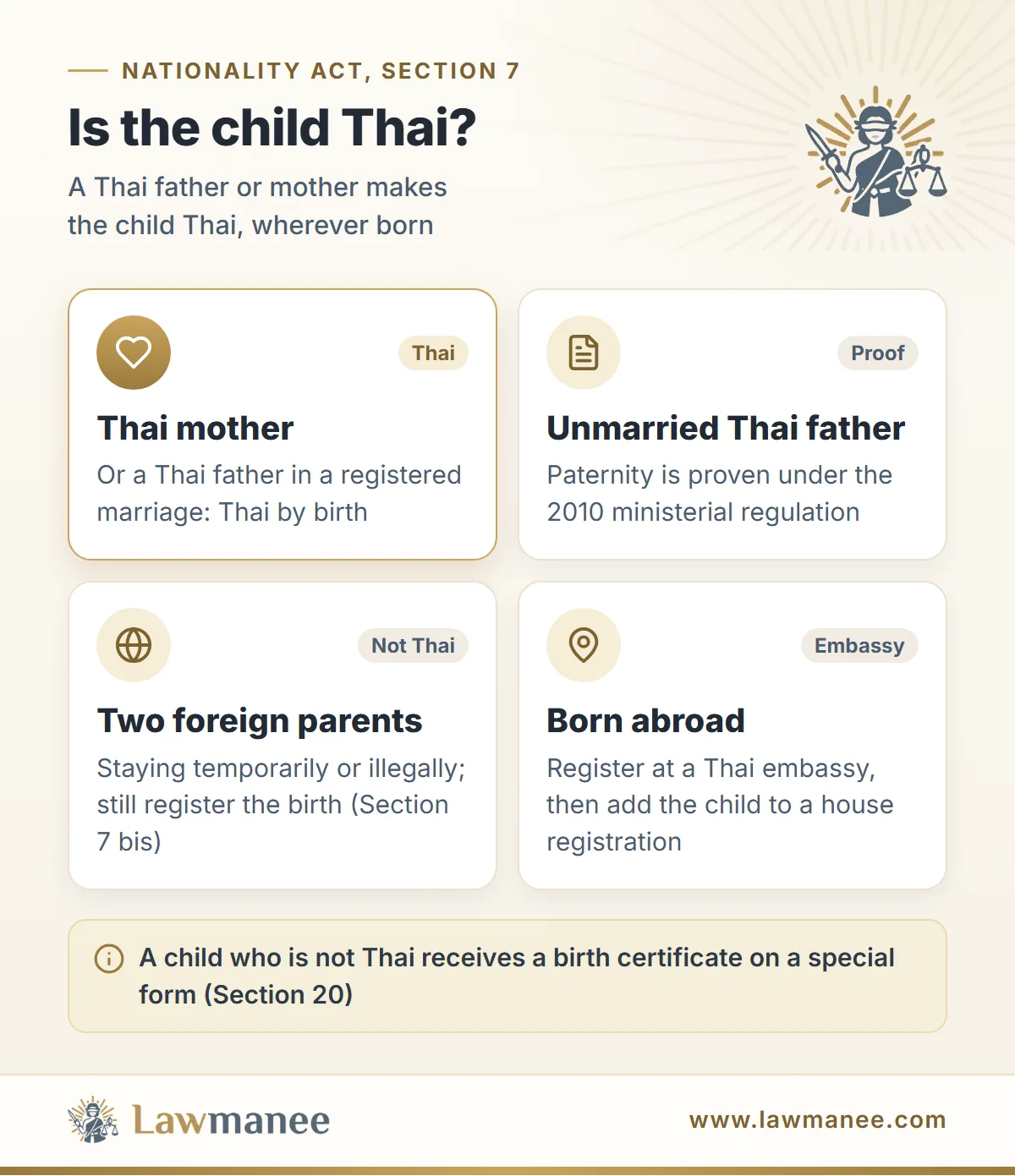
Under Section 7(1) of the Nationality Act, a person whose father or mother is a Thai national is Thai by birth, whether born in Thailand or abroad. A child of a Thai–foreign couple is therefore Thai from birth, even if the child also takes the other parent's nationality.
| Situation | Result |
|---|---|
| Mother is Thai | Thai by birth |
| Father is Thai and married to the mother (registered marriage) | Thai by birth |
| Father is Thai, not married to the foreign mother | The father's paternity must be proven through an application under the 2010 (B.E. 2553) ministerial regulation |
| Born in Thailand to two foreign parents staying temporarily, under a special waiver, or without permission | Not Thai (Section 7 bis) |
A child who is not Thai must still be registered. The registrar issues a birth certificate on the form set by the Director-General (Section 20, second paragraph), which the parents then take to their own embassy for the child's nationality and passport.
Born abroad to a Thai parent
Register the birth at the Royal Thai Embassy or Consulate-General in that country, using the local birth certificate, your marriage certificate and the parents' documents. Each embassy publishes its own checklist, so use the current one for the embassy you go to. With the Thai birth certificate you can then add the child to a house registration at a registration office in Thailand.
Example
Nid, a Thai national, is married to Tom, a British citizen. Their baby is born in a hospital in Chiang Mai on 1 March. They must register the birth by 15 March, either at the registration office of the area where the baby was born or at the office where Nid is in the house registration (20 baht for another area). They bring the hospital birth certificate, the householder's copy of the house registration, Nid's ID card and Tom's passport. The baby is Thai by birth under Section 7(1) because the mother is Thai, and is listed in Nid's house registration.
Talk to a lawyer
Some cases are harder than they look: a registration years late without a hospital certificate, an unmarried Thai father who wants to be recorded as the parent, or a mistake on the birth certificate. On Lawmanee you can post your case for free and interested lawyers reply in the platform chat, or find a lawyer in family law by province and by the language you speak.