
Buying a house or land in Thailand rarely happens in one day. The buyer and seller agree a price, sign an agreement to sell, pay part of the money, and then go to the Land Office for the transfer later. The time in between is where most disputes start: the seller changes their mind, or the buyer cannot raise the rest of the price. This guide explains the rules of the Thai Civil and Commercial Code in plain terms.
A sale vs an agreement to sell
- A completed sale transfers ownership. A sale of immovable property such as land or a house must be made in writing and registered with the competent official, otherwise it is void (Section 456, first paragraph). In practice this is the registration at the Land Office.
- An agreement to sell is a promise to transfer later. It does not need to be registered, but to enforce it in court you need one of these: written evidence signed by the party to be held liable, a deposit, or part performance (Section 456, second paragraph).
An oral agreement backed by a deposit can be enforced, but a complete written contract avoids many arguments later.
What is a deposit?
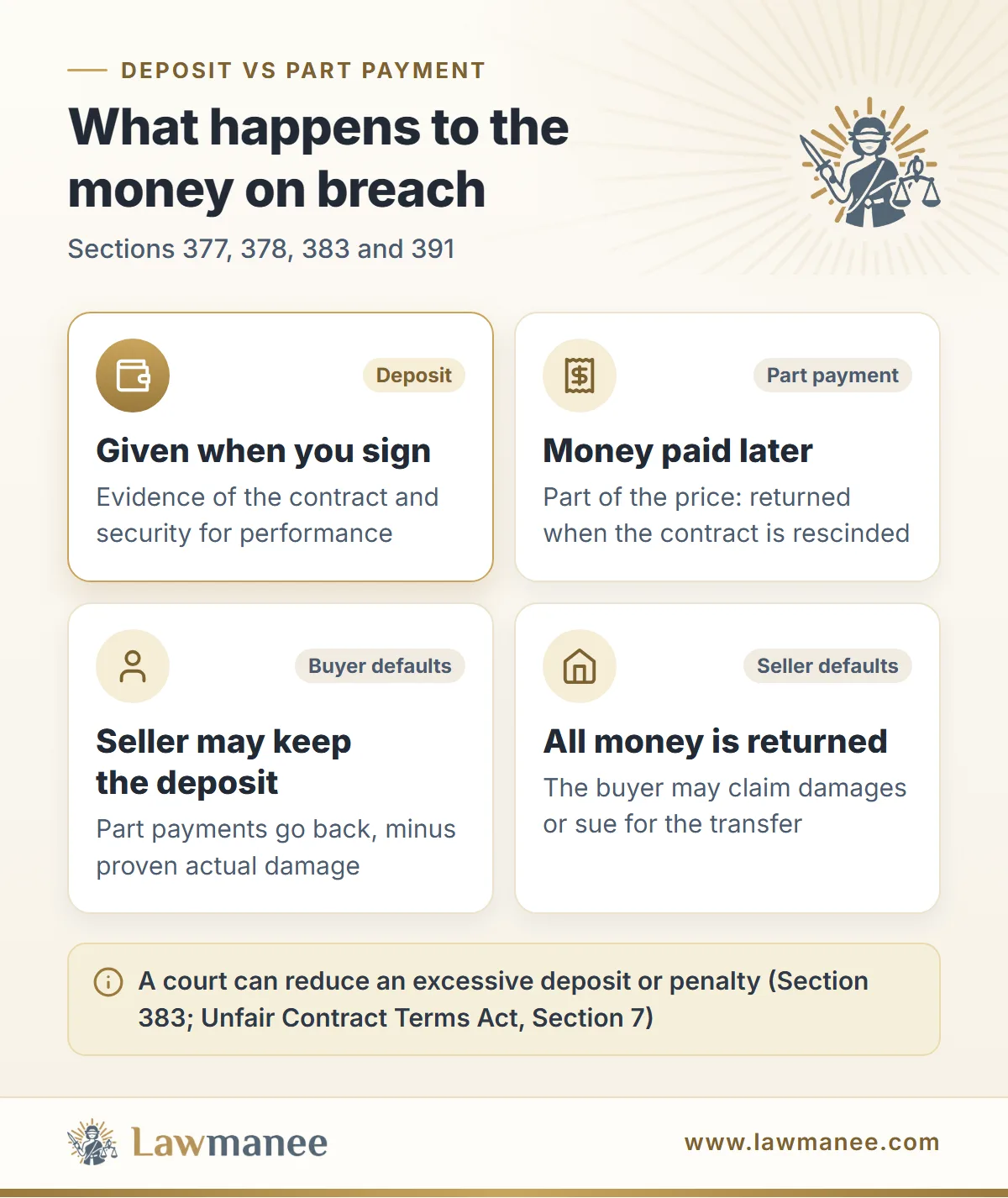
A deposit is something given when the contract is made. It is evidence that the contract exists and security that it will be performed (Section 377). Unless agreed otherwise, Section 378 gives three outcomes:
- Everything goes to plan: the deposit is returned or counted towards the price on transfer day.
- The party who paid it (usually the buyer) defaults: the seller may keep the deposit.
- The party who received it (usually the seller) defaults: the deposit must be returned to the buyer.
Later payments are not a deposit
Money the buyer pays after the contract date, such as a down payment in instalments, is part payment of the price, not a deposit, even if the contract calls it a "deposit". The court looks at when and why the money was paid.
When the contract is rescinded, both parties must be restored to their original position (Section 391), so part payments must be returned even if the buyer is the one at fault. The seller can still claim the actual damage the buyer caused.
If the contract says "on breach, all money paid is forfeited", that clause works as a contractual penalty. If it is excessive, the court can reduce it to a reasonable amount (Section 383).
Can a court reduce an excessive deposit?
Yes. Section 7 of the Unfair Contract Terms Act B.E. 2540 (1997) lets the court reduce an excessive deposit so that only the actual damage is forfeited.
The court does not reduce it in every case. It looks at all the circumstances: who broke the agreement, how many times, and how much the other side really lost. Do not pay a larger deposit than you need to.
When the other side will not transfer or will not pay
The seller refuses to transfer. The buyer can:
- Sue to make the seller register the transfer. If the seller still does not go, the court can order that the judgment stands in place of the seller's declaration of intent (Section 213), and the buyer registers the transfer with the judgment.
- Or rescind the agreement and claim back the deposit and everything paid, plus damages.
The buyer does not pay or does not turn up for the transfer. The seller may keep the deposit and claim proven damages.
Unless the transfer date was made an essential term, the party who wants to rescind should first give written notice with a reasonable period to perform, and may rescind only if the other side still fails within that period (Section 387). Send it by registered post with acknowledgement of receipt and keep the proof.
Example
Mr A agrees to buy land with a house from Ms B for 3,000,000 baht. He pays a 100,000-baht deposit when they sign, another 200,000 baht a month later as the agreement requires, and the transfer is set for three months later.
| Situation | Deposit of 100,000 baht | Later payment of 200,000 baht |
|---|---|---|
| The buyer defaults | The seller may keep it | Returned on rescission (minus proven actual damage, or a penalty the court finds reasonable) |
| The seller defaults | Returned | Returned, and the buyer may claim damages or sue for the transfer |
Who pays the costs on transfer day?
On transfer day the Land Office collects a transfer fee, withholding income tax, and either specific business tax or stamp duty, calculated on the official appraised value or the sale price as the law sets out. The parties can agree who pays which item. Without an agreement, the fees for making the sale contract are shared equally by buyer and seller (Section 457). Write each item into the contract and ask the Land Office for the amounts before the appointment.
What the agreement should contain
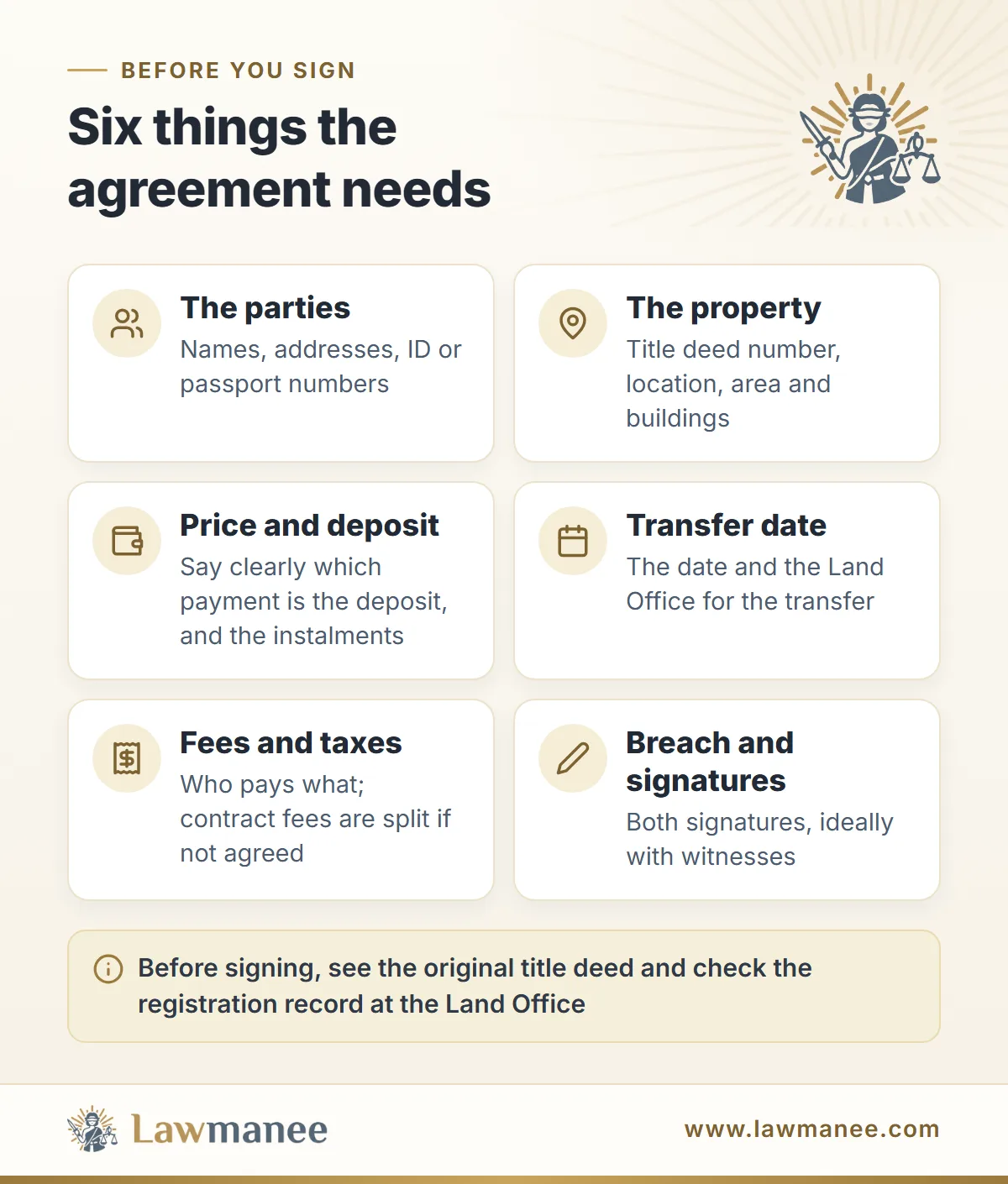
- Names, addresses and ID or passport numbers of buyer and seller
- Title deed number, location and area of the land, and the house or buildings included
- Price, the deposit paid on signing and the remaining instalments, stating clearly which payment is the deposit
- Transfer date and the Land Office where it will take place
- Who pays each fee and tax
- What happens on breach, and both parties' signatures, ideally with witnesses
Before you sign, ask to see the original title deed, check that the owner's name matches the seller, and ask the Land Office to check the registration record for registered encumbrances such as a servitude or a lease.
For foreigners
As a rule, foreigners cannot own land in Thailand except where the law specifically allows it, so speak to a lawyer before paying any money. Condominium units follow their own foreign-quota rules.
Talk to a lawyer about a property agreement
Having a lawyer review the draft before you sign usually costs far less than a lawsuit later. On Lawmanee you can post your case for free and interested lawyers reply in the platform chat, or find a property lawyer by province and language, including lawyers who speak English or Chinese.