
When parents die in an accident or from illness, their children who are still minors usually go to live with grandparents, aunts and uncles, or an adult brother or sister. Taking a child in, however, does not make that relative the child's legal representative. To sign documents for the child, manage money or property the child has inherited, or deal with authorities on the child's behalf, the family needs a court-appointed guardian. This guide summarises the guardianship chapter of the Thai Civil and Commercial Code (Sections 1585 to 1598/18): when a guardian is needed, who may apply, who cannot be a guardian and what a guardian must do after the appointment.
If the child or the proposed guardian is a foreign national, other rules may also apply, for example on which country's law governs or on documents issued abroad, so have a lawyer check before filing. Court papers are filed in Thai.
When a child needs a guardian
A minor who has no parents, or whose parents have been deprived of parental power, may have a guardian for as long as they remain a minor (Section 1585). The common situations are:
- Both parents have died: nobody holds parental power any more, so the relative caring for the child asks the court to appoint a guardian.
- The parents have lost parental power: the court may withdraw parental power if the parent has been declared incompetent or quasi-incompetent, exercises parental power over the child improperly or behaves badly, and may withdraw only the power to manage property, for example when the parent manages the child's property so wrongly that it may be endangered (Section 1582). The court can then appoint a guardian just for the part withdrawn, or only to manage the property (Section 1585).
- Only one parent has died: parental power stays with the surviving parent (Section 1566 (1)), so no guardian is needed. A father who never married the mother and has not legitimated the child, however, is not yet the child's legal father (Sections 1546 and 1547); in that case, talk to a lawyer first about which route to take.
Who may apply
A guardian is appointed only by court order, on the petition of one of three groups (Section 1586):
- A relative of the child, such as a grandparent, an aunt or uncle, or an adult brother or sister
- The public prosecutor: the family can contact the provincial legal aid and rights protection office of the Office of the Attorney General and ask a prosecutor to file
- The person named as guardian in the will of the parent who died last
If a will names a guardian, the court must appoint that person unless the will has no effect or the person is barred from being a guardian (Section 1586). Parents who want to choose who will look after their children can therefore name a guardian in their will.
There is only one guardian at a time, unless a will provides for several or someone shows good reason; the court may then appoint several guardians and have them act jointly or give each specific powers (Section 1590).
Who cannot be a guardian
Any adult may be appointed, except the persons barred by Section 1587, for example:
- a person the court has declared incompetent or quasi-incompetent
- a person unsuitable to look after the child or the child's property
- a person who has, or has had, a court case against the child, the child's ascendants, or the child's full or half brothers and sisters
- a person whom the deceased father or mother excluded by name in writing
If it later turns out that the appointed guardian was already barred when appointed, the court revokes the appointment (Section 1588).
Steps at the court
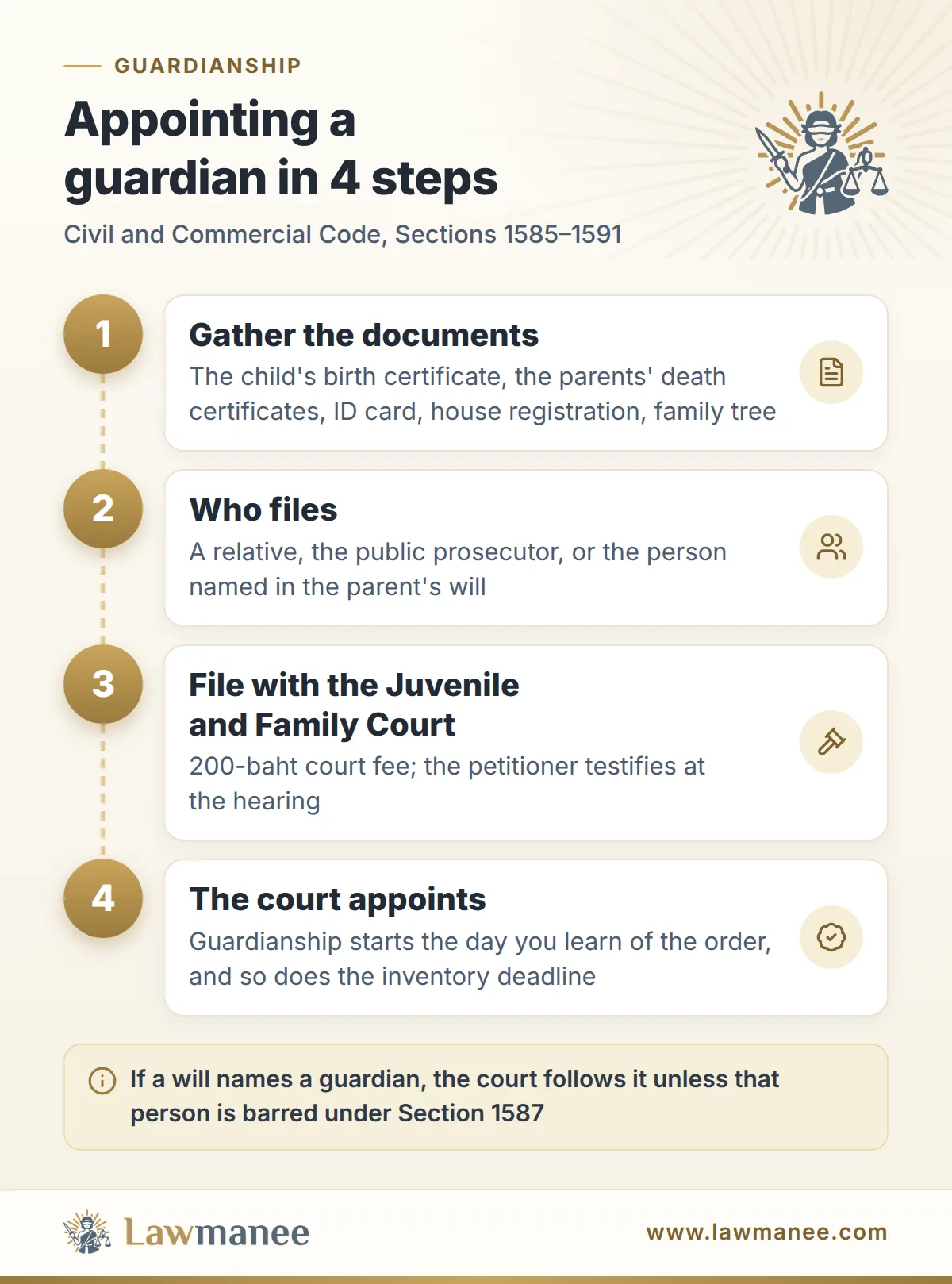
- Gather the documents: the child's birth certificate, the parents' death certificates, the ID card and house registration, any name-change certificate, photographs showing your relationship with the child, and a family tree.
- File the petition with the Juvenile and Family Court for the area where the matter arose or where the petitioner is domiciled (Civil Procedure Code Section 4 (2)), through a lawyer or a public prosecutor. The court fee is 200 baht, plus other costs such as publication and service fees set by the court.
- Hearing: the petitioner testifies, and the court considers whether the petitioner is suitable to care for the child and the child's property.
- The court appoints the guardian: guardianship begins on the day the guardian learns of the court order (Section 1591), and the deadline for the inventory runs from that day.
A guardian's duties after the appointment
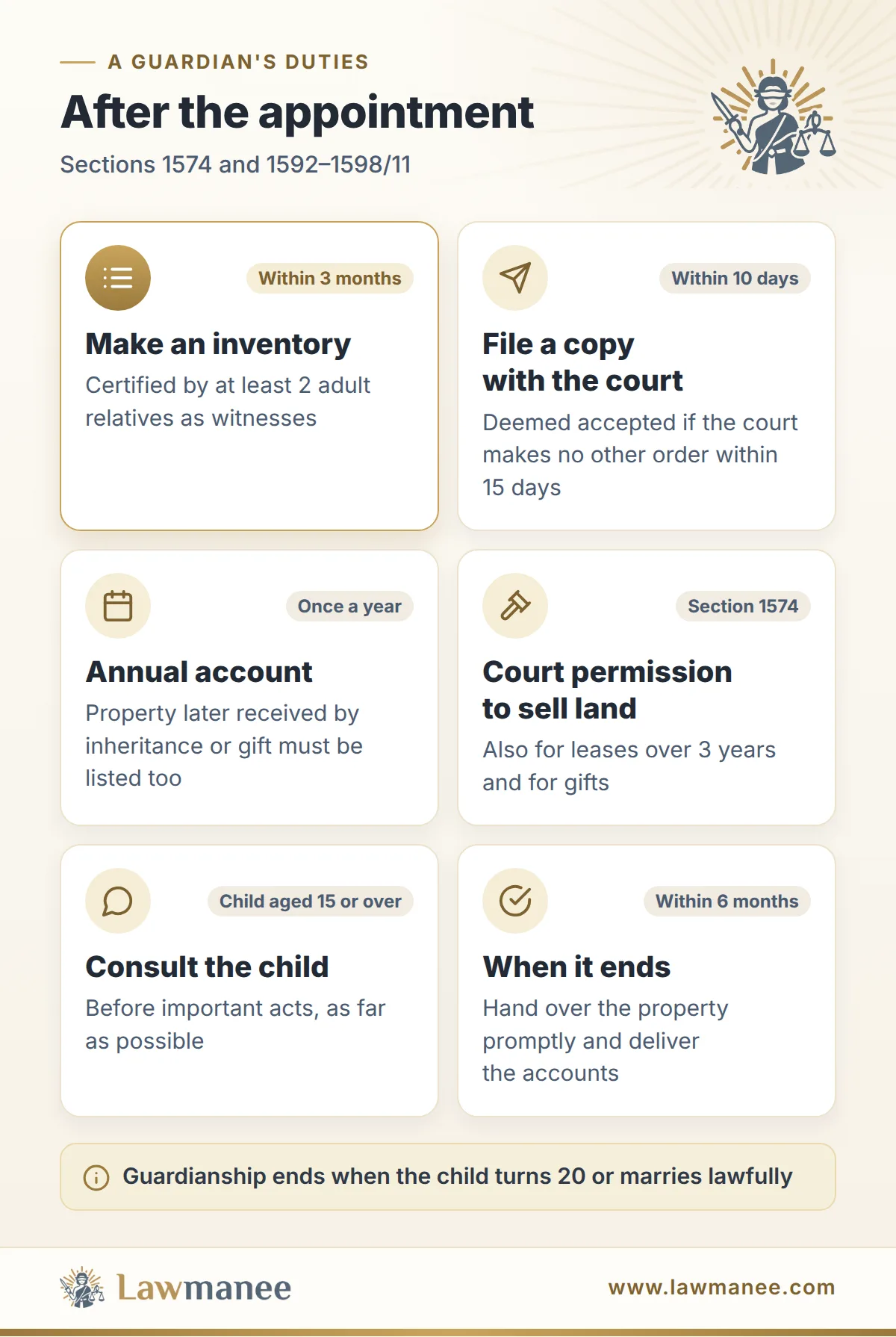
- Make an inventory of the child's property within 3 months of learning of the order; if you need more time, ask the court before the deadline. At least two adult relatives of the child must certify the inventory as witnesses, or other people if no relatives can be found (Section 1592).
- File a certified copy with the court within 10 days of completing it. If the court makes no other order within 15 days, the inventory is deemed accepted (Section 1593). Until then, the guardian may only do what is urgent and necessary (Section 1595).
- File an account of the property with the court once a year, counted from the day you became guardian; after the first year the court may allow longer intervals (Section 1598/1). Valuable property the child later receives by inheritance or gift must be inventoried the same way (Section 1598).
- Care for and educate the child: a guardian has the same rights and duties as a parent to support and properly educate the child and to decide where the child lives (Section 1598/2 with Sections 1564 and 1567), and is the child's legal representative (Section 1598/3).
- Use the child's money for the child: the child's income may be used, as reasonable, for the child's support and education; any surplus may only be invested in the ways the law allows, such as Thai government bonds or other investments the court specially permits (Section 1598/4).
- Consult a child aged 15 or over: if the child is mature enough, consult them before important acts as far as possible, but their consent does not release the guardian from liability (Section 1598/5).
A guardian is not entitled to remuneration unless the will provides for it or the court grants it on request (Section 1598/14).
Acts that need court permission
Being a guardian does not mean you can sell the child's property yourself. The major acts listed in Section 1574 need the court's permission (Section 1598/3), for example:
- selling or exchanging the child's house or land
- creating a servitude, right of habitation, superficies or usufruct over the child's real estate
- renting out real estate for more than 3 years
- giving the child's property away
- settling a dispute or referring it to arbitration
Removal of a guardian, and when guardianship ends
- Removal: the court removes a guardian who neglects the duties, is grossly negligent, abuses the position, behaves in a way unfit for the role, is so lacking in ability that the child's interests are likely to suffer, or falls under Section 1587 (3), (4) or (5) (Section 1598/8). The petition may come from a child aged 15 or over, a relative of the child or the public prosecutor (Section 1598/9). While it is pending, the court may appoint a temporary manager of the child's property (Section 1598/10). A guardian who fails to make or file the inventory properly may also be removed (Section 1594).
- Guardianship ends when the child dies or comes of age (Section 1598/6), that is, at 20 (Section 19) or on a lawful marriage (Section 20).
- A guardian's role ends, for example, when the guardian dies, resigns with the court's permission or is removed by the court (Section 1598/7).
- Handover: the guardian, or the guardian's heirs, must promptly hand the property over to the child, the child's heirs or the new guardian, and deliver an account of the management within 6 months (Section 1598/11).
Example
Fon is 12. Her parents died together in an accident without making a will, and she inherited a house and some money. Her mother's younger sister has taken her in.
- As Fon's relative, her aunt may petition the Juvenile and Family Court with Fon's birth certificate, the parents' death certificates and a family tree, and pays the 200-baht court fee.
- Once appointed, the aunt must complete an inventory of Fon's property within 3 months of learning of the order, certified by two adult relatives, and file a copy with the court within 10 days.
- After that she files an account with the court every year. If she wants to sell the house to pay for Fon's education, she must first ask the court for permission.
- When Fon turns 20, the guardianship ends: the aunt promptly hands the property over to Fon and delivers an account of her management within 6 months.
Talk to a lawyer about guardianship
A petition with complete documents and relatives who agree makes the hearing smoother. If several relatives want to be guardian, the child has an estate to manage, or you need permission to sell property, it pays to have a lawyer from the start. On Lawmanee you can post your situation for free and interested lawyers reply in the platform chat, or find a lawyer for family matters by province and language right away.