

Punched in a quarrel, attacked in a road-rage incident or hurt by a stranger badly enough to need hospital care: victims are often unsure how serious the case is, whether a private settlement ends it, and who pays for treatment. This guide covers what a victim of assault in Thailand needs to know, from how the Criminal Code grades the offence, collecting evidence and reporting it, to claiming damages from the attacker and the compensation the state pays to crime victims.
If you are a foreigner, the steps are the same. Police statements and court papers are in Thai, so bring an interpreter; the Tourist Police hotline 1155 runs 24 hours and can help in English and other languages. Violence within the family is also governed by a special law and is not covered here.
Three levels of assault
The Criminal Code grades assault by what it does to the victim:
| Offence | Result | Penalty |
|---|---|---|
| Use of force (Section 391) | No harm to body or mind | Up to 1 month in prison, a fine of up to 10,000 baht, or both |
| Assault (Section 295) | Harm to body or mind | Up to 2 years in prison, a fine of up to 40,000 baht, or both |
| Grievous assault (Section 297) | Grievous harm | 6 months to 10 years in prison and a fine of 10,000 to 200,000 baht |
Grievous harm under Section 297 means blindness, deafness, loss of the tongue or of the sense of smell; loss of reproductive organs or capacity; loss of an arm, leg, hand, foot, finger or any other organ; permanent disfigurement of the face; miscarriage; permanent mental impairment; disability or chronic illness that may last for life; and disability or illness with suffering for more than 20 days, or inability to carry on one's ordinary activities for more than 20 days.
That last item makes the treatment period in the medical certificate important: if the injury keeps you from your ordinary activities for more than 20 days, the case falls under Section 297 rather than Section 295.
Does a settlement end the case?
- Sections 295 and 297 cannot be settled privately. Both are offences against the state: even if the attacker pays and you no longer wish to pursue the matter, or you withdraw your complaint, the criminal case does not end, and the police must carry on with it.
- Section 391 is a petty offence. If the inquiry official considers that the suspect should not be imprisoned, the official may settle the case with a fine when both the suspect and the victim agree, and, if both agree, may also fix compensation the suspect pays to the victim. Once the fine is paid within the set time, which is no longer than 15 days, the case is closed for good (Criminal Procedure Code Sections 37 (2) and 38).
What to do right after an assault
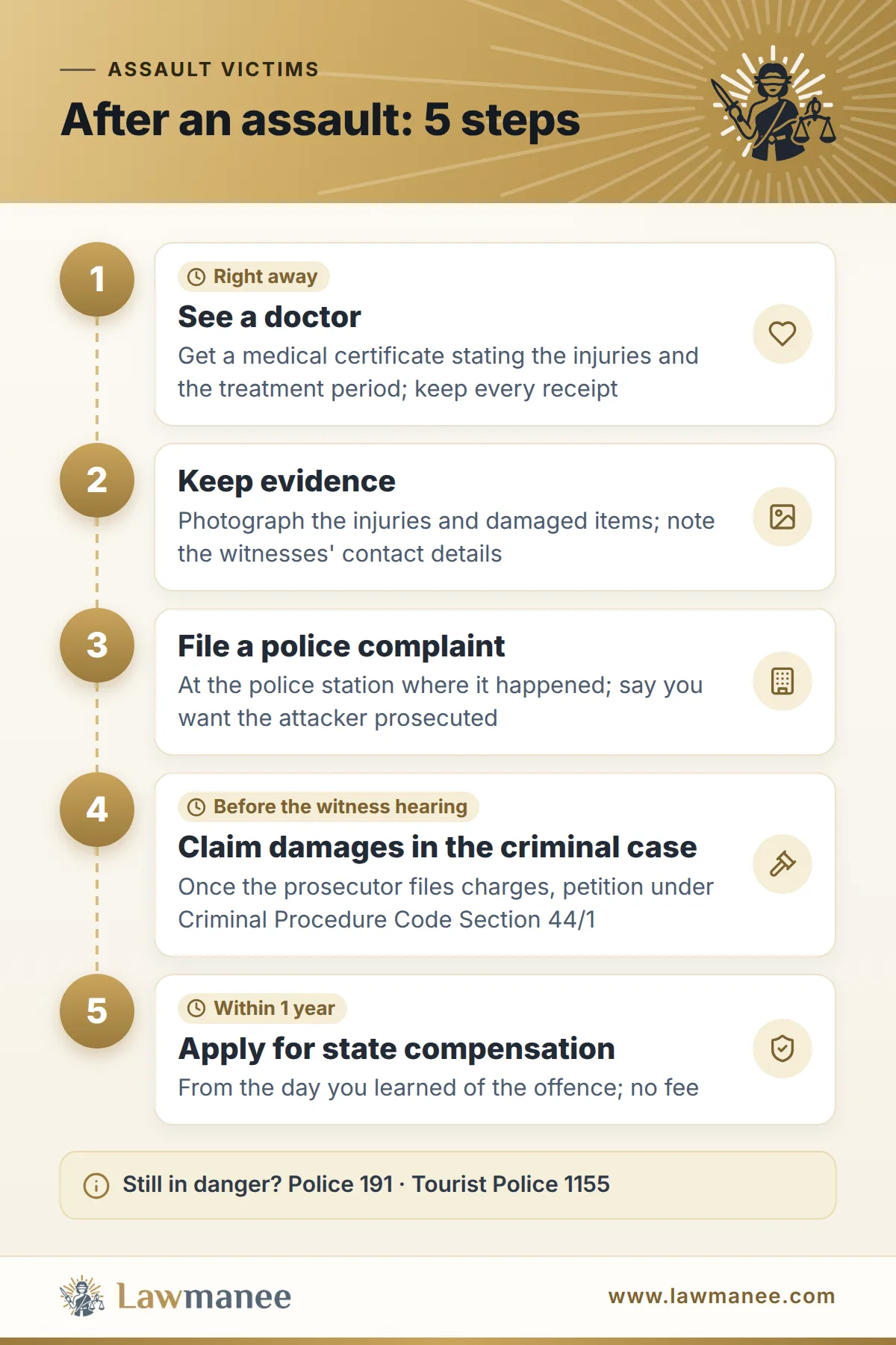
- See a doctor. Ask for a medical certificate that describes the injuries and the treatment period, and keep X-ray or other test results and every receipt.
- Keep evidence. Photograph the injuries, bloodstains, clothing and damaged belongings, and note the names and contact details of witnesses.
- File a complaint with the inquiry official (Criminal Procedure Code Section 123) at the police station for the area where it happened, as soon as possible, and say clearly that you want the attacker prosecuted.
- Claim damages in the criminal case. When the public prosecutor takes the case to court, file a petition under Section 44/1 before the court starts hearing witnesses.
- Apply for state compensation within 1 year of learning of the offence.
If you are still in danger, call the police on 191.
Time limits for prosecution
The period runs from the day of the offence, and within it the case must be filed and the offender brought before the court (Criminal Code Section 95):
- Section 391: up to 1 month in prison, so a 1-year limit
- Section 295: up to 2 years in prison, so a 10-year limit
- Section 297: up to 10 years in prison, so a 15-year limit
The 3-month deadline for filing a complaint applies only to compoundable offences, so it does not apply to Sections 295 and 297. Reporting quickly still matters, because evidence and witnesses are easier to secure.
Claiming damages from the attacker
- Inside the criminal case: when the public prosecutor is the plaintiff, the victim may petition the criminal court to order the defendant to pay compensation. The petition must be filed before the court begins hearing witnesses or, if there is no witness hearing, before the court decides the case. It is treated as a civil plaint, with the victim as plaintiff in the civil part (Criminal Procedure Code Section 44/1).
- No court fee, unless the court finds the claim excessive or made in bad faith (Section 253).
- What you can claim: the expenses you incurred, such as medical costs; damages for losing all or part of your ability to work, now and in the future (Civil and Commercial Code Section 444); and damages for non-financial harm (Section 446).
- A separate civil lawsuit: a tort claim must be filed within 1 year of learning of the wrongful act and of the person liable, and within 10 years of the act; but if the act is also a criminal offence with a longer limitation period, the longer period applies (Section 448).
Compensation from the state
Besides claiming from the attacker, a victim can apply for compensation from the state under the Damages for Injured Persons and Compensation and Expenses for the Accused in Criminal Cases Act B.E. 2544 (2001).
- Who qualifies: a person whose life, body or mind was harmed by another person's criminal offence listed in the Act, which includes the offences against the body in Sections 295 to 300, and who was not involved in the offence. If the victim died, the heirs apply.
- Deadline: within 1 year of the day the victim learned of the offence.
- Where: the Rights and Liberties Protection Department of the Ministry of Justice, any provincial justice office, any police station, or the Central Institute of Forensic Science. There is no fee, and the Justice hotline 1111 ext. 77 answers questions.
- Documents: the original ID card and house registration, plus name-change or marriage certificates where relevant; keep your medical receipts, because medical costs are paid as actually incurred. The official list names Thai documents, so foreign victims should ask the provincial justice office or a lawyer what to bring.
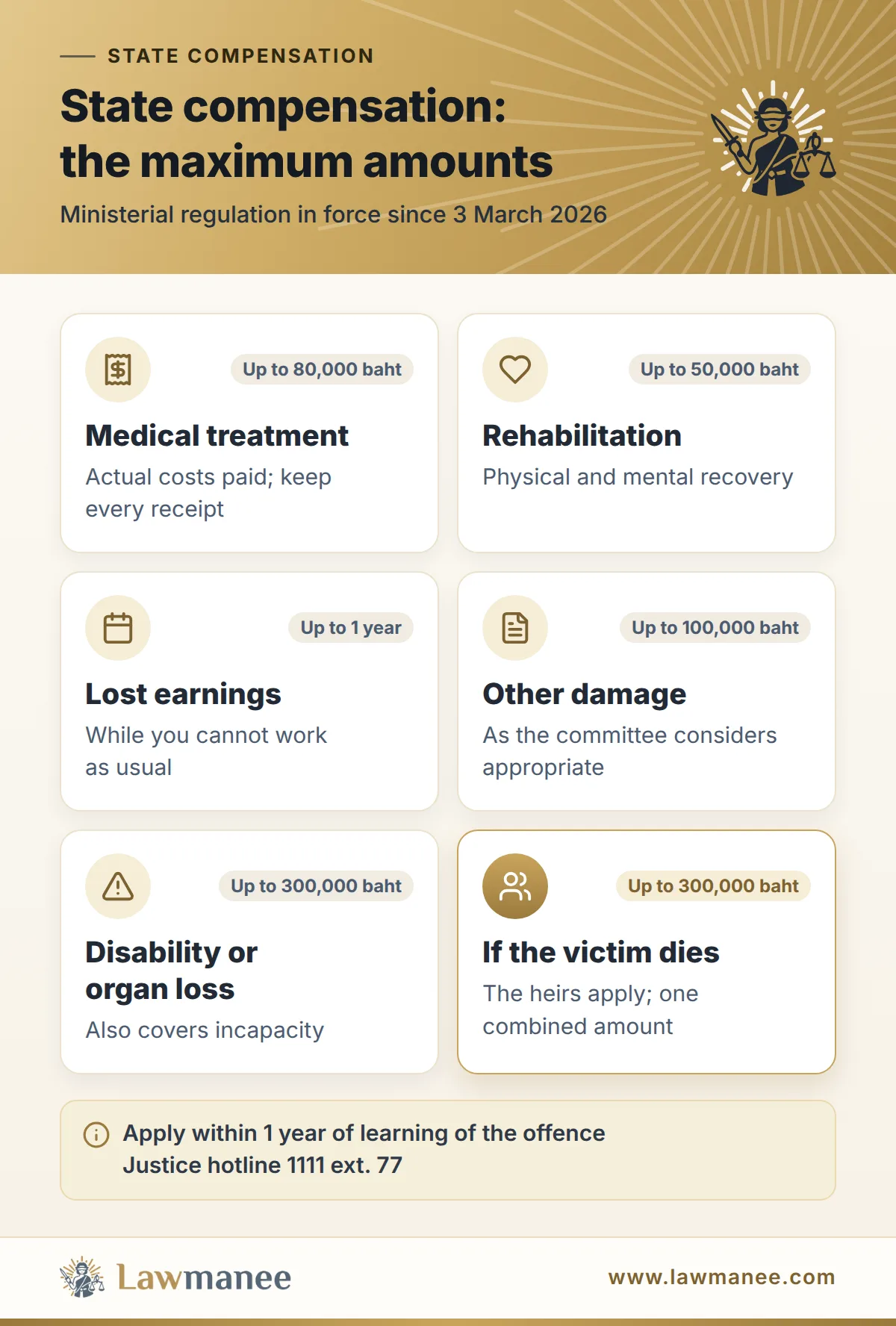
A ministerial regulation in force since 3 March 2026 set new maximum amounts. For an injured victim: medical treatment up to 80,000 baht; physical and mental rehabilitation up to 50,000 baht; lost earnings while unable to work as usual, for up to 1 year; other damage up to 100,000 baht; and disability, incapacity or loss of an organ up to 300,000 baht. If the victim died, the heirs receive up to 300,000 baht in total. These are ceilings, not fixed payments: the committee under the Act decides the amount actually paid.
Example
Mr A is punched in the face by a stranger as he gets out of his car, and his nose is broken. His doctor certifies that he needs 30 days of rest and cannot carry on his ordinary activities during that time. Treatment costs 35,000 baht.
- Being unable to carry on ordinary activities for more than 20 days falls within grievous harm under Section 297 (8): the offence cannot be settled privately, and the limitation period is 15 years.
- Mr A files a complaint at the local police station with the medical certificate, photos of the injury and the witnesses' names.
- When the prosecutor files charges, he petitions under Section 44/1 before the witness hearing begins, claiming the 35,000 baht treatment cost, damages for the 30 days he could not work and damages for non-financial harm, without paying a court fee.
- Within 1 year, he also applies for state compensation at the provincial justice office, bringing his medical receipts.
Talk to a lawyer about an assault case
Judging which level of offence an injury falls under, listing every item in a compensation petition and filing on time are all areas where a lawyer helps. On Lawmanee you can post your situation for free and interested lawyers reply in the platform chat, or find a lawyer for criminal cases by province and language right away.