
Pushing away someone who steps right up to you in an argument, shoving each other and walking off, or catching a thief only to be reported for assault yourself: many people assume that “self-defence” excuses anything. Thai law protects only defence that meets its conditions. This guide explains when self-defence is lawful, when it becomes excessive, how far you may go when catching an offender yourself, and what to do if you are reported or charged.
The rules are the same for foreigners. If you do not speak or understand Thai, the inquiry official, the public prosecutor or the court must provide an interpreter without delay (Criminal Procedure Code Section 13), and the Tourist Police hotline 1155 can help in English and other languages.
What lawful self-defence means
Under Section 68 of the Criminal Code, a person who must act to protect their own or another person's rights from danger caused by an unlawful attack, where the danger is imminent, acts in lawful defence if the act is proportionate to the circumstances, and commits no offence. They also do not have to pay compensation for the harm caused; the injured person can claim it instead from whoever made the defence necessary (Civil and Commercial Code Section 449).
The four conditions
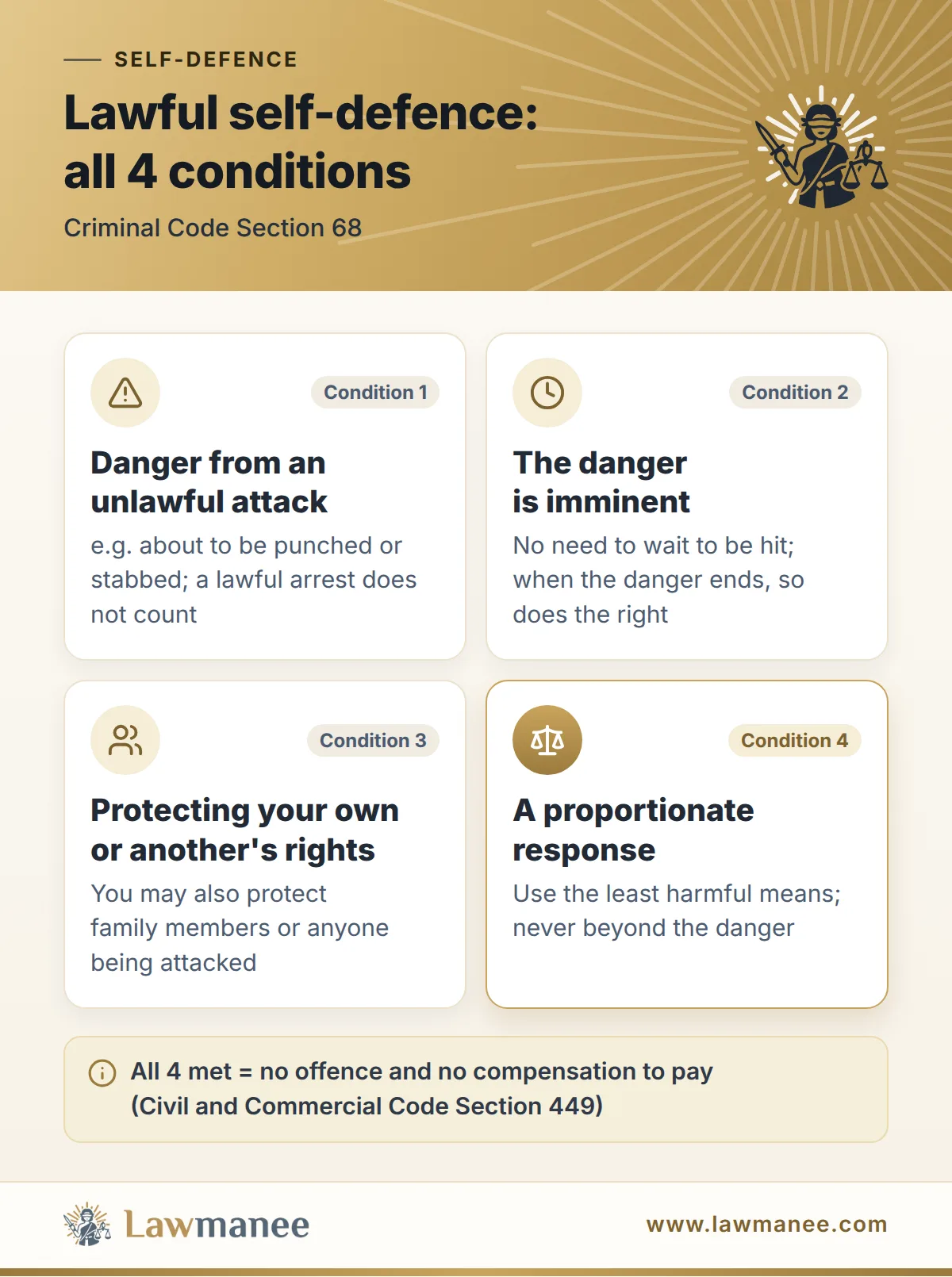
- Danger from an unlawful attack, such as someone about to punch or stab you. An act the law authorises, such as a lawful arrest by an official, is not something you can defend against.
- The danger is imminent. You do not have to wait to be hit first, but the danger must really be about to happen; worrying that the other person “might” attack is not enough. When the danger ends, so does the right to defend.
- You must act to protect your own or another person's rights, so you may also protect a family member or anyone else being attacked.
- The response is proportionate. Use the least harmful means available at that moment, and do not go beyond the danger you face.
Excessive defence is still an offence
If there was a reason to defend yourself but you went further than the circumstances justified, the act is still an offence, although the court may impose any lighter penalty than the law prescribes; if the excess came from excitement, fright or fear, the court may impose no penalty at all (Section 69).
A common case is carrying on after the danger has passed. The Supreme Court has held that once the attacker has fallen and can no longer cause harm, what the defender does afterwards is excessive defence (Supreme Court Decision 7940/2551). And if the attacker has stopped and backed off, going after them later is no longer defence at all.
Self-defence, necessity and provocation compared
| Ground | When it applies | Effect |
|---|---|---|
| Lawful defence (Section 68) | Imminent danger from an unlawful attack, met with a proportionate response | No offence |
| Excessive defence (Section 69) | There was a reason to defend, but the response went too far | An offence; the court may reduce the penalty, or impose none if the excess came from excitement, fright or fear |
| Necessity (Section 67) | Acting under compulsion you could not avoid or resist, or to escape an imminent danger you did not cause and could not avoid any other way | An offence, but no punishment if the act was not excessive |
| Provocation (Section 72) | Acting against someone, at that moment, after being seriously and unjustly provoked by them | An offence; the court may reduce the penalty |
A voluntary fight, or starting it yourself, rules out self-defence
If the circumstances show that both sides willingly joined a fight, neither can claim self-defence, and each is answerable for what they did to the other; whoever caused the danger cannot claim it either. In one case the defendant swore at the other man, shoved a table at him and then fought with him until he bit off part of his ear. The Supreme Court held that the defendant had started the incident and fought voluntarily, so he could not rely on self-defence (Supreme Court Decision 1665/2543).
A quarrel in which nobody was hurt can still be reported, because some offences need no injury:
- Using force without causing harm to body or mind, for example a push or a slap that leaves no injury, falls under Section 391: up to 1 month in prison, a fine of up to 10,000 baht, or both.
- Insulting someone to their face is a separate offence under Section 393, with the same penalty.
- If the force causes harm to body or mind, it is assault under Section 295: up to 2 years in prison, a fine of up to 40,000 baht, or both. Grievous harm falls under Section 297, with much heavier penalties.
Sections 391 and 393 are petty offences that the inquiry official can settle with a fine when the conditions are met; Sections 295 and 297 cannot be settled privately. More detail in our guide Assaulted in Thailand?
Example: pushing a neighbour during an argument
Mr A argues with his neighbour about a car parked across his gate. Mr A swears first; the neighbour steps right up to him and points in his face, and Mr A pushes him away.
- Stepping up and pointing is not, on its own, always an imminent danger; it depends on whether the neighbour was about to strike.
- Mr A swore first. If the whole sequence shows that both were willing to fight, he cannot claim self-defence.
- A push that causes no injury falls under Section 391; if the neighbour falls and is hurt, Section 295. The earlier swearing can be a separate offence of insult under Section 393.
- By contrast, if Mr A had not provoked anyone and the neighbour drew back his fist to punch him, a push just to get out of the way would be proportionate defence.
Catching a thief yourself: how far can you go?
As a rule, a private person may not arrest anyone, except when an official executing an arrest warrant asks for help, or when the person commits a flagrant offence listed in the schedule to the Criminal Procedure Code (Sections 79 and 82), such as theft, snatching, robbery, gang robbery and bodily assault.
- A flagrant offence is one seen being committed, or where the person is found in circumstances leaving hardly any doubt that they have just committed it. For offences in the schedule, it also covers a person chased with a hue and cry, or found near the scene almost immediately afterwards with property obtained from the offence (Section 80).
- The arrester must tell the person they are under arrest and take them to the inquiry official's office at once; the official records the arrester's name, address and how the arrest happened (Sections 83 and 84).
- Use only force appropriate to the circumstances, when the person resists or tries to escape (Section 83). Once they are under control, further kicking, punching or beating is not protected and can be assault, even if they really are the thief.
If you have the choice, call the police on 191 rather than acting yourself.
Reported or charged after defending yourself
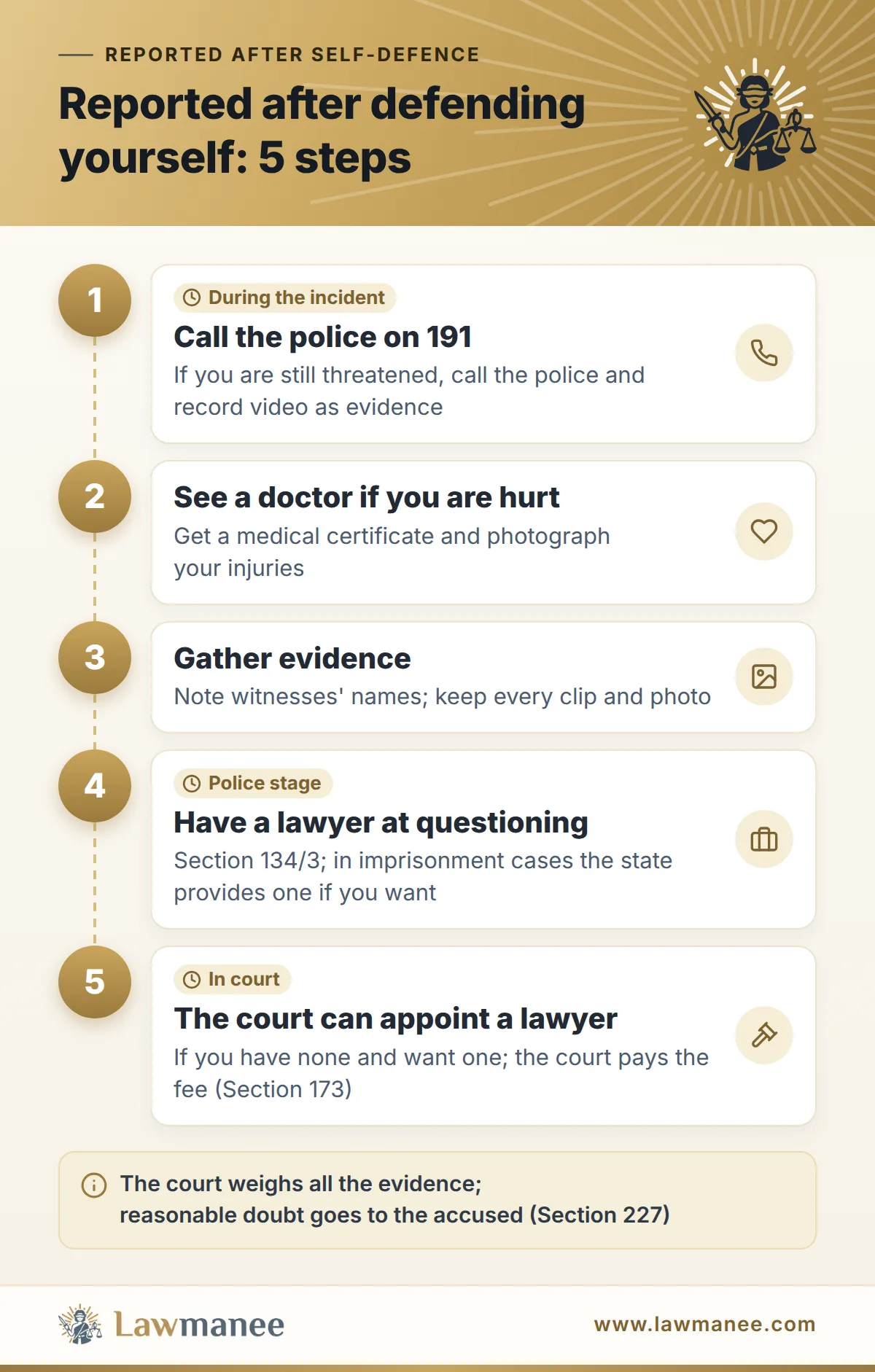
Being reported does not mean you are guilty. The inquiry official gathers the evidence and sends the file to the public prosecutor with an opinion on whether to prosecute, and the prosecutor decides (Criminal Procedure Code Sections 142 and 143). If the evidence clearly shows lawful defence, the prosecutor can decide not to prosecute, so the case never reaches court. If it does, the court weighs all the evidence and, where there is reasonable doubt about guilt, gives the benefit of the doubt to the accused (Section 227).
- Still being threatened? Call the police on 191 and record video as evidence.
- Hurt? See a doctor, ask for a medical certificate and photograph your injuries.
- Gather evidence: note witnesses' names and contact details, and keep every clip and photo for your lawyer or the inquiry official.
- At the police stage, a suspect may have a lawyer or a trusted person present during questioning (Section 134/3), and in a case punishable by imprisonment the state provides a lawyer if you have none and want one (Section 134/1). More in our guide Summoned or arrested in Thailand?
- In court, in a case punishable by imprisonment, the court appoints a lawyer if you have none and want one, and the court pays that lawyer's fee and expenses (Section 173).
Talk to a lawyer about a self-defence case
Small details, such as who started it, how close the other person was, what they were holding or the moment the danger ended, can change the outcome completely. A lawyer can assess the evidence and prepare your defence from the police stage onwards. On Lawmanee you can post your situation for free and interested lawyers reply in the platform chat, or find a lawyer for criminal cases by province and language right away.