


You visit your land upcountry and find a shed or a new fence that is not yours, or someone walks into your home without permission and refuses to leave. Thai law offers both a criminal and a civil route. This guide explains the trespass offences in Sections 362 to 366 of the Thai Criminal Code: what counts as trespass, the penalties, when you must file a complaint within three months, and when the matter belongs in a civil court. The rules are the same whether the victim is Thai or a foreigner.
Three main forms of criminal trespass
- Trespass on immovable property (Section 362): entering another person's land or other immovable property to take possession of all or part of it, or entering to do anything that disturbs their peaceful possession. Example: going onto someone else's land to put up posts and plant trees in order to hold it (Supreme Court Decision 2253/2531).
- Moving or destroying boundary markers (Section 363): moving or destroying a boundary marker, such as a survey peg, in order to take another person's land for oneself or for someone else.
- Trespass on a home or office (Section 364): entering or hiding, without reasonable cause, in a dwelling, a building used to store property, or an office in another person's possession, or refusing to leave when the person entitled to keep you out tells you to go.
A dwelling is a place used for living in, such as a house, shed, boat or raft that people live in, and it includes the grounds around it, fenced or not (Section 1 (4)). A front yard or garden therefore counts as part of the home.
Because the law protects whoever is in possession, it also protects a house or condo you rent, not only property you own.
Aggravated trespass: heavier penalty, cannot be settled
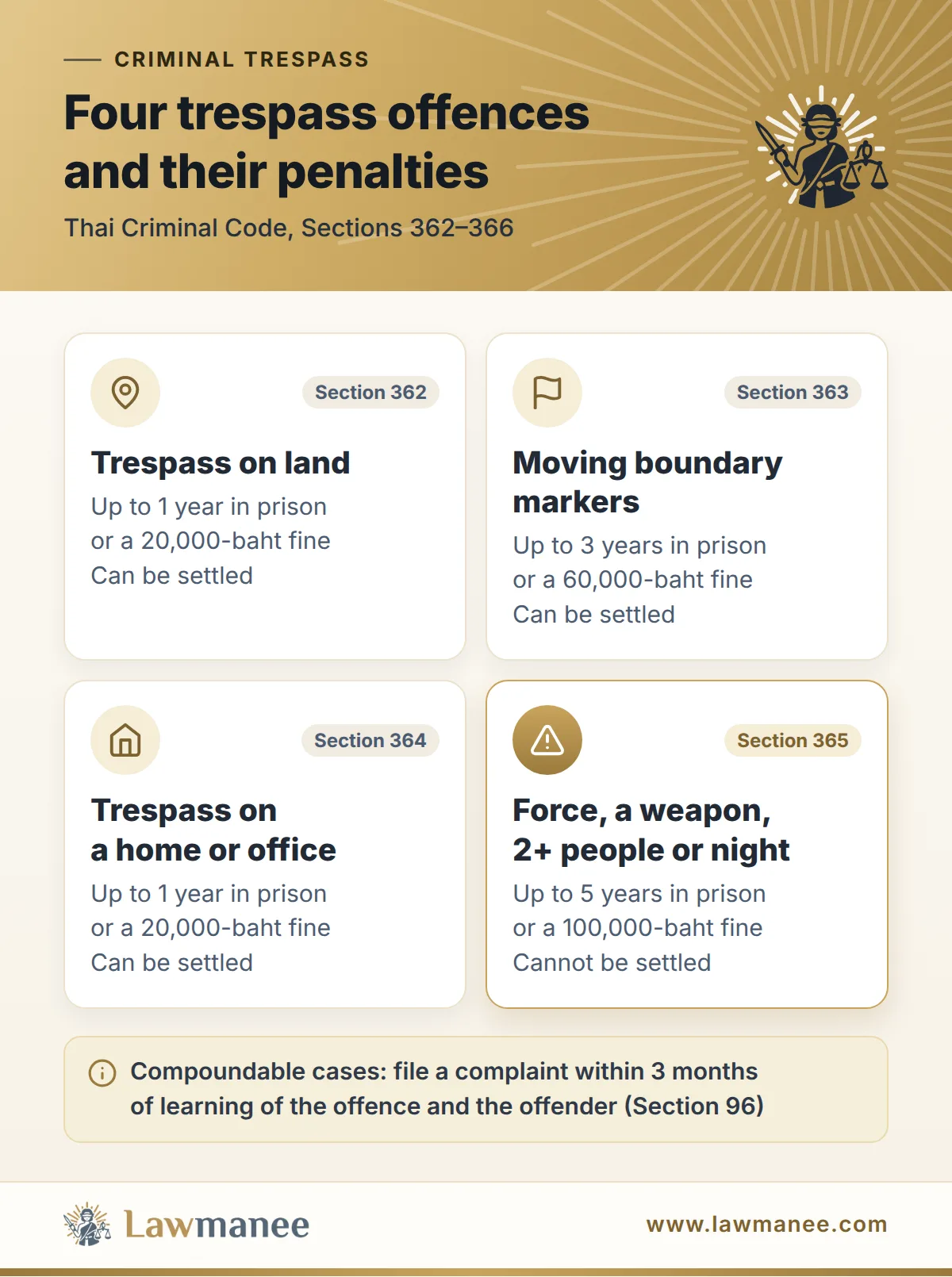
Trespass under Section 362, 363 or 364 becomes aggravated trespass under Section 365 if it is committed:
- by using or threatening to use violence;
- while carrying a weapon, or by two or more people together; or
- at night, meaning between sunset and sunrise (Section 1 (11)).
| Offence | Section | Maximum penalty | Can it be settled? |
|---|---|---|---|
| Trespass on land or other immovable property | 362 | 1 year in prison or a 20,000-baht fine, or both | Yes |
| Moving or destroying boundary markers | 363 | 3 years in prison or a 60,000-baht fine, or both | Yes |
| Trespass on a dwelling, storage building or office | 364 | 1 year in prison or a 20,000-baht fine, or both | Yes |
| Aggravated trespass | 365 | 5 years in prison or a 100,000-baht fine, or both | No |
Every offence in the trespass chapter is compoundable, meaning it can be settled, except Section 365 (Section 366).
The law protects possession, and requires intent
Trespass protects possession, not just the name on the title deed, and the offender must act with intent. In practice this means:
- An owner can commit trespass when someone else is in possession. The Supreme Court held that a landlord who nailed boards across the door of a rented room in the tenant's possession, so that the tenant could not get in, was guilty under Section 362 (Decision 1/2512). To get an occupier out, go through the courts.
- The intruder must know the other side has the better right. The Supreme Court has held that trespass requires proof that the accused entered to take possession while knowing that the other party had a better right (Decision 13674/2556). A boundary dispute in which each neighbour honestly believes the strip is theirs is therefore settled in civil proceedings, for example a boundary survey at the Land Office or a civil suit.
File a complaint within three months
- Trespass under Sections 362, 363 and 364 is compoundable. The injured person must file a complaint within three months from the day they learned of the offence and of the offender, or the case is time-barred (Section 96).
- An intruder who stays on does not restart the three months. The Supreme Court held that the offence is complete on entry and the later occupation is only its result, not a continuing offence, so a complaint filed more than three months after the owner found out was out of time (Decision 2253/2531).
- Asking the police only to note the incident in the daily log is not a complaint. Tell the inquiry official clearly that you want the intruder prosecuted.
- Once a complaint or a case is withdrawn, or the parties lawfully settle, the right to prosecute ends (Criminal Procedure Code, Section 39 (2)).
- Aggravated trespass under Section 365 has no three-month limit, and withdrawing your complaint does not stop the inquiry official or the public prosecutor (Section 126). The case must still be filed, with the offender brought before the court, within 10 years of the offence (Criminal Code, Section 95).
- If you plan to leave Thailand, file before you go: the three months keep running.
Example: a shed on vacant land
Somsri owns titled land in another province. On 10 January she visits and finds a shed and a fence that are not hers. On 15 January she learns that Mr A put them up; he came alone, by day, and used no force.
- If Mr A knew the land was Somsri's and still moved in, this is trespass under Section 362, which is compoundable. Somsri knew of the offence and the offender on 15 January, so she must file a complaint within three months of that day. If she waits until May, the criminal case is time-barred, even though Mr A is still there.
- The civil route stays open: she can sue to evict him and claim damages. She should not wait, because a person who possesses another's land peacefully, openly and with the intent to own it for 10 years in a row becomes the owner (Civil and Commercial Code, Section 1382).
- If Mr A had come with two others, or at night, the offence would be aggravated trespass under Section 365, which cannot be settled and has no three-month limit.
The civil route: eviction and damages
- An owner may recover their property from anyone who has no right to hold it and may stop unlawful interference (Civil and Commercial Code, Section 1336), so the owner can sue for eviction, removal of structures and damages.
- Land held with possessory rights only, such as Nor Sor 3 land: a possessor who is disturbed must sue within one year of the disturbance (Section 1374), and one who is dispossessed must sue to recover possession within one year (Section 1375). This kind of land needs faster action than titled land.
- A criminal complaint and a civil eviction suit can run at the same time. When the public prosecutor charges the intruder, you can also ask the criminal court to order compensation, filing before the court starts hearing witnesses (Criminal Procedure Code, Section 44/1).
What to do first
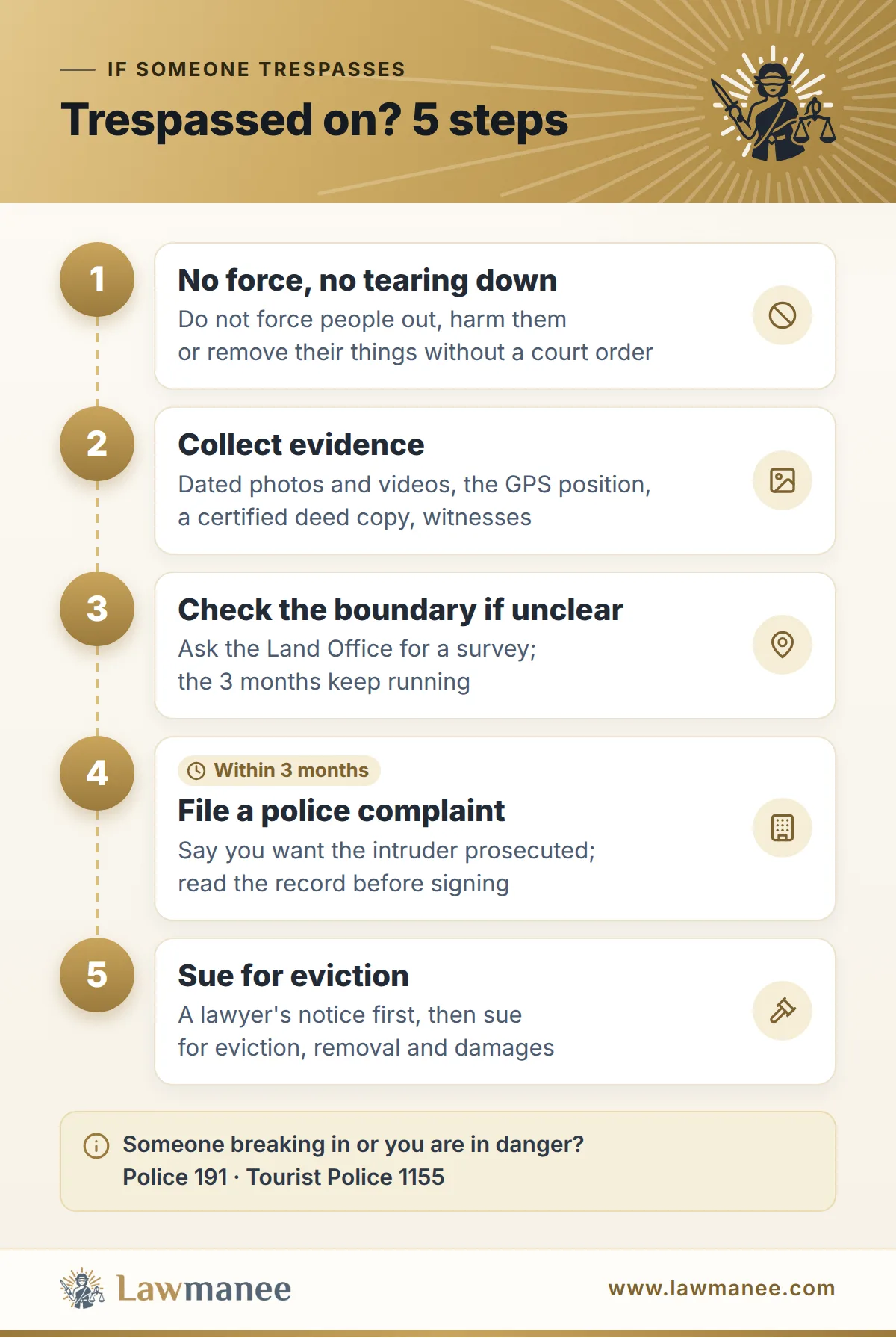
- Do not use force or remove things yourself. Throwing someone out by force, or tearing down structures and removing their belongings without a court order, puts you at risk of being reported or sued in turn.
- Collect evidence: dated photos and videos of the structures and fences, the GPS position, certified copies of your title deed and the names of witnesses.
- Check the boundary if it is unclear by asking the Land Office for a boundary survey. The three months keep running while you wait for the result.
- File a complaint with the inquiry official within three months and say clearly that you want the intruder prosecuted. The record is in Thai, so read it through, with help from someone you trust if needed, before you sign.
- Go to the civil court: have a lawyer send a notice to leave, then sue for eviction, removal and damages.
If someone is breaking in right now or you are in danger, call the police on 191. The Tourist Police on 1155 answer 24 hours a day in several languages, including English and Chinese.
Talk to a lawyer about trespass
Small facts decide these cases: who was in possession, whether the other side knew they had no right, and when you learned who did it. On Lawmanee you can post your case for free in English, and interested lawyers reply in the platform chat. You can also search the directory for criminal and property lawyers by province and by the language they speak.