
A condominium unit is the most straightforward type of property a foreigner can own in Thailand. But the legal conditions have to be met before any money is sent, and missing a single step can mean the unit cannot be registered in your name.
What foreigners can and cannot own
- Condominium units can be owned outright (freehold) under the Condominium Act B.E. 2522 (1979), provided the buyer meets one of the conditions in Section 19.
- Land generally cannot be owned by foreigners, except in special cases permitted by law.
- Houses: you can own the building itself, but the land underneath usually has to be leased, and a lease can be registered for no more than 30 years at a time.
Using a Thai person or a Thai company to hold property on your behalf (a nominee) to get around these restrictions is illegal, and you risk losing both the property and the money you paid.
Two conditions you must meet
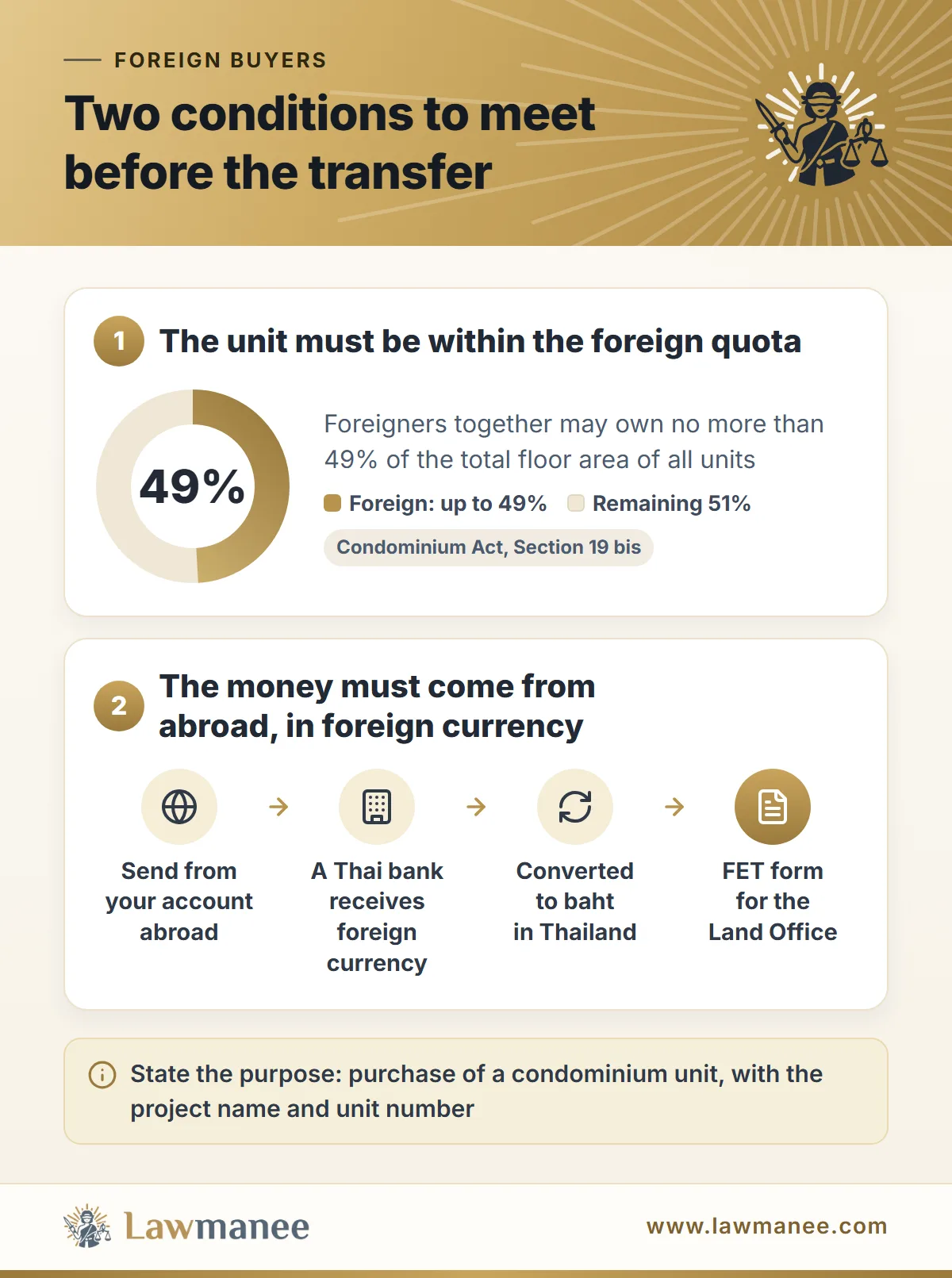
1. The unit must be within the 49% foreign quota
Section 19 bis limits the units owned by foreigners in any one condominium building to 49% of the total floor area of all units. It is counted by floor area, not by number of units.
Before paying a reservation deposit, ask the developer or the condominium juristic person whether foreign quota is still available, and get it confirmed in writing. Popular buildings often run out of foreign quota quickly. If the quota is full, the remaining option is a long-term lease, which is not ownership.
2. The money must come from abroad, in foreign currency
Most foreign buyers qualify by bringing foreign currency into Thailand. In practice:
- Transfer the money from an account abroad to a bank account in Thailand in a foreign currency, and let the Thai bank convert it into baht.
- State the purpose of the transfer as the purchase of a condominium unit, with the project name and unit number.
- Ask the receiving bank for the supporting document commonly called the FET form (issued for amounts of USD 50,000 or more; for smaller amounts, ask for a letter confirming receipt of the funds instead). You will submit it to the Land Office.
- The amount brought in should be no less than the purchase price to be registered.
Also check the outbound transfer rules of the country the money is leaving.
The purchase in 5 steps
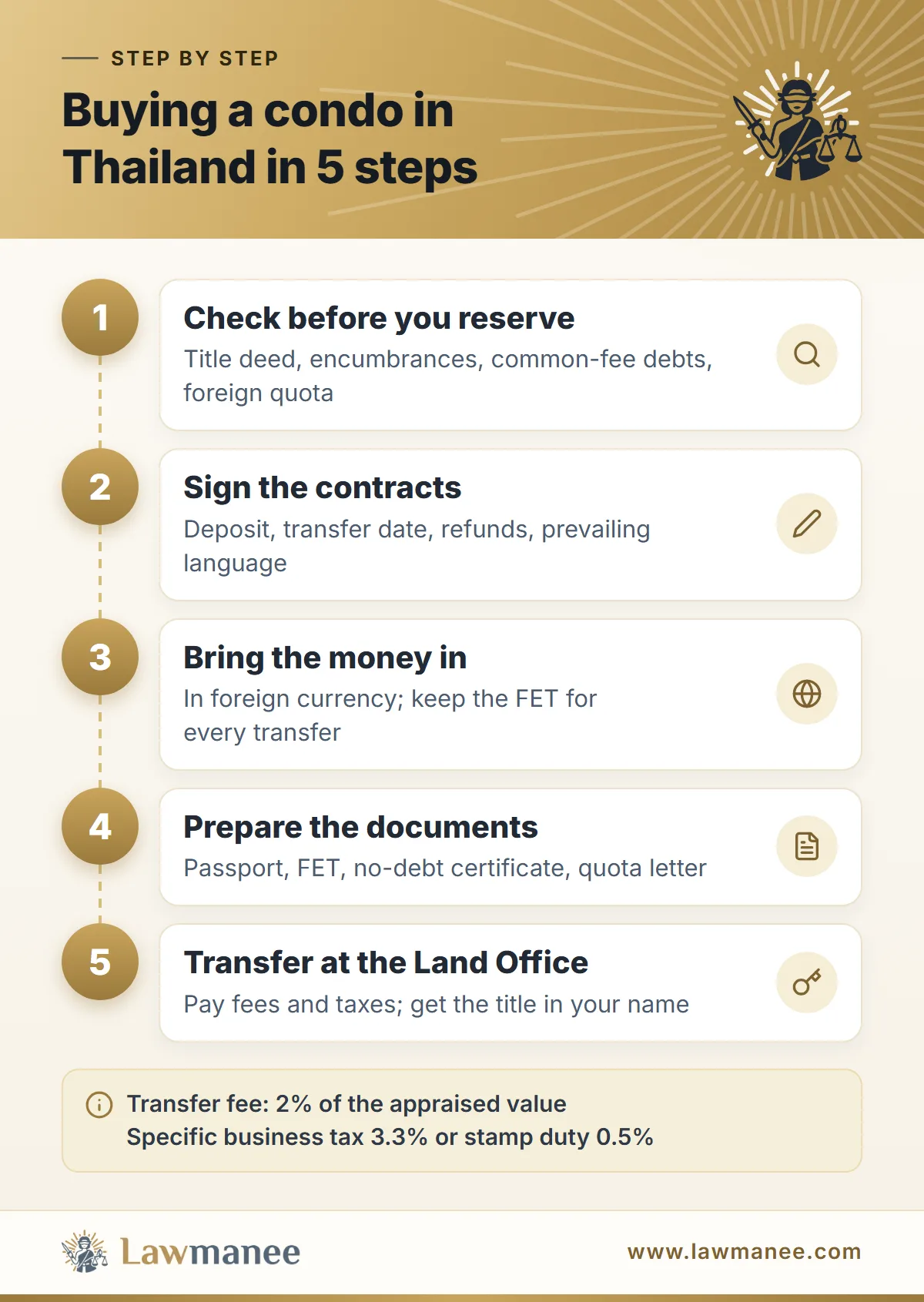
- Check before you reserve: the owner and any encumbrances on the unit title deed (Or.Chor.2), the condominium registration, unpaid common fees, and the foreign quota.
- Sign the contracts: the reservation agreement and the sale and purchase agreement. Read the deposit terms, the transfer date, refunds if the project is delayed, and which language prevails if the contract is bilingual.
- Bring the money into Thailand as described in condition 2, and keep the FET documents for every transfer.
- Prepare the documents: your passport, the transfer documents, a certificate from the condominium juristic person that no common fees are owed, and a letter confirming the foreign quota. If you cannot attend in person, you will need a power of attorney on the Land Office's form.
- Register the transfer at the Land Office: pay the fees and taxes, then receive the unit title deed (Or.Chor.2) in your name.
Transfer-day costs
| Item | Rate | Paid by |
|---|---|---|
| Transfer fee | 2% of the official appraised value | as agreed (often split 50/50) |
| Specific business tax | 3.3%, generally if the seller has owned the unit for under 5 years or is a company | seller |
| Stamp duty | 0.5%, only if specific business tax does not apply | seller |
| Withholding income tax | depends on the type of seller and the holding period | seller |
The contract can allocate these costs differently. New projects often add further charges, such as common fees paid in advance and a contribution to the sinking fund. Transfer-fee reductions that the government has offered from time to time were limited to Thai nationals, so foreign buyers should budget at the standard rates.
Common mistakes
- Paying a deposit before confirming that foreign quota is available.
- Transferring the money in baht, or through someone else's Thai account, leaving no proof that foreign currency was brought in.
- Believing that a "30+30+30-year" lease is guaranteed to be renewed, when a lease can only be registered for up to 30 years at a time and renewal is not assured.
- Using a Thai nominee or a nominee company to hold the property.
- Signing a Thai-language contract you cannot read, without a translation or someone you trust to explain it.
Have a lawyer check before you pay a deposit
Having the documents and contract checked before you buy usually costs far less than fixing a problem afterwards. On Lawmanee you can find property lawyers who speak English or Chinese, or post a case for free to get quotes for a title and contract review.