


Extending the kitchen, roofing a carport, adding a bedroom upstairs or building a new house on your own land: many people assume that their land means their rules. Under Thailand's Building Control Act B.E. 2522 (1979), however, most construction and alteration needs a permit from the local authority, or a notification to it, before work starts. Building without one can lead to a stop order, daily fines and a demolition order. This guide covers which work needs a permit, which small jobs do not, how far to stay from the neighbouring plot and what happens if the work is already done.
The rules are the same for Thai and foreign owners. Foreigners usually own a condominium unit rather than land, and work inside a condo unit also follows the building's own rules, so check with the juristic person before renovating.
Does the Act apply to your land?
The Act applies in areas named by royal decree and in areas that have had a comprehensive town plan (Section 2). High-rise buildings, extra-large buildings, assembly buildings and theatres are covered everywhere. The simplest way to find out whether your plot is covered is to ask the engineering or public works section of the municipality, the Subdistrict Administrative Organisation (SAO) or, in Bangkok, the district office before you design anything.
A building under the Act is broad: houses, shophouses, sheds and anything built that people can live in or use, including fences and walls built next to or near public land (Section 4).
What needs a permit
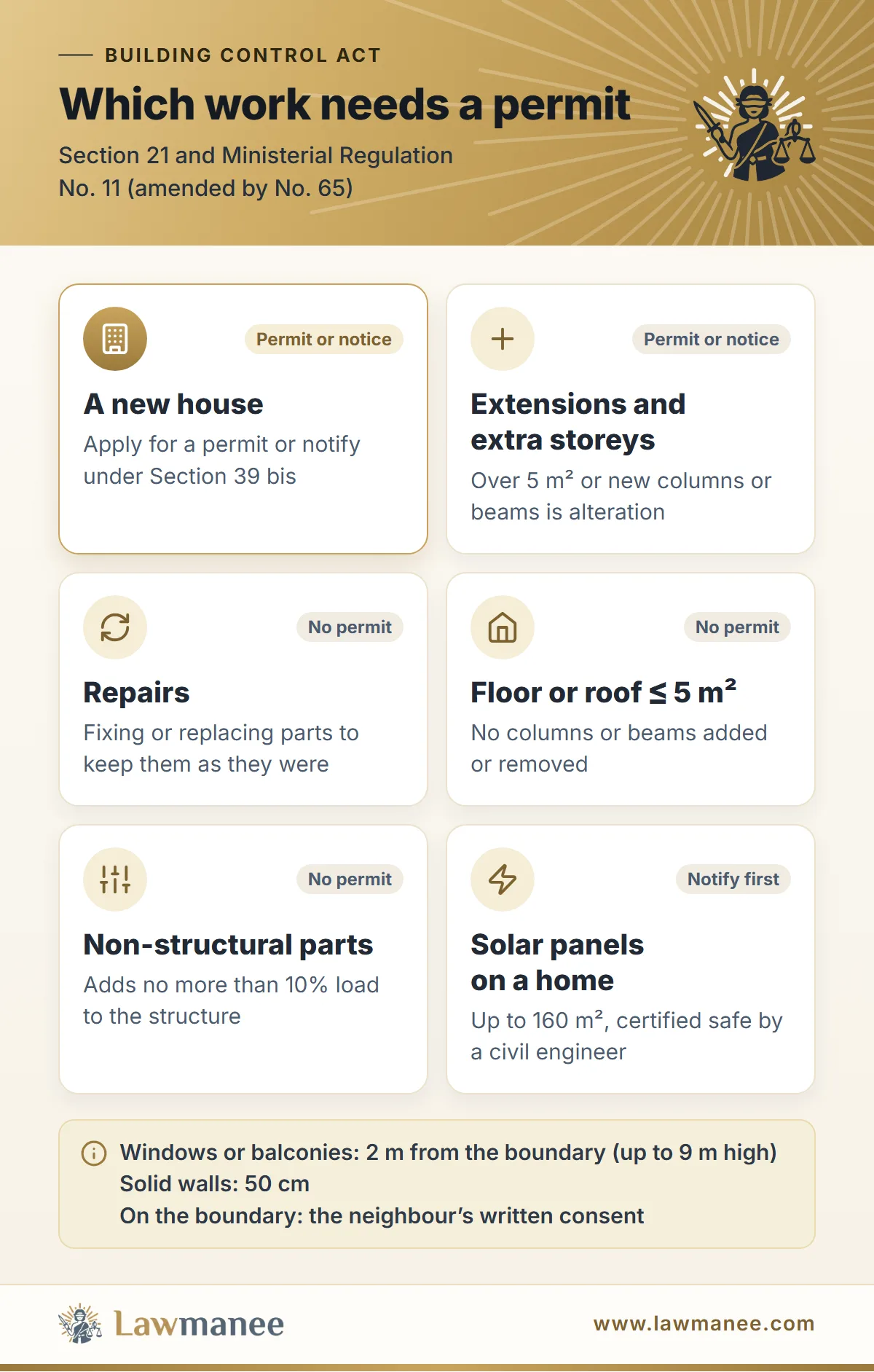
Section 21 says that anyone who will construct, alter or move a building needs a permit from the local official, or must notify the local official under Section 39 bis. Demolishing a building that stands less than 2 metres from another building or public land, or one taller than 15 metres standing closer than its own height, also needs a permit or notification (Section 22).
Alteration means changing, extending, adding to, reducing or enlarging the form, extent, design, shape, proportions, weight or area of the structure or parts of a building. Adding a room, enlarging the kitchen or adding a storey is therefore alteration. Repair, meaning fixing or replacing parts so the building stays as it was, needs no permit.
Small jobs that do not count as alteration
Ministerial Regulation No. 11 (B.E. 2528), as amended by No. 65 (B.E. 2558), lists work that is not alteration and so needs no permit:
- Replacing structural parts with the same size, number and type of material, except reinforced concrete, prestressed concrete and structural steel
- Changing or extending non-structural parts such as floor finishes, partitions or window panels, without adding more than 10% to the load on any part of the existing structure
- Reducing or enlarging the floor of any storey by no more than 5 m² in total, without adding or removing columns or beams
- Enlarging the roof by no more than 5 m² in total, without adding or removing columns or beams
- Solar panels on the roof of a home, up to 160 m² and 20 kg per m², with a civil engineer's safety check and certificate, and notice to the local authority before installation
These jobs must still comply with other ministerial regulations and local bylaws, such as the boundary distances below.
Permit or Section 39 bis notification
| Permit | Section 39 bis notification | |
|---|---|---|
| Work may start | When the permit is issued | When you receive the notification receipt, which must be issued within 3 working days of paying the plan-check fee (Section 39 ter) |
| Decision time | 45 days from the application, extendable twice by up to 45 days each (Section 25) | If the plans are wrong, the authority sends a written objection asking for corrections |
| Designers | Depends on the work | Licensed architects and engineers must design, calculate, supervise and certify the plans |
Apply to the local official where the land is: the district office in Bangkok, or the municipality or SAO elsewhere.
How far from the neighbouring plot
Ministerial Regulation No. 55 (B.E. 2543), clause 50, sets the distance of walls facing the boundary:
- Walls with windows, doors, vents, light openings or balconies: at least 2 metres from the boundary for a building up to 9 metres high, and at least 3 metres for a building over 9 metres but under 23 metres
- Walls closer than that must be solid walls and at least 50 centimetres from the boundary
- Building right on the boundary is allowed only for a building up to 15 metres high, with a solid wall on that side, a solid parapet at least 1.80 metres high on the roof deck on that side, and the written consent of the neighbouring owner on that side
Local authorities can also issue their own building bylaws, so have your designer check with the local office before fixing the layout.
If the work was done without permission
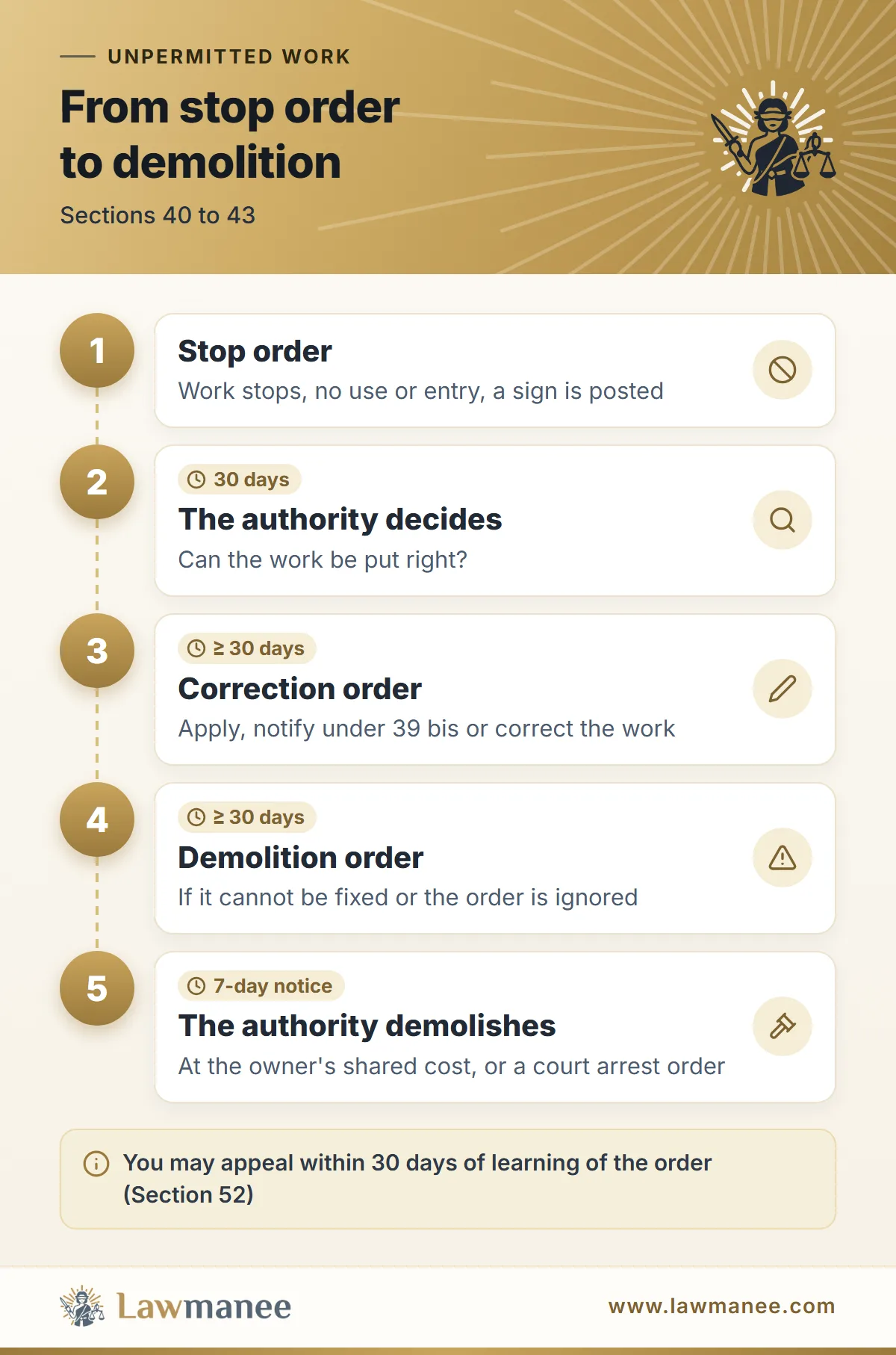
When the local official finds unlawful construction or alteration, Sections 40 to 43 set out the steps:
- Stop order: work stops, nobody may use or enter that part, and a prohibition sign is posted
- Within 30 days, the authority decides whether the work can be put right
- If it can, the owner is ordered to apply for a permit, file a Section 39 bis notification or correct the work within a set period of at least 30 days (Section 41)
- If it cannot, or the order is ignored, the authority orders full or partial demolition within a set period of at least 30 days (Section 42)
- If nothing is demolished, the authority may ask the court to arrest and detain the person, or demolish the building itself after posting a notice for at least 7 days, at the shared cost of the owner and others involved (Section 43)
A person who receives an order may appeal to the appeals committee within 30 days of learning of it, in writing, through the local official who issued it. The committee must decide within 60 days, and anyone who disagrees with the decision may go to court within 30 days (Section 52).
Penalties
| Offence | Maximum penalty |
|---|---|
| Building or altering without a permit or notification (Section 65) | 3 months in prison or a 60,000-baht fine or both, plus up to 10,000 baht a day |
| Ignoring a Section 40 stop order (Section 67) | 6 months or 100,000 baht or both, plus up to 30,000 baht a day |
| Not demolishing as ordered while no appeal is pending (Section 66 bis) | 6 months or 100,000 baht or both, plus up to 30,000 baht a day |
Penalties double for commercial buildings and for buildings put up to rent out or sell (Section 70). The law treats unpermitted building as the act of the owner or occupier unless they prove someone else did it (Section 71), so leaving everything to the contractor does not always protect the owner.
Example
Somchai has a two-storey detached house, 8 metres high. He wants a 3 x 4 metre kitchen extension at the back with two new columns; its side wall would be 1 metre from the neighbour's fence, and he would like a window there.
- At 12 m² with new columns, the kitchen is an alteration: he needs a permit or a Section 39 bis notification.
- The wall is 1 metre from the boundary, less than 2 metres, so it cannot have a window on that side and must be a solid wall.
- To build right up to the fence, the wall must be solid and he needs the neighbour's written consent.
- A 1.5 x 3 metre canopy (4.5 m²) over the front door with no new columns or beams is not an alteration, but it must still respect the distance rules.
A neighbour built too close, or you are buying an extended house
Under Section 73, owners or occupiers of land or buildings next to an unlawful building, and anyone whose use of their land is affected by it, are injured persons who can file a criminal complaint. You can also complain to the local official, who can act under Section 40.
If you are buying a second-hand house that has been extended, ask to see the permit or notification receipt for the extension, because correction and demolition orders are addressed to whoever owns the building at the time.
Talk to a lawyer about building work
Whether you have received a stop or demolition order, need to appeal within the 30-day window or are in a dispute with a neighbour who built up to the boundary, on Lawmanee you can post your situation for free and interested lawyers reply in the platform chat, or find a lawyer for land and property by province and language right away.