
In Thailand an engagement is more than a family ceremony: the Civil and Commercial Code gives it legal effects. When an engagement does not end in a wedding, the questions are always the same. Does the ring have to be returned? Can the sinsod paid to the other family be recovered? Who pays for the wedding costs already spent? This guide follows Sections 1435 to 1447/2 of the Code as amended by the marriage equality law, in force since 23 January 2025.
The law now speaks of the "betrothing party" and the "betrothed party"
The old text said a man gives the engagement gift to a woman. Since the 2024 amendment, the Code uses neutral terms: the betrothing party (phu mun) gives the engagement gift and the betrothed party (phu rap mun) receives it, whatever the couple's genders. The same rules on returns and damages apply to every couple.
Minimum age
- Both people must be at least 18; an engagement in breach of this is void (Section 1435).
- At 18 or 19 a person is still a minor in Thailand (majority is reached at 20, Section 19), so they need the consent of both parents, the surviving parent, an adoptive parent or a guardian, as the case may be. Without it the engagement is voidable (Section 1436).
The engagement gift and sinsod are different things
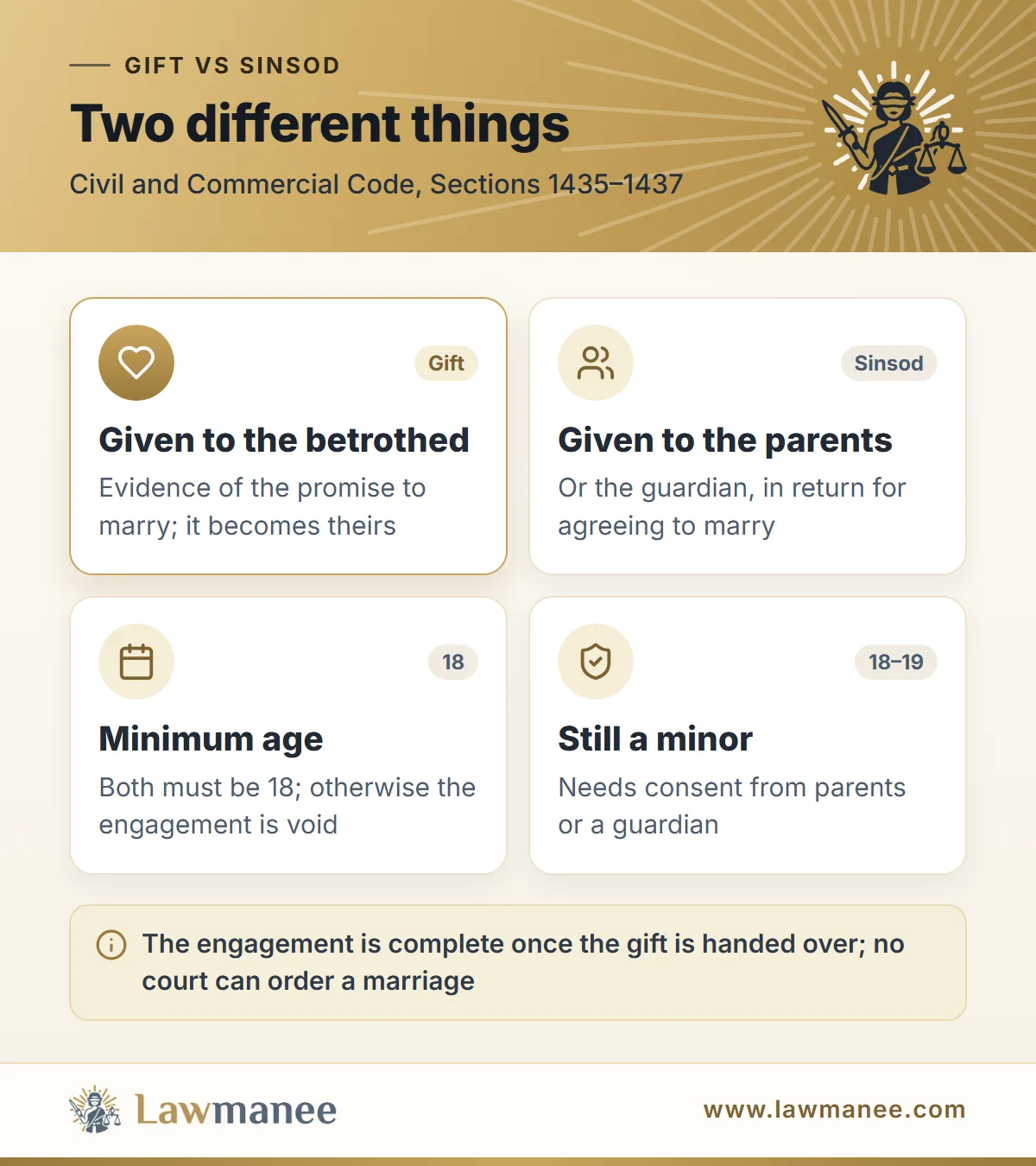
The engagement gift (khong mun), such as a ring or gold jewellery, is property the betrothing party hands over or transfers to the betrothed party as evidence that they will marry. The engagement is complete once it is handed over, and the gift then belongs to the betrothed party personally (Section 1437, paragraphs 1 and 2). A promise to give a gift later, without delivery, is not yet a complete engagement under this section.
Sinsod is property the betrothing party gives to the parents, adoptive parent or guardian of the betrothed party in return for the betrothed party agreeing to marry (Section 1437, paragraph 3). The law sets no amount for either; the two families agree on it.
| Engagement gift | Sinsod | |
|---|---|---|
| Given to | The betrothed party | Their parents, adoptive parent or guardian |
| Purpose | Evidence of the promise to marry | In return for agreeing to marry |
| Belongs to | The betrothed party | Whoever received it |
| Can be reclaimed when | The betrothed party breaks the engagement, or it is ended for a serious cause on their side | No marriage because of a serious cause on the betrothed party's side, or circumstances their side is responsible for |
No one can be forced to marry
An engagement is not a ground for asking a court to order a marriage, and an agreed penalty for breaking the engagement is void (Section 1438). What the law gives instead is the right to recover the engagement gift or sinsod, and to claim the damages listed in the Code.
When the engagement ends without a marriage: who returns what
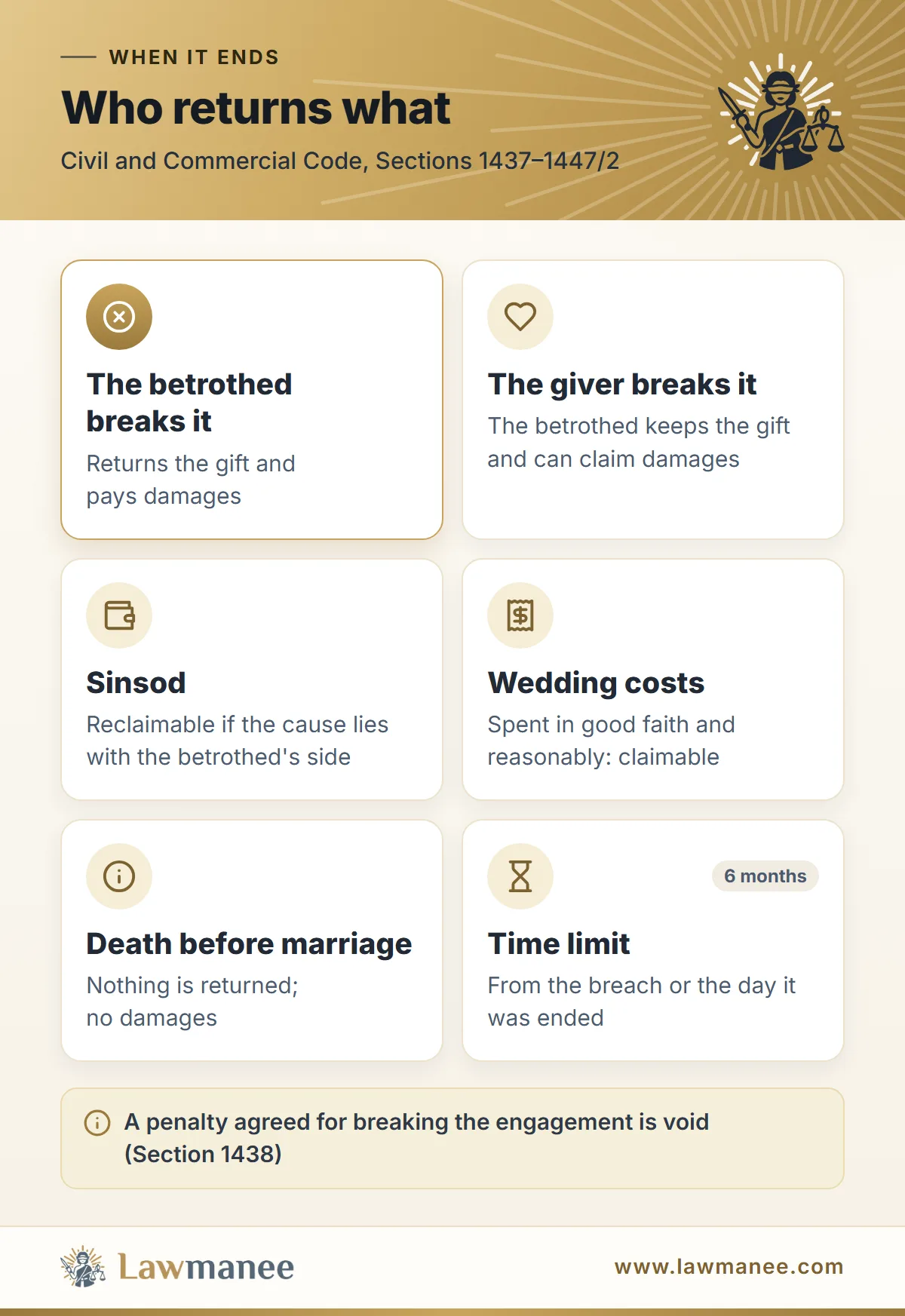
- The betrothed party breaks the engagement, for example refuses to marry without good reason: they must return the engagement gift, and the betrothing party may claim damages (Section 1439).
- The betrothing party breaks the engagement: the betrothed party keeps the gift and may claim damages (Section 1439).
- A serious cause on the betrothed party's side makes the marriage inappropriate: the betrothing party may end the engagement and the gift must be returned (Section 1442).
- A serious cause on the betrothing party's side: the betrothed party may end the engagement without returning the gift (Section 1443).
- One of them dies before the marriage: no one can claim damages, and neither the gift nor the sinsod has to be returned (Section 1441).
If the engagement is ended because of the other person's seriously wrongful conduct after the engagement, that person owes damages as if they had broken the engagement (Section 1444). Sinsod can be reclaimed when there is no marriage because of a serious cause on the betrothed party's side or circumstances their side is responsible for (Section 1437, paragraph 3). Returns of gifts or sinsod follow the unjust enrichment rules of Sections 412 to 418, applied by analogy.
What damages can be claimed
Section 1440 allows three kinds of damages:
- Harm to the body or reputation of the fiancé or fiancée
- Expenses or debts that the couple, their parents or people acting as parents incurred in good faith and reasonably to prepare the wedding
- Losses from reasonably arranging one's property, work or business in the expectation of marrying
If the betrothed party is the one entitled to damages, the court may count the engagement gift as all or part of the damages, or award damages without counting it. The amount is set by the court according to the circumstances (Section 1447).
A fiancé or fiancée may also claim damages from a third party in some cases: someone who had sexual relations with their partner knowing, or who should have known, of the engagement, once the engagement has been ended (Section 1445), and someone who raped or attempted to rape their partner knowing of the engagement, without having to end it first (Section 1446).
Worked example
A gives B a diamond ring worth 80,000 baht as the engagement gift and 200,000 baht sinsod to B's parents. A then pays a 50,000 baht deposit for the venue, but B refuses to marry without good reason. B has broken the engagement: B must return the ring, A can reclaim the sinsod from B's parents because the wedding fell through for circumstances B's side is responsible for, and A can claim the venue deposit as an expense paid in good faith and reasonably. A must sue within 6 months of the day B broke the engagement.
The other way round, if A simply changes their mind, B keeps the ring, A cannot reclaim the sinsod because the cause is not on B's side, and B may claim damages from A.
The 6-month time limits
- Damages for breaking the engagement: 6 months from the breach (Section 1447/1)
- Damages for seriously wrongful conduct: 6 months from when the conduct was or should have been known, and never more than 5 years after it (Section 1447/1)
- Damages from a third party under Sections 1445 and 1446: 6 months from knowing of the act and of who is liable, and never more than 5 years after the act (Section 1447/1)
- Recovering the engagement gift: 6 months from the breach, or from ending the engagement under Section 1442 (Section 1447/2)
Except for wedding-preparation costs, these damage claims cannot be transferred and do not pass to heirs, unless they were acknowledged in writing or a lawsuit had already been filed (Section 1447).
If one of you is a foreigner
Foreigners living in Thailand often meet the sinsod custom when engaged to a Thai partner. The rules above are those of the Thai Civil and Commercial Code. When one partner is a foreign national, ask a lawyer which country's law applies to your engagement before you rely on them, and keep written records of what was given, to whom and why, ideally in a language both families understand.
Keep evidence from the engagement day
Keep photos and videos of the ceremony, the names of witnesses, receipts or transfer slips for the sinsod, receipts for the ring or gold, wedding contracts and receipts, and the chat messages that show who called the wedding off and why.
Talk to a family lawyer
Every case turns on its facts: whether the reason for ending it is a "serious cause", who is in breach, and which costs can be recovered. On Lawmanee you can post your case free of charge and interested family lawyers reply in the platform chat, or search the lawyer directory by case type, province and language, including lawyers who speak English or Chinese.