


If you own a condo in Thailand, you pay common fees every month. What are they based on, who decides how the building is run, and what can an owner do when they disagree with the management? The answers are in the Condominium Act B.E. 2522 (1979), substantially amended in 2008. This guide sets out the rights and duties of unit owners, whom the Act calls co-owners. The Act makes no distinction by nationality: a foreign owner pays and votes on the same basis as any other co-owner.
What the juristic person is
The condominium juristic person exists to manage and maintain the common property in line with the co-owners' resolutions (Section 33). Common property is everything in the condominium that is not a unit, such as the land the building stands on, the structure, the fire-protection and wastewater systems and the juristic person's office (Section 15).
It is run by three bodies:
- The general meeting of co-owners, which decides the important matters.
- The committee of 3 to 9 members appointed by the general meeting. A term lasts 2 years (Section 37). The committee supervises the management (Section 38).
- The manager, one natural or juristic person, who represents the juristic person and handles the day-to-day work (Sections 35 and 36).
How common fees are calculated
Co-owners share the cost of common services and of maintaining the common property, either in proportion to their ownership ratio in the common property or according to the benefit to each unit, as the by-laws provide (Section 18). The ownership ratio is the floor area of your unit compared with the total floor area of all units when the condominium was registered (Section 14).
For example, a 40 sq m unit in a building whose units total 8,000 sq m has an ownership ratio of 0.5%. If the by-laws share costs by ownership ratio and the common expenses for the year are 6 million baht, this unit pays 30,000 baht a year, or 2,500 baht a month, and it also carries 0.5% of the votes at a general meeting.
For units that have not yet been transferred to a buyer, the developer counts as the co-owner and must pay the fees for them (Section 18, paragraph three).
What happens if you pay late
The Act sets the consequences step by step (Section 18/1):
| Situation | Consequence |
|---|---|
| Not paid by the due date | A surcharge of up to 12% a year on the unpaid amount, not compounded, as set in the by-laws |
| Unpaid for 6 months or more | A surcharge of up to 20% a year; common services or the use of common property may be suspended under the by-laws; no vote at general meetings |
| Unpaid for more than 6 months | The manager has a duty to sue for payment (Section 36) |
| Selling or transferring the unit | A certificate from the juristic person that no fees are outstanding must be shown when the transfer is registered (Section 29) |
Once you have paid in full and asked for it, the manager must issue that certificate within 15 days (Section 29, paragraph three).
General meetings: who calls them, and when
- The first ordinary general meeting must be held by the manager within 6 months of the juristic person's registration, to appoint the committee and to approve the by-laws and the manager registered at the start (Section 42).
- The annual ordinary general meeting must be held by the committee within 120 days of the end of each financial year, to approve the balance sheet, consider the annual report and appoint the auditor (Section 42/1).
- An extraordinary general meeting may be called when necessary by the manager, by the committee on a majority resolution, or by co-owners holding at least 20% of all votes who sign a written request to the committee. The committee must then hold the meeting within 15 days; if it does not, those co-owners may hold it themselves by appointing one representative to send the notice (Section 42/2).
The notice must state the place, date, time and agenda and reach the co-owners at least 7 days before the meeting (Section 42/3). The quorum is co-owners holding at least one quarter of all votes. If it is not reached, a new meeting is called within 15 days, and that second meeting needs no quorum (Section 43).
Votes and resolutions
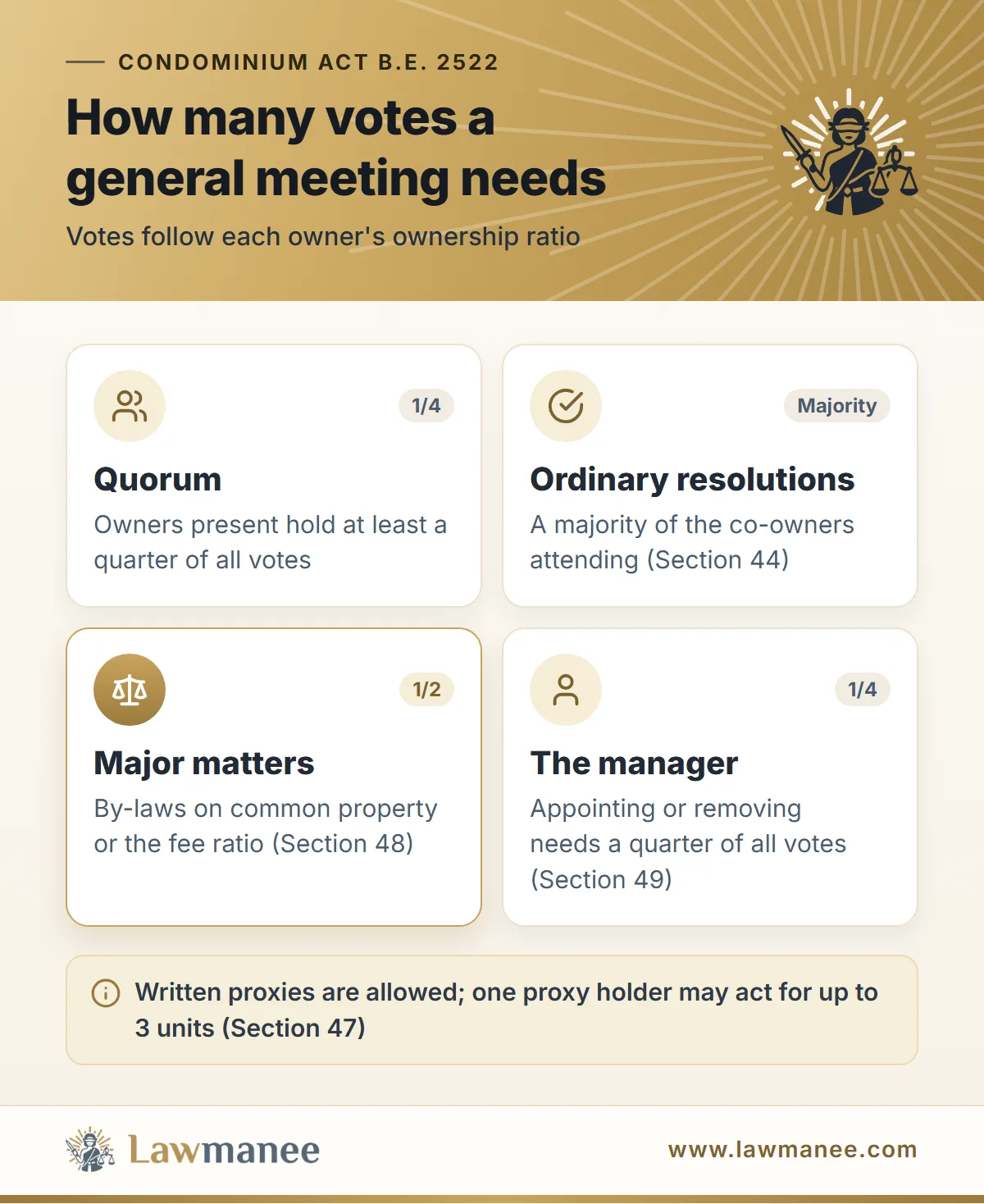
Each co-owner's votes equal their ownership ratio. If a single co-owner holds more than half of all votes, the Act reduces their votes to equal those of all the other co-owners combined (Section 45).
Ordinary resolutions pass by a majority of the co-owners attending (Section 44). Some matters need more:
- At least half of the votes of all co-owners (Section 48): buying or disposing of immovable common property; allowing a co-owner to alter a unit in a way that affects the common property or the building's exterior; amending the by-laws on the use or management of common property; changing the ratio of shared expenses; construction that alters or improves the common property; and earning income from the common property. If the votes at the meeting fall short, a new meeting is called within 15 days, where the resolution needs at least one third of all votes.
- At least one quarter of the votes of all co-owners (Section 49): appointing or removing the manager.
If you cannot attend, for example because you live abroad, you can give someone a written proxy. One proxy holder may act for no more than 3 units at a meeting, and committee members, the manager, their spouses and the juristic person's staff cannot be proxies (Section 47).
Registered by-laws can be changed only by a resolution of the general meeting, and the manager must register the change with the competent official within 30 days of the resolution (Section 32).
Checking the juristic person's finances
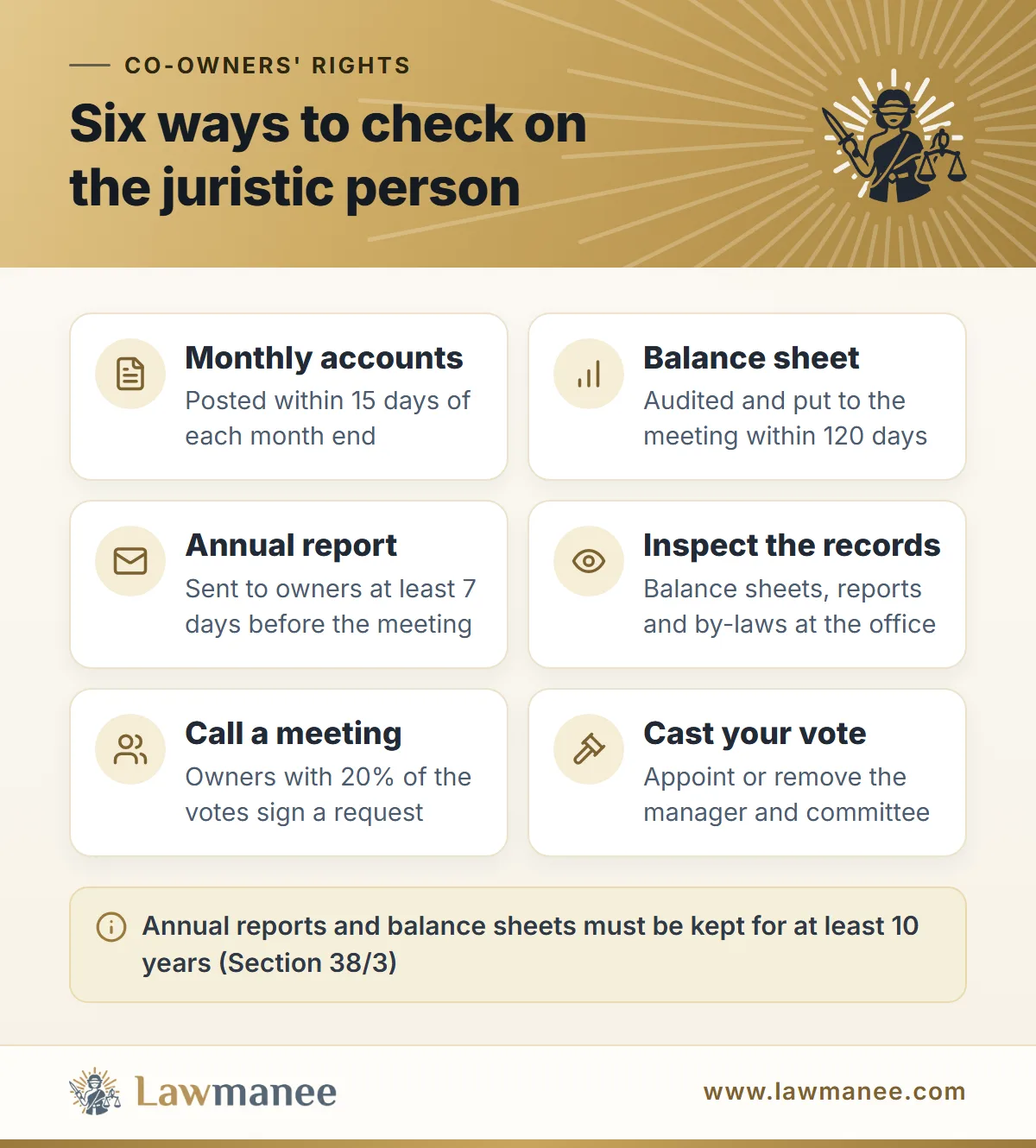
The Act gives co-owners several ways to see the numbers:
- Monthly income and expense account: the manager must prepare it and post it for the co-owners within 15 days of the end of each month, and keep it posted for at least 15 consecutive days (Section 36). A manager who fails to do so faces a fine of up to 50,000 baht plus up to 500 baht a day until it is done (Section 68).
- Balance sheet: prepared at least every 12 months, audited, and put to the general meeting for approval within 120 days of the financial year end (Section 38/1).
- Annual report: presented with the balance sheet, with copies sent to the co-owners at least 7 days before the meeting (Section 38/2).
- Inspection: the juristic person must keep the annual reports, balance sheets and by-laws at its office for co-owners to inspect, and keep the reports and balance sheets for at least 10 years (Section 38/3).
If you disagree with the management
- Ask to inspect the balance sheet, annual report and by-laws at the juristic person's office, and read the posted monthly accounts.
- Gather co-owners holding at least 20% of the votes and sign a request for an extraordinary general meeting.
- Put a motion to the meeting, such as removing the manager (at least one quarter of all votes) or removing a committee member (a majority of those attending, Section 37/3).
Talk to a lawyer about a condo dispute
Disputes with a juristic person usually turn on that building's own by-laws and meeting minutes, which are normally in Thai and differ from one building to the next. If you want a lawyer to read the documents or act for you, you can post your case on Lawmanee for free and interested lawyers will reply in the platform chat, or search lawyers by case type, province and language.