
When a marriage cannot go on, the first question is usually whether you have to go to court. Thai law allows a divorce in only two ways: by mutual consent, or by judgment of the court (Section 1514). This guide explains how the two differ, the legal grounds for a divorce action, how marital property is divided and what has to be settled about the children, under Book V (Family) of the Thai Civil and Commercial Code.
Since January 2025 Thai family law uses the word spouse instead of husband and wife, so everything below applies to every registered couple, whatever their gender.
Two ways to divorce
| Divorce by mutual consent | Divorce by court judgment | |
|---|---|---|
| When | Both spouses agree | The other spouse refuses, or you cannot agree on the children or property |
| Legal ground needed? | No | Yes, under Section 1516 |
| Where | Any district office in Thailand, or a Thai embassy or consulate abroad | The Juvenile and Family Court |
| Cost | No registration fee | Court fees, lawyer's fees and other costs |
| Takes effect | On registration | When the judgment becomes final |
The timing follows Section 1531. After a court divorce, have the judgment recorded at a district office too: until it is registered, the divorce cannot be used against third parties who acted in good faith.
Divorce by consent at a district office
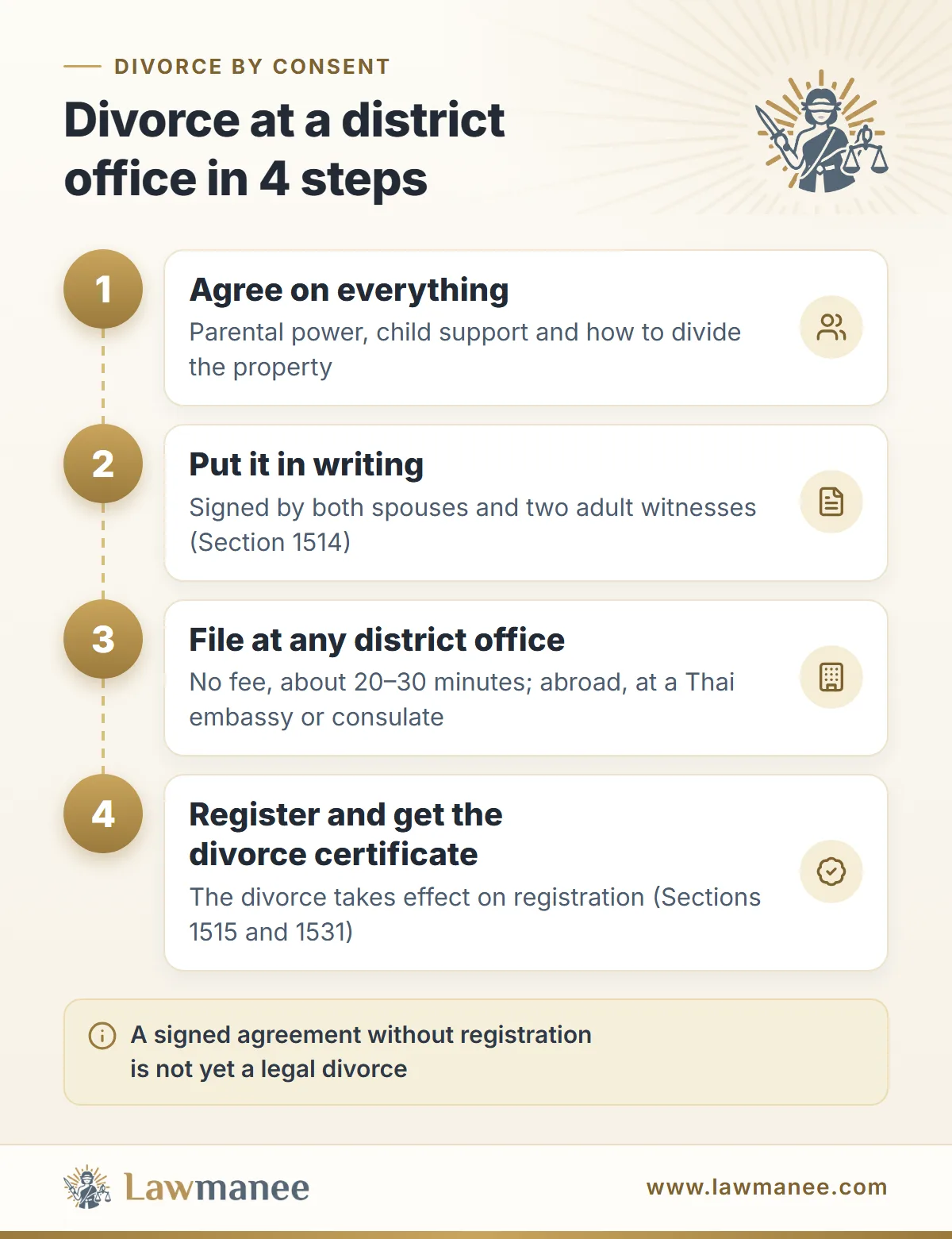
A divorce by mutual consent must be in writing and signed by at least two witnesses (Section 1514), and if the marriage was registered, the divorce is complete only once it has been registered too (Section 1515). An agreement you sign at home, even with two witnesses, is not yet a legal divorce.
- Agree on everything: which of you will exercise parental power over which child, who pays how much child support (Sections 1520 and 1522), and how the property will be divided.
- Prepare documents and witnesses: Thai ID cards or the ThaID app; a foreign spouse brings a passport; the marriage certificate if you have it; and two adult witnesses.
- File at any district office: it does not have to be the one where you married. Abroad, you can file at a Thai embassy or consulate. There is no fee, and the Department of Provincial Administration's guide says it takes about 20–30 minutes.
- Register and receive the divorce certificate: each of you keeps a copy, and the divorce takes effect at the moment of registration.
If you cannot attend together, the law also allows a divorce at two registration offices: each spouse files at their own office, after agreeing who goes first, and the divorce is complete when the second office has registered it.
Divorce in court needs a legal ground
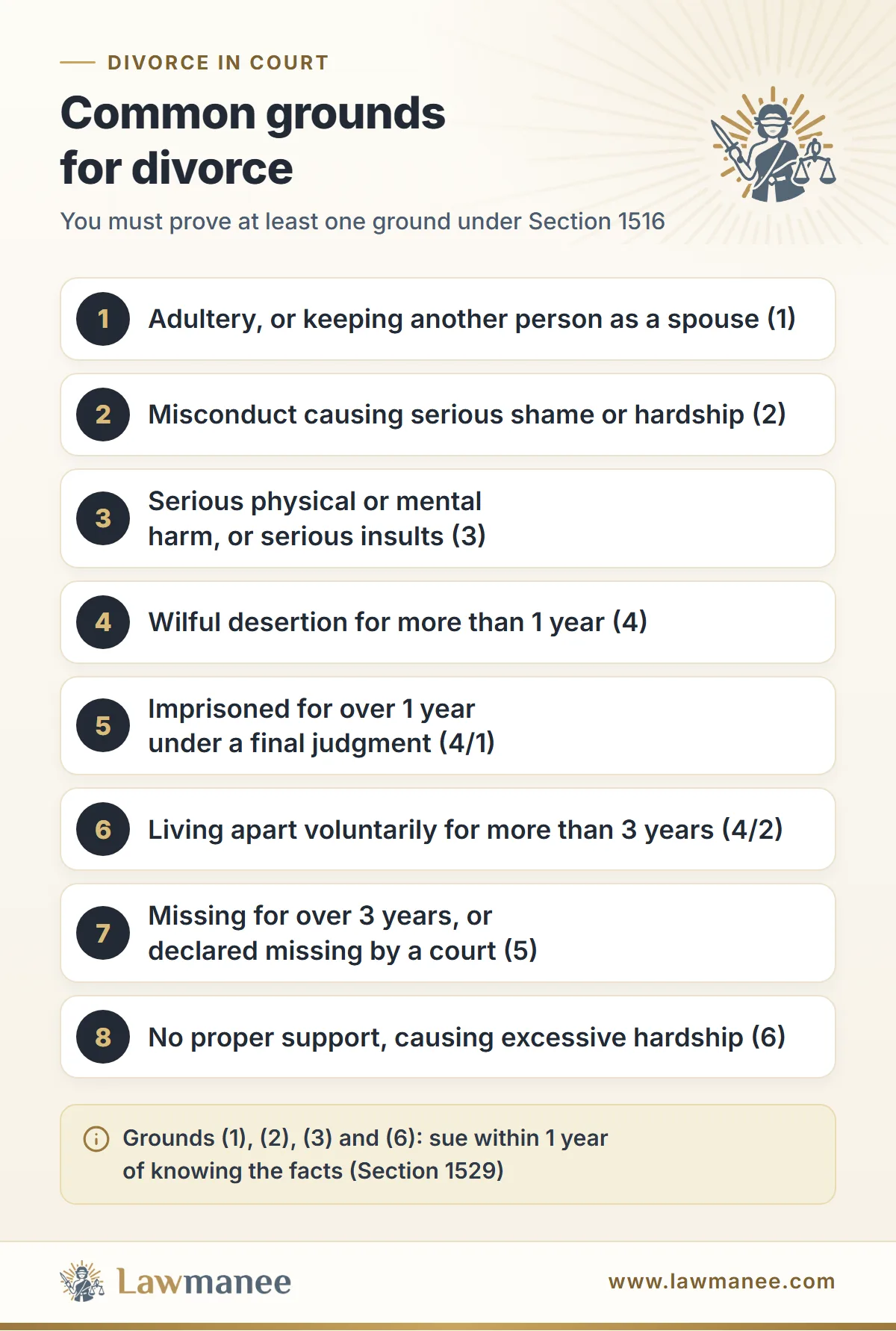
If your spouse will not agree, you have to sue and prove at least one ground under Section 1516:
- (1) the other spouse has maintained or honoured another person as a spouse, committed adultery, or habitually had sexual relations with someone else;
- (2) misconduct that causes you serious shame, contempt or excessive hardship;
- (3) serious physical or mental harm or torture, or serious insults, against you or your parents;
- (4) wilful desertion for more than 1 year;
- (4/1) imprisonment for more than 1 year under a final judgment, for an offence you had no part in, where staying married would cause you excessive hardship;
- (4/2) living apart voluntarily for more than 3 years because you could not live together normally, or apart under a court order for more than 3 years; here either spouse may sue;
- (5) the other spouse has been declared missing by a court, or has been gone for more than 3 years with no news of whether they are alive;
- (6) failure to give proper support, or acting seriously against the marriage, causing you excessive hardship.
The remaining grounds are unsoundness of mind for more than 3 years that is unlikely to be cured, breach of a written bond of good behaviour, a serious, chronic and incurable communicable disease, and a permanent physical inability to have sexual relations (Section 1516 (7) to (10)).
Time limits and bars
- Sue within 1 year: the right to divorce on grounds (1), (2), (3) or (6), and to claim compensation under Section 1523, ends 1 year after you knew or should have known the facts (Section 1529). A ground that is too old can still be proved in support of another ground.
- Forgiveness ends the right: if you act in a way that shows you have forgiven the other spouse, you can no longer sue on that ground (Section 1518).
- Consent is a bar: a spouse who consented to or connived at the conduct in grounds (1) or (2) cannot rely on it (Section 1517).
Where to file and what to prepare
Divorce is a family case, filed at the Juvenile and Family Court with jurisdiction, usually where the defendant is domiciled or where the cause of action arose. The court fee for a claim for divorce alone is 200 baht, as a claim without a monetary value; claims for property or money in the same case may add fees based on their value. The court usually sends the parties to mediation first, and a settlement can be recorded as a compromise agreement in court.
Keep evidence from the start: chat messages, photos, medical certificates, police reports and the names of witnesses. If you are being hurt or are in danger, your safety comes first: call the police on 191 or the Social Assistance Center hotline on 1300.
How marital property is divided
On divorce, marital property (sin somros) is divided equally (Section 1533), while each spouse keeps their own separate property (sin suan tua). So the first job is to sort the two.
- Separate property (Section 1471): property owned before the marriage; personal belongings, clothing and jewellery suitable to your station; tools of your trade or profession; property received during the marriage by inheritance or as a gift; and the engagement gift (khongman).
- Marital property (Section 1474): property acquired during the marriage; property received by will or written gift that declares it to be marital property; and the fruits of separate property, such as rent. In case of doubt, property is presumed to be marital property.
The name on a title deed or a car registration does not decide who owns it: property acquired during the marriage is marital property even if only one spouse's name is on it. For a divorce by consent, the property is divided as it stood on the day of registration; for a court divorce, the judgment on property takes effect back to the day the case was filed (Section 1532).
Example: A and B are married. A owns a condo bought before the marriage and rents it out, and has saved 300,000 baht of rent during the marriage. Together they bought a 3,000,000-baht house in B's name only, and saved another 1,000,000 baht during the marriage. B inherited 500,000 baht from B's father.
| Asset | Type |
|---|---|
| A's condo | A's separate property |
| B's 500,000-baht inheritance | B's separate property |
| 300,000 baht of saved condo rent | Marital property (fruits of separate property) |
| 3,000,000-baht house in B's name | Marital property |
| 1,000,000 baht of savings | Marital property |
The marital property totals 4,300,000 baht, so each spouse receives 2,150,000 baht. A also keeps the whole condo, and B keeps the whole inheritance.
Children, child support and alimony
- Parental power: in a divorce by consent, you must agree in writing who will exercise parental power over each child; if you cannot agree, the court decides. In a court divorce, the court decides this in the same case, having regard above all to the child's happiness and interests (Section 1520).
- Child support: the divorce agreement states how much one or both of you will pay; in a court divorce, or if the agreement is silent, the court fixes it (Section 1522).
- Alimony: if the divorce is caused by the fault of the other spouse alone, and the divorce leaves you in need because your income from property or work is not enough, you can ask the spouse at fault for a living allowance. You must claim it in the divorce case itself, or the right is lost (Section 1526).
- Compensation: when the court grants a divorce on ground (1), you can claim compensation from your spouse and from the person who caused the divorce (Section 1523).
If you or your spouse is a foreign national
- If you married at a Thai district office, you can also divorce by consent at a district office. The foreign spouse uses a passport; bring an interpreter if you do not understand Thai, and have foreign-language documents translated into Thai and certified before you file.
- If you have to sue in Thailand, a Thai court grants the divorce only if the national laws of both spouses allow divorce, while the grounds follow the law of the place where the case is filed (Conflict of Laws Act B.E. 2481, Section 27).
- Whether your home country recognises a Thai divorce, and what you must do there, varies by country: check with your embassy before you file.
Talk to a family lawyer
An agreed divorce does not require a lawyer, but if you have children, several assets, or a spouse who will not agree, having a lawyer draft the agreement or assess your evidence before you sue can prevent problems later. On Lawmanee you can describe your situation for free so that family lawyers can contact you, or search lawyers by case type, province and language.