
A photo edited to make you look ridiculous, a private picture you once sent an ex now posted for everyone, or your phone number and address shared with a stream of abuse: it can happen to anyone, and the longer it stays up the further it spreads. This guide explains what Thai law offers and what to do, in order.
Several laws can apply
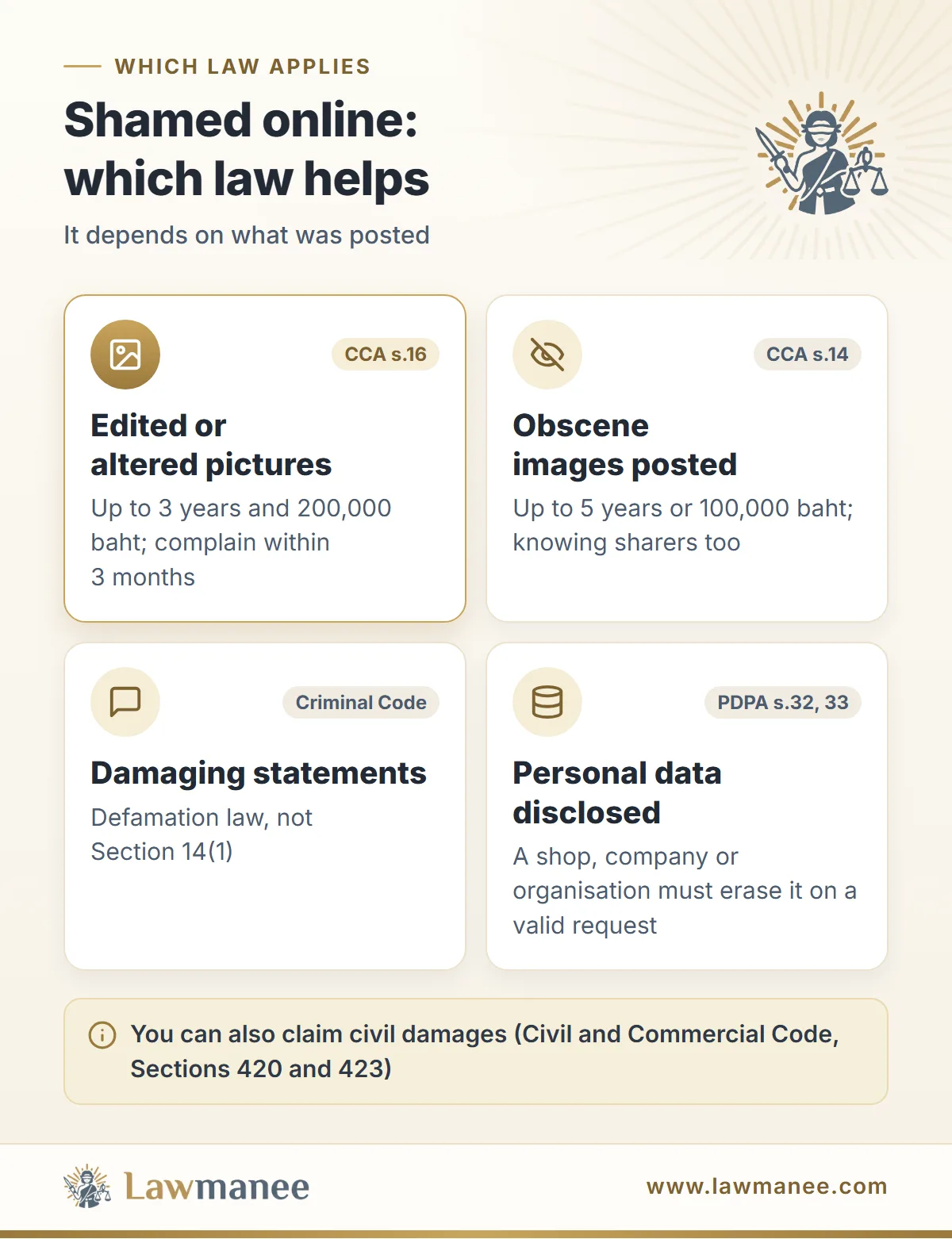
Being exposed or shamed online can fall under several laws at once, depending on what was posted.
| What was posted | Main law | Penalty or remedy |
|---|---|---|
| A picture of you created, edited or altered to damage your reputation or shame you | Computer Crime Act, Section 16 | Up to 3 years in prison and a fine of up to 200,000 baht |
| Obscene images or data that the public can access | Computer Crime Act, Section 14(4) | Up to 5 years in prison or a fine of up to 100,000 baht, or both |
| Statements that damage your reputation | Criminal Code, Sections 326 and 328 | Defamation; see Lawmanee's guide to online defamation |
| Personal data disclosed by a shop, company or organisation | Personal Data Protection Act B.E. 2562 (PDPA) | Erasure, complaint and damages |
| Harm to your reputation, wellbeing or income | Civil and Commercial Code, Sections 420 and 423 | A civil claim for damages |
Section 16: edited or altered pictures
Section 16 of the Computer Crime Act covers putting into a publicly accessible computer system a picture of another person that has been created, edited, added to or altered, electronically or otherwise, in a way likely to damage that person's reputation or expose them to contempt, hatred or shame. AI-generated pictures and deepfakes can fall under it.
- Up to 3 years in prison and a fine of up to 200,000 baht.
- There is no need to prove that viewers believed the picture was real; it is enough that it was likely to cause the harm.
- It is a compoundable offence: the victim must file a complaint within 3 months of learning of the offence and who committed it (Criminal Code, Section 96), or criminal proceedings are no longer possible.
Section 14: obscene and false data
If a private image or clip of an obscene nature is posted where the public can see it, that may be an offence under Section 14(4), and people who knowingly share it on may commit an offence under Section 14(5). The penalty is up to 5 years in prison or a fine of up to 100,000 baht, or both.
Section 14(1), on false data likely to harm the public, states expressly that it does not cover defamation. A post that insults or makes false claims about you personally is a matter for defamation law instead.
Getting it taken down
- Report it to the platform. Every platform has a way to report posts that breach privacy or share intimate images. Do this alongside keeping evidence, not instead of it.
- A court order to destroy the data. When a court convicts someone under Section 14 or 16 it may order the data destroyed (Section 16/1), and anyone who knows they hold data the court has ordered destroyed must destroy it, or face half the penalty for the original offence (Section 16/2).
- A court order to suspend or remove data. Under Section 20, a competent official under the Computer Crime Act, with the minister's approval, can ask the court to order that data which is an offence under the Act be suspended or removed.
- Your PDPA rights. If the data was disclosed by a shop, company or organisation that held it, you can object (Section 32), ask for it to be erased or destroyed (Section 33), and complain to the Office of the Personal Data Protection Committee.
Keep the evidence before the post disappears
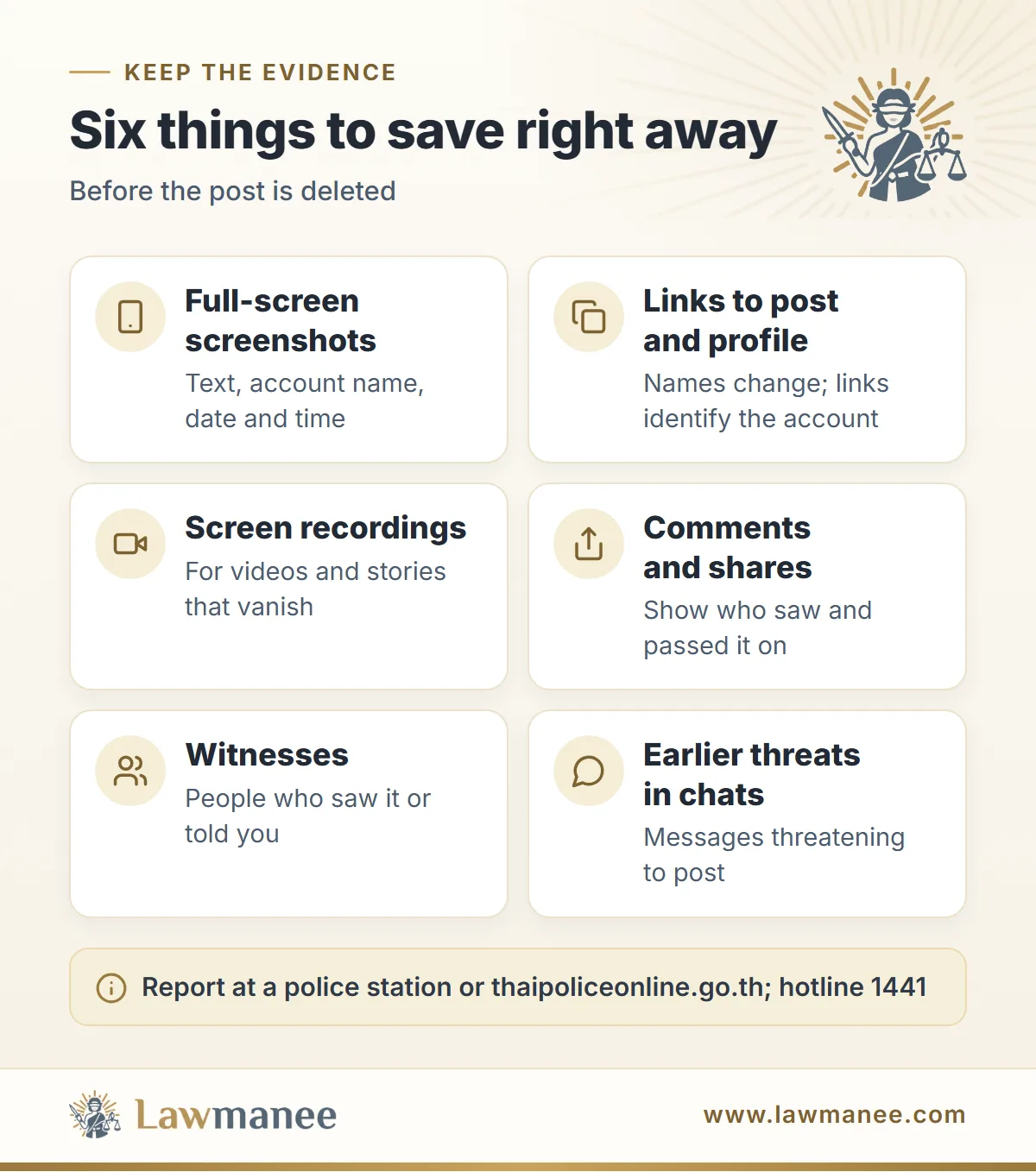
Posts can be deleted at any moment, so keep the evidence as soon as you see them:
- Screenshot the whole screen, showing the text or picture, the account name, and the date and time of the post.
- Copy the links (URLs) of the post and of the poster's profile. Display names change; the link identifies the account.
- Screen-record videos and stories that disappear on their own.
- Keep comments and shares that show people saw and passed it on.
- Note your witnesses, the people who saw the post or told you about it.
- Keep earlier chats. If the poster threatened to release the picture, that threat is important evidence.
Do not hit back by exposing them in return; you could end up committing an offence yourself.
Where to report it
You can report at a police station, or online at thaipoliceonline.go.th, which takes technology crimes including Computer Crime Act offences; the 24-hour hotline 1441 gives advice. Beware of fake pages offering to take complaints by chat: Thai government agencies do not take police reports through Facebook, LINE or private messages.
For example, Nan finds that an account has turned her photo into an indecent picture and posted it in a public group on 1 March. On 10 March she learns that the account belongs to her ex-boyfriend. The 3-month deadline for a Section 16 complaint therefore runs from 10 March.
Talk to a lawyer
A lawyer can help you choose which law to rely on, draft the police complaint, send a demand to remove the post and sue for damages. On Lawmanee you can describe your situation for free, without putting any pictures or personal details in the post, and interested lawyers reply in the platform chat; or search lawyers for criminal cases by province and language.