
Many Thai families prefer to hand a house or land to their children while the parents are still alive, so that everyone knows who gets what and no estate has to be administered later. This is a gift (การให้โดยเสน่หา), and it costs far less in fees and tax than a sale. There are still points to think through before signing, above all where the parents will live afterwards and whether the gift can ever be taken back.
What a gift is and how it is made
A gift is a contract by which the giver transfers their property to the recipient without payment, and the recipient accepts it (Section 521 of the Civil and Commercial Code). For a house or land, the gift is complete only when it is made in writing and registered with the competent official (Section 525). A private letter or handing over the title deed does not transfer ownership: the gift has to be registered at the Land Office.
Fees and taxes when parents give to their child
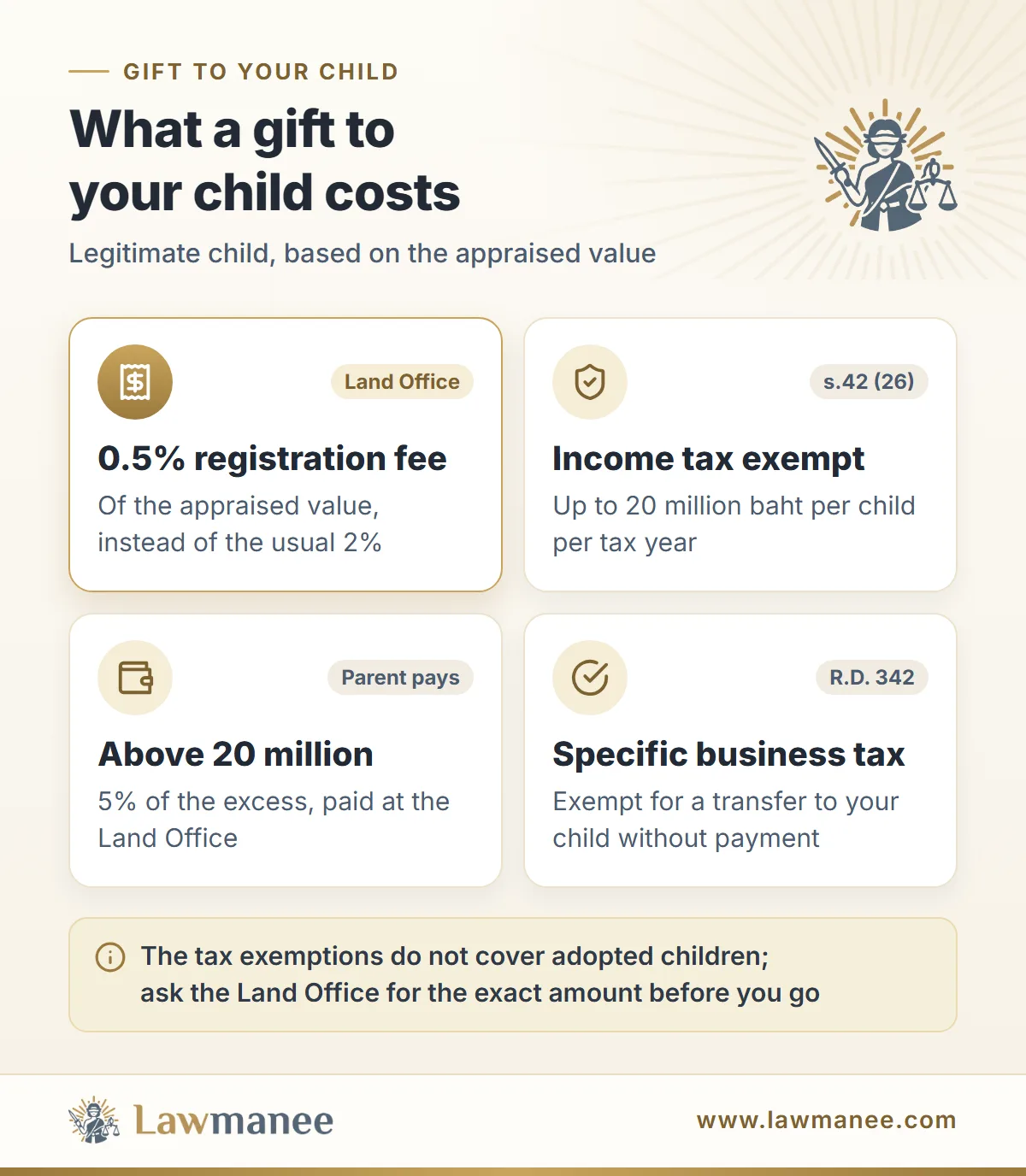
When a father or mother gives property to their legitimate child, the main costs are:
| Item | Gift to your child | Notes |
|---|---|---|
| Registration fee | 0.5% of the appraised value | Applies between ascendants and descendants, or between spouses; otherwise 2% |
| Parent's income tax | Exempt up to 20 million baht per child in the same tax year | Revenue Code Section 42 (26); adopted children are not included |
| The part above 20 million baht | 5% of the appraised value above that amount | Paid by the transferring parent at the Land Office on the day of registration |
| Specific business tax | Exempt | Royal Decree No. 342; legitimate children, not adopted children |
A common misunderstanding is that the child who receives the property pays the tax. For real estate given by a parent to a child, the Revenue Department makes the transferring parent pay the tax on any part above 20 million baht. Ask the Land Office that handles the plot for the full amount before you go, because everything is calculated on that plot's appraised value.
Example. A mother gives her daughter a house and land appraised at 3,000,000 baht. The registration fee is 0.5%, or 15,000 baht; there is no income tax because the value is under 20 million baht, and specific business tax is exempt. If the plot were appraised at 22,000,000 baht, the part above 20 million would be 2,000,000 baht and the mother would pay 5% of it, 100,000 baht, as in the Revenue Department's own example. (Figures for illustration only.)
If the home is marital property
A house or land acquired during the marriage is often marital property (สินสมรส). Giving it away, including to your own child, requires both spouses to act together or one spouse to have the other's consent (Section 1476 (5)). Both spouses should go to the Land Office, or bring the other spouse's written consent.
The steps at the Land Office
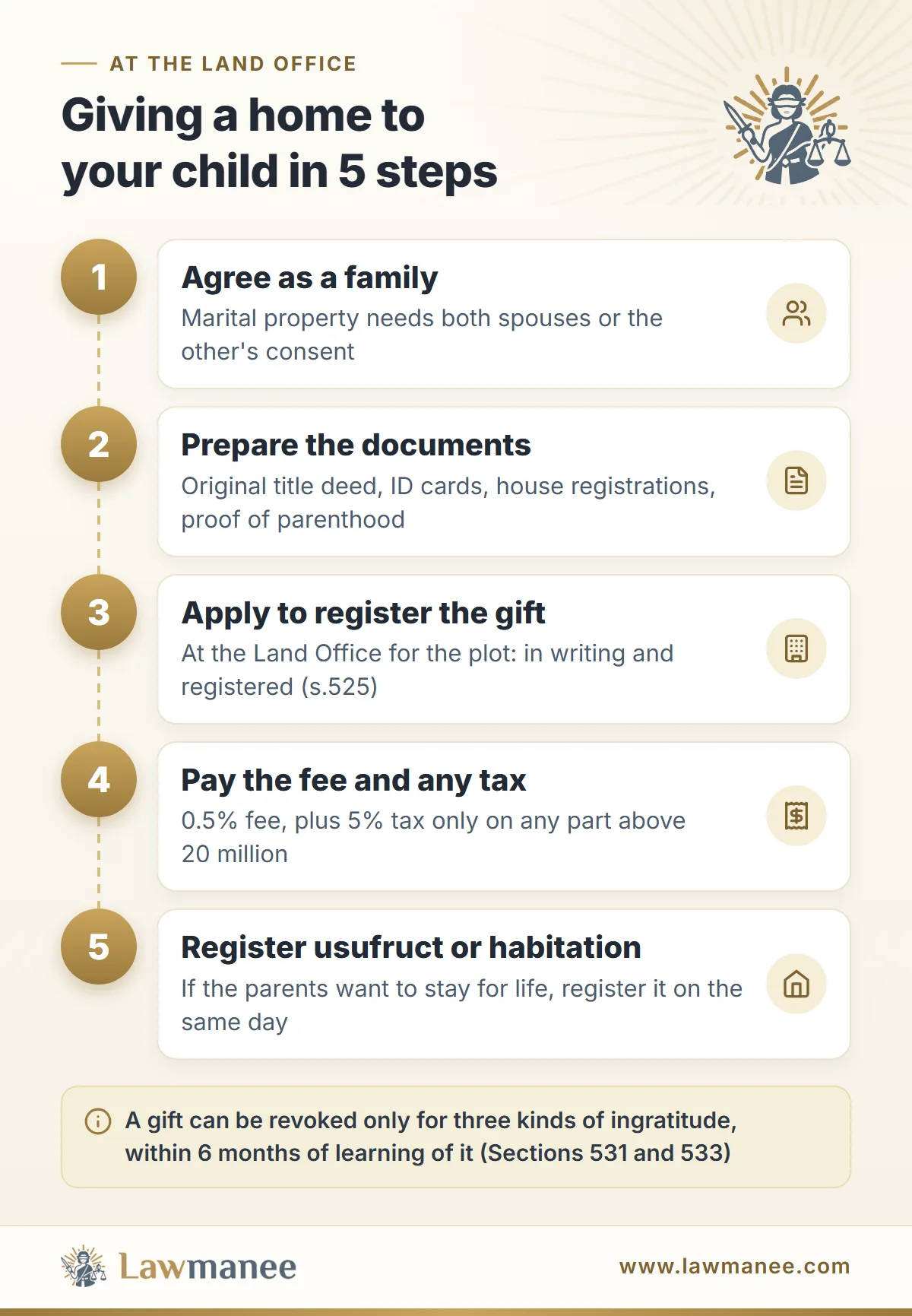
The documents usually needed are the original title deed or condominium title, the ID cards and house registration books of the giver and the recipient, proof of the parent-child relationship such as a birth certificate, the marriage certificate or the spouse's consent when the property is marital property, and a power of attorney if someone acts for you. Check the exact list with the Land Office before you go.
Can a minor child receive the gift?
Yes. A minor may make any juristic act by which they merely acquire a right (Section 22). But if the gift comes with conditions or a charge, the parent exercising parental power may accept it on the child's behalf only with the court's permission (Section 1574 (9)). If you want to attach conditions, ask a lawyer first whether court permission is needed.
How parents can keep living in the home
Once the transfer is registered, the house belongs to the child, who can sell or transfer it. Parents who want to be sure they can stay for life can register a right on the title deed at the same time.
- Usufruct (สิทธิเก็บกิน): the holder may possess, use and enjoy the property (Section 1417). It can be for a fixed period or for life; if no period is set it lasts for life, and it ends when the holder dies (Section 1418). Registering it without payment costs a fee of 50 baht per plot.
- Right of habitation (สิทธิอาศัย): the right to live in a building without paying rent (Section 1402), for up to 30 years or for life (Section 1403); it cannot be transferred or inherited (Section 1404).
Once registered, the right stays attached to the land even if the child later transfers the land to someone else.
When can a gift be revoked?
A gift cannot be taken back at will. The giver can revoke it for ingratitude in only three cases (Section 531):
- The recipient committed a serious criminal offence against the giver.
- The recipient seriously defamed or insulted the giver.
- The recipient refused to give the giver the necessities of life when the giver was in need and the recipient was able to help.
Limits to know:
- Time limits: no revocation once the giver has forgiven the recipient, or after six months from learning of the cause, and never more than ten years after the event (Section 533).
- The giver's heirs may revoke only if the recipient intentionally and unlawfully killed the giver or prevented the giver from revoking; if the giver had already sued, the heirs may continue the case (Section 532).
- Gifts that cannot be revoked include gifts subject to a charge, gifts made out of moral duty and gifts made on marriage (Section 535).
Hurt feelings or family arguments are therefore not enough to get a house back. If this worries you, registering a usufruct or a right of habitation on the day of the transfer is the better protection.
If your child is a foreign national
Under the Land Code, foreigners generally cannot own land in Thailand. For condominiums, foreigners together may own no more than 49% of the total unit area of a building (Condominium Act Section 19 bis). If your child holds another nationality, talk to a lawyer before planning the transfer.
Talk to a lawyer before you transfer
A gift of a home is signed once but has effects for decades. Planning who receives what, when, and which rights the parents keep prevents many family disputes. On Lawmanee you can describe your situation for free, without personal details, and interested lawyers reply in the platform chat, or search lawyers for property matters by province and language.