
Many families mean to make a will, write something simple themselves, and only later find out it is worthless. Thai law sets strict forms for wills; if the form is wrong, the property goes to the statutory heirs as if there were no will at all. This guide explains how to make a will that works under the Thai Civil and Commercial Code.
Why make a will
Without a will, the estate is shared among the statutory heirs in the order the law sets, which may not be what you want. For example:
- A partner you live with without a registered marriage is not a statutory heir.
- Your spouse's children who are not your own children do not inherit from you.
- You may want the house to go to one child and the land to another, rather than everyone owning everything jointly.
- You may want to leave something to a temple, a foundation or the person who cares for you.
For example, Somchai owns a condominium unit worth 3 million baht as his personal property, has one child, and lives with Nid without a registered marriage. If he dies without a will, the whole unit goes to his child and Nid receives nothing. If he leaves the unit to Nid in a valid will, it becomes hers under the will.
Remember that a will can only dispose of the testator's own property. With marital property, half already belongs to the spouse, so you can only leave your own half.
Who can make a will
The testator must be at least 15 years old; a will made by someone under 15 is void (Section 1703). Make the will while fully of sound mind. If the testator is elderly or ill, keep evidence that they were clear-minded on the day, to prevent disputes later.
The five legal forms of will
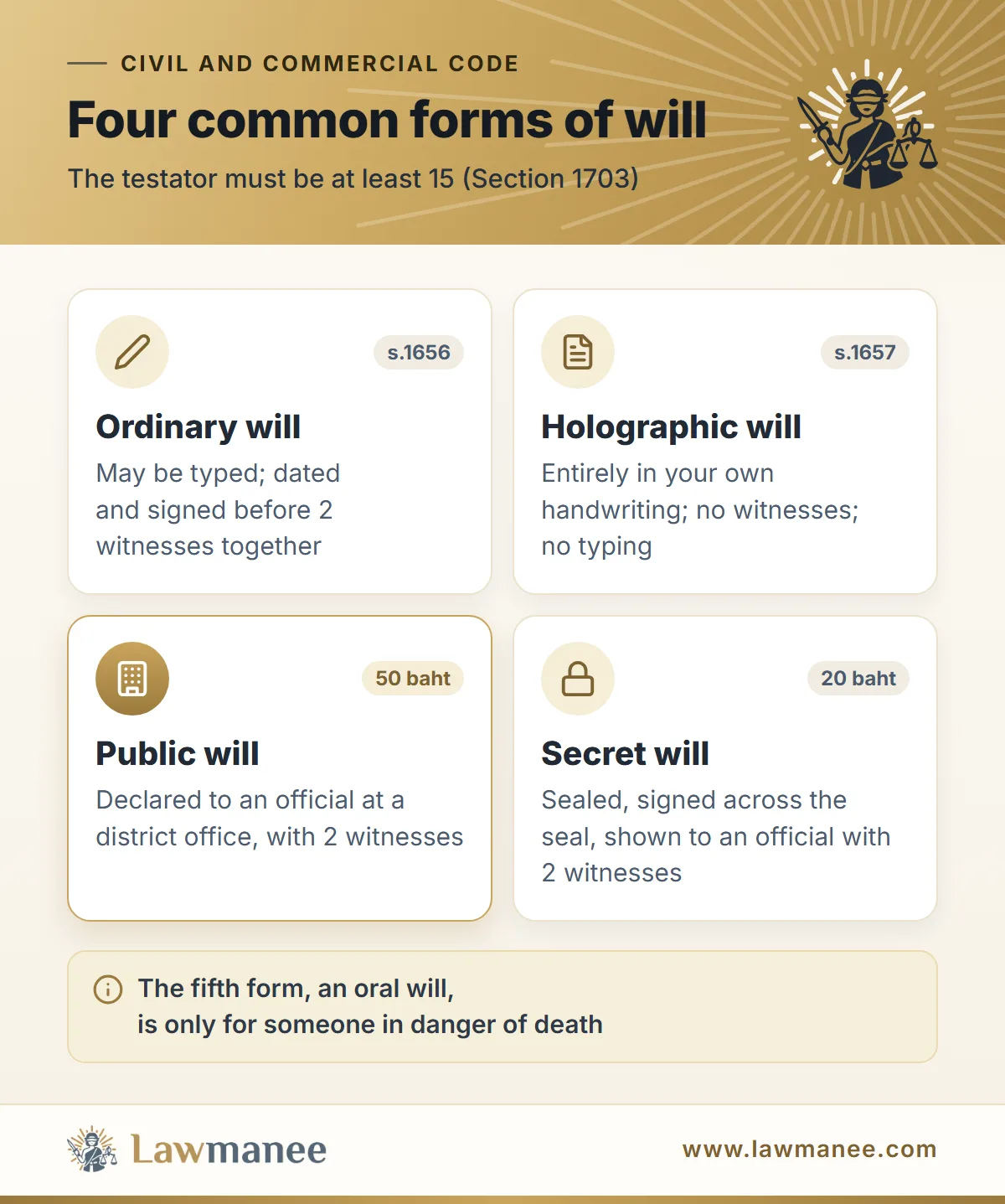
| Form | How it is made | Witnesses |
|---|---|---|
| Ordinary (Section 1656) | In writing (typing is fine), dated, signed by the testator in front of the witnesses | at least 2, present together, who sign at that time |
| Holographic (Section 1657) | The whole text, the date and the signature in the testator's own handwriting | none needed |
| Public (Section 1658) | Declared to an official at a district office, who writes it down and reads it back | at least 2 |
| Secret (Section 1660) | Signed, sealed in an envelope, signed across the seal, then presented to a district official | at least 2 |
| Oral (Section 1663) | Only in danger of death when no other form is possible | at least 2, who must report to an official promptly |
Common mistakes with each form:
- Ordinary will: both witnesses must be present together when the testator signs, not sign one after the other later. Any later erasure, addition or change must go through the same formalities again.
- Holographic will: nothing may be typed or written by anyone else, not even part of it. It needs a real signature (a fingerprint does not count), and every change must be handwritten and signed by the testator.
- Secret will: any change to the text must carry the testator's signature.
Making a will at the district office
A public will suits anyone who wants maximum reliability, because a government official writes down and certifies it. You can go to any district registration office or, in Bangkok, any district office, wherever you live.
- Fee for a public will: 50 baht, or 100 baht if you ask the official to come to you.
- Fee for a secret will: 20 baht.
- Bring your ID card or passport, a list of your assets and title documents, the names of the beneficiaries, and two witnesses.
- You can ask the district office to keep the will for you. For details, call the Department of Provincial Administration call centre on 1548 (Thai language).
Who cannot witness, and who cannot benefit
Section 1670 says the following people cannot witness a will:
- Minors
- Persons of unsound mind, or persons the court has declared quasi-incompetent
- Persons who are deaf, mute or blind in both eyes
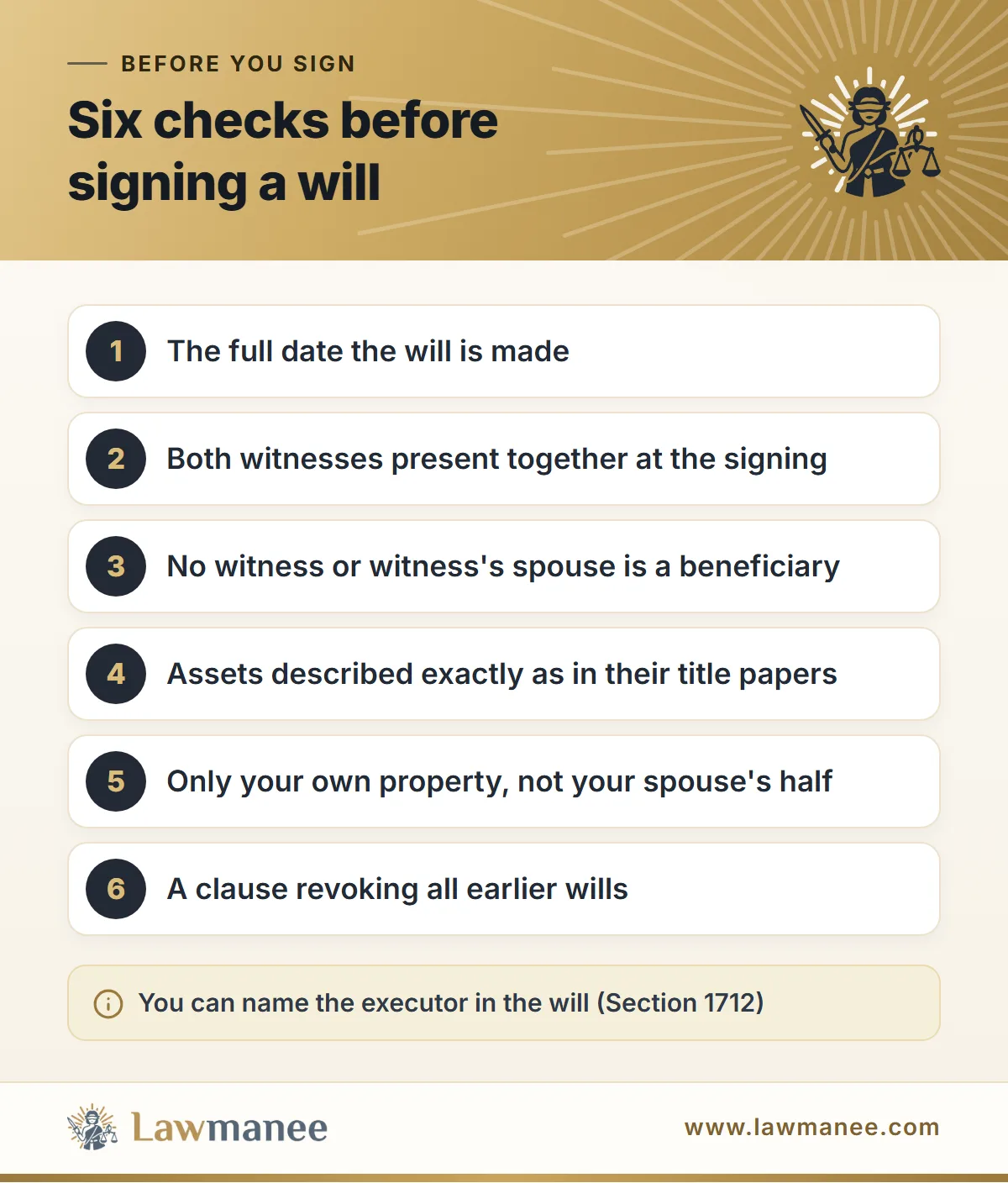
In addition, the person who writes the will for the testator, the witnesses, and their spouses cannot benefit under that will (Section 1653). A common mistake is asking a beneficiary's child or spouse to witness, so choose witnesses with no interest in the will at all.
Naming an executor in the will
The testator can name the executor in the will, or name someone who will choose the executor (Section 1712). Pick someone you trust, who is comfortable with paperwork and willing to take on the task. Naming one in advance reduces disputes between heirs, although in practice many institutions may still ask for a court order appointing the administrator before transferring assets.
Changing or revoking a will
- The testator may revoke the will at any time, wholly or in part (Section 1693).
- If you revoke it with a new will, the new will must itself follow a legal form (Section 1694).
- If there is only one original, you can revoke it by deliberately destroying or striking it out; if there are several originals, you must do so to every one (Section 1695).
- If an earlier and a later will conflict and you have not said otherwise, the earlier will is revoked only where the two conflict (Section 1697).
The clearest way is to state in the new will that all earlier wills are revoked, and to make the new will in a valid form.
Foreigners making a will in Thailand
Foreigners can make a will in a Thai legal form. If you own assets in Thailand, such as a condominium unit or bank deposits, a will made under Thai law makes it easier for your heirs to deal with them here. Make it bilingual or have an accurate translation, and check that it does not conflict with any will you made in your home country. Land in Thailand is subject to special rules on inheritance by foreigners, so talk to a lawyer first.
Talk to a lawyer about your will
A good will follows the correct form, uses clear wording and describes each asset exactly as in its title documents. A lawyer can draft it, check the formalities and arrange the witnesses. On Lawmanee you can describe your situation for free so that inheritance lawyers can reply in the platform chat, or search lawyers by case type, province and language.