
You buy a plot and find it has no road access, or a family divides inherited land and the inner plot ends up boxed in. Thais call this "blind land" (ที่ดินตาบอด). The Civil and Commercial Code offers two solutions, a way of necessity and a servitude, with very different conditions and effects. Here is how to tell which one fits.
What a way of necessity is
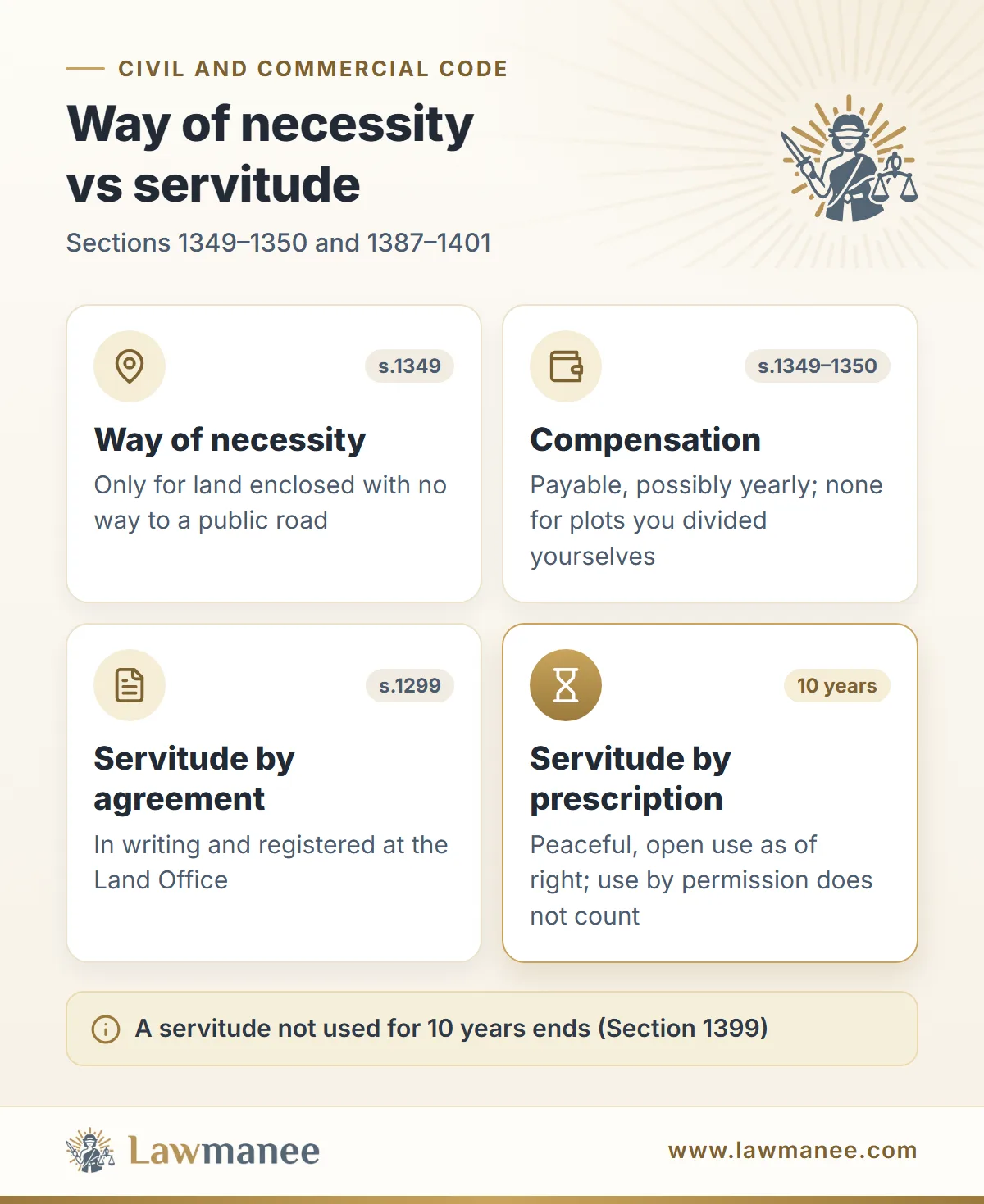
Under Section 1349, when a plot is surrounded by other land so that it has no way to a public road, its owner may pass through the surrounding land to reach the road. The same applies when the only way out crosses a pond, marsh or the sea, or when the land and the road are at very different levels.
- Where and how: the route must be reasonable for the owner's needs while causing the least possible damage to the surrounding land; a road may be built if necessary.
- Compensation: the person using the way must compensate the surrounding owner for the damage, and apart from damage from building a road, it may be set as an annual payment.
- It arises by law: no consent from the neighbour and no years of prior use are needed.
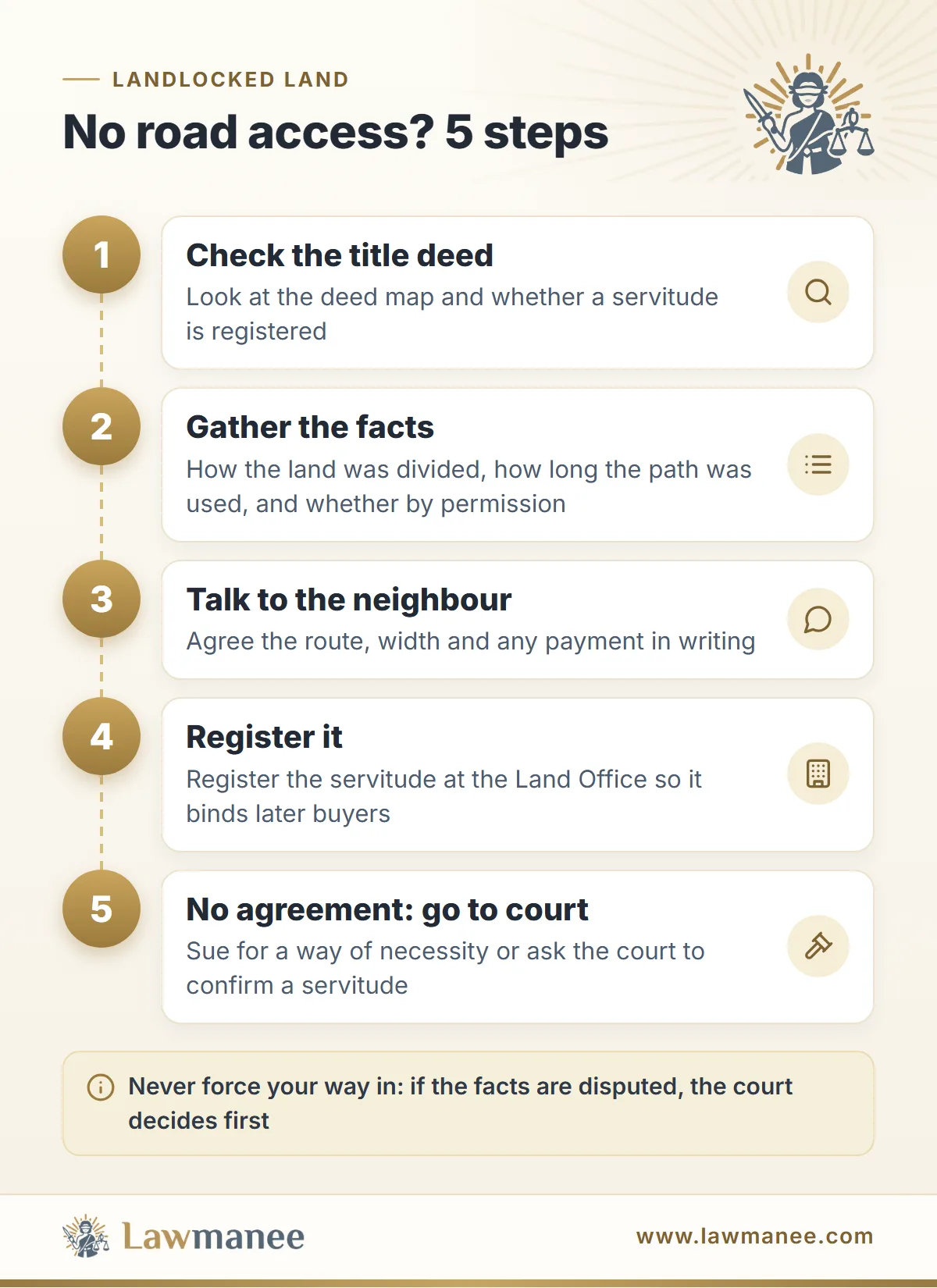
It does not, however, let you go in and build a path by force. The Supreme Court (judgment 1323/2564, 2021) held that when the parties still dispute whether the land really is enclosed, a civil court must decide first.
Land you divided yourselves: no compensation
If a subdivision or partial transfer is what leaves a plot without access, its owner can claim a way only over the plots that came from that same subdivision, and pays no compensation (Section 1350).
Example: parents divide one plot among three children, and the youngest child's plot is at the back. The youngest can claim a way across the siblings' plots from the same land, free of charge, but cannot claim one across an unrelated neighbour's land. The better approach is to leave a path when dividing the land and register it clearly.
What a servitude is
A servitude is a real right under which the owner of one plot (the servient land) must tolerate certain acts, or refrain from certain rights, for the benefit of another plot (the dominant land) (Section 1387). A right of way is the most common servitude, but unlike a way of necessity your land need not be landlocked, and the route can cross any plot the owners agree on.
A servitude can be acquired in two ways:
- By agreement, with or without payment. It must be in writing and registered at the Land Office, or it is not complete as a real right (Section 1299, paragraph 1).
- By prescription: using the way peacefully, openly and with the intention of acquiring a servitude, continuously for 10 years (Section 1401 with Section 1382).
Does 10 years of use always give you the right?
No. If you used the way because the owner allowed it, because you asked, because you paid, or simply as a friendly courtesy, the courts treat the use as lacking the intention to acquire a servitude, and no servitude arises even after more than 10 years.
Also, a servitude acquired by prescription but not registered cannot be raised against a third party who later buys the servient land in good faith, for value, and registers the purchase (Section 1299, paragraph 2). Once the 10 years are complete, have a court confirm the right and register it promptly.
Rights and duties once a servitude exists
| Issue | Rule |
|---|---|
| Owner of the servient land | Must not do anything that reduces the servitude's usefulness or convenience, such as blocking it (Section 1390) |
| User of the way | Must not make changes that add to the burden on the servient land (Sections 1388 and 1389) |
| Upkeep | The user may do everything necessary to maintain it, at their own cost and with as little damage as possible (Section 1391) |
| Moving the way | The servient owner may ask to move it to another part of the land if this benefits them and they pay the cost (Section 1392) |
| When it ends | Not used for 10 years (Section 1399), or either plot is entirely destroyed (Section 1397) |
Which route to take
- If you and the neighbour agree, sign a written servitude and register it at the Land Office: this is the clearest option and binds later buyers.
- If you cannot agree and the land really is enclosed, sue for a way of necessity and be ready to pay compensation (none in a subdivision case under Section 1350).
- If you have used the way for 10 years with the intention of having a right, ask the court to confirm the servitude and register the judgment.
Foreigners and buyers: check access first
Foreigners generally cannot own land in Thailand, except in narrow cases, but these rules still matter if your Thai spouse or family owns the land, or if you rent or plan to buy a house. The rights belong to the registered landowner. Before any purchase, check the map on the title deed to see whether the land touches a public road. If access crosses someone else's land, ask at the Land Office whether a servitude is registered, and do not rely on "everyone has used this path for years". Land Office documents are in Thai, so bring someone you trust to translate.
Talk to a lawyer about landlocked land
Necessity and servitude cases turn on the facts: how the land was divided, who allowed what and when, and the situation on the ground. A property lawyer who looks at the documents early helps you choose the right route. On Lawmanee you can describe your situation for free so that interested lawyers reply in the platform chat, or search lawyers by case type, province and language.