
Under Thai law, a child born to parents who never registered their marriage is the legal child of the mother only, even if the father supports the child or is named on the birth certificate. A father who wants to be the legal father, share parental power and give the child full rights must first make the child his legitimate child. This guide explains the rules in Book V (Family) of the Civil and Commercial Code.
Whose child is a child born outside marriage?
A child born to a woman who is not married to the man is the legitimate child of that woman, unless a law provides otherwise (Section 1546). The mother therefore holds parental power alone. The father becomes the legal father in one of three ways (Section 1547):
| Route | How |
|---|---|
| The parents marry later | Register the marriage at a district office; the child becomes the father's legitimate child without a separate legitimation |
| The father registers legitimation | Apply at a district office; both the child and the mother must consent |
| A court judgment | File a claim or petition at the Juvenile and Family Court |
Whose consent is needed?
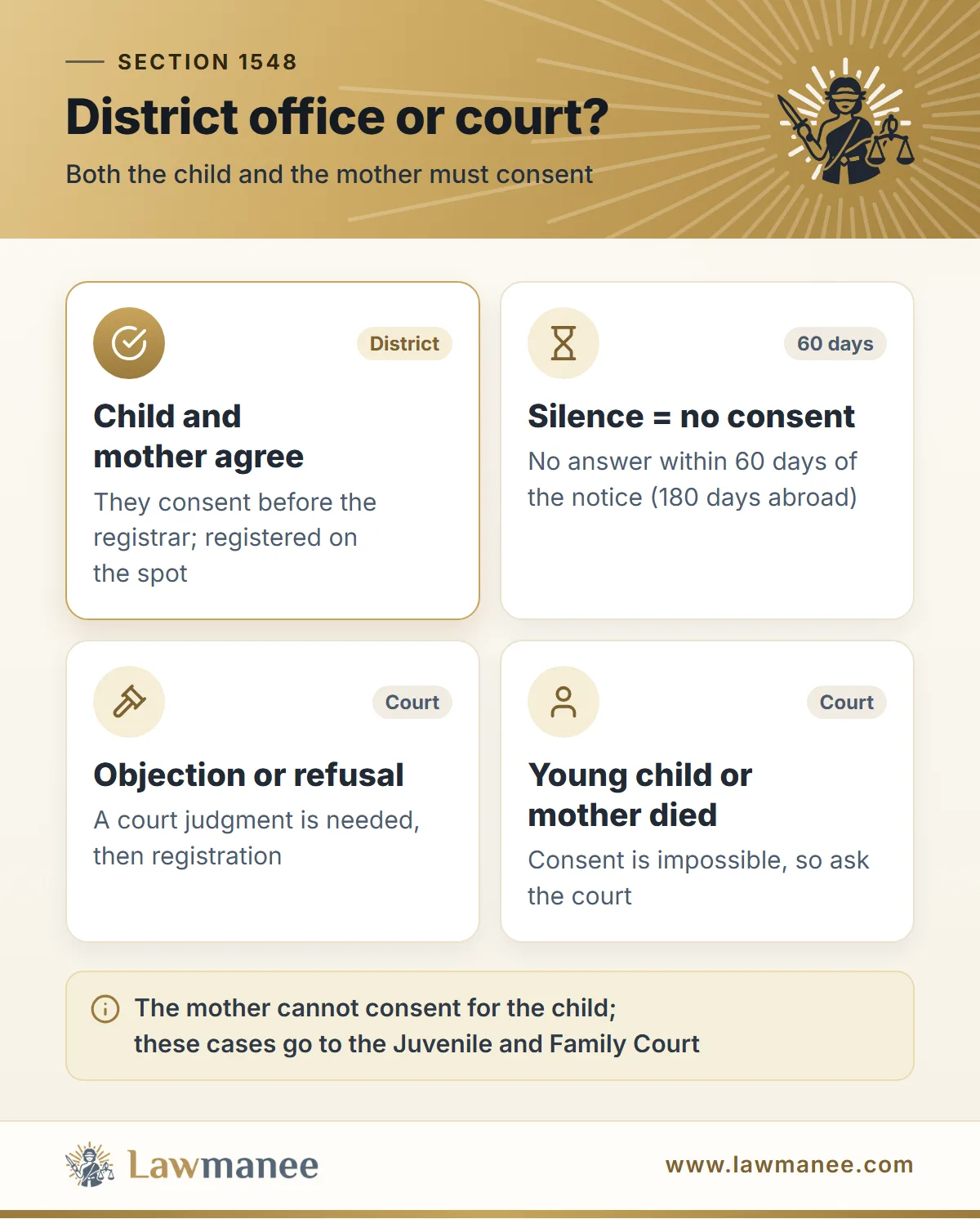
The father can register the child as his legitimate child only with the consent of both the child and the mother (Section 1548). Consent is personal: the mother cannot consent on the child's behalf.
- The child or the mother did not come to the office: the registrar notifies them of the father's application. If they neither object nor consent within 60 days of the notice, the law presumes that they do not consent; the period is 180 days if they live outside Thailand. Silence is not agreement.
- The child or the mother objects, refuses or cannot consent: registration requires a court judgment. When the father brings the judgment, the registrar registers the legitimation.
- The child is too young to understand: the child cannot give consent. The Supreme Court has held that a court judgment was needed for a 5-month-old (judgment 1177/2540) and for a 3-year-old (judgment 5982/2551). In practice the registrar checks whether the child understands enough to consent personally.
- The mother has died: she cannot consent, so a court judgment is needed here too.
Registering at the district office
The father files the application at any district office (amphoe) or Bangkok district office (khet), regardless of where he lives, or at a Thai embassy or consulate abroad. The mother and the child must give their consent in person before the registrar.
- Bring the ID cards and house registration books of the father, the mother and the child, the child's birth certificate, and two witnesses.
- The father files the application.
- The mother and the child consent before the registrar.
- The registrar registers it and issues the legitimation certificate (Kor Ror 11).
Registration at the registry office is free of charge; registration outside the office costs 200 baht per copy.
When a court must decide
Cases go to the Juvenile and Family Court. When everyone agrees, for example the mother consents but the child is too young, it is usually filed as a petition; when the mother objects, it becomes a contested case. The Juvenile and Family Court advises that the applicant must take the child and the mother to the director of the Observation and Protection Centre, who prepares a report for the court.
If paternity is in doubt, the court can order a scientific test such as DNA (Civil Procedure Code Section 128/1). A person may refuse, but refusing without good reason can lead the court to presume facts against that person.
The other way round, if the father denies the child, the child can ask the court to declare him the father on the grounds in Section 1555, for example a document in which the man acknowledged the child, open cohabitation with the mother during the period of conception, or the child being generally known as his child. A child under 15 sues through the legal representative, usually the mother; from 15 the child sues personally (Section 1556).
What changes after registration
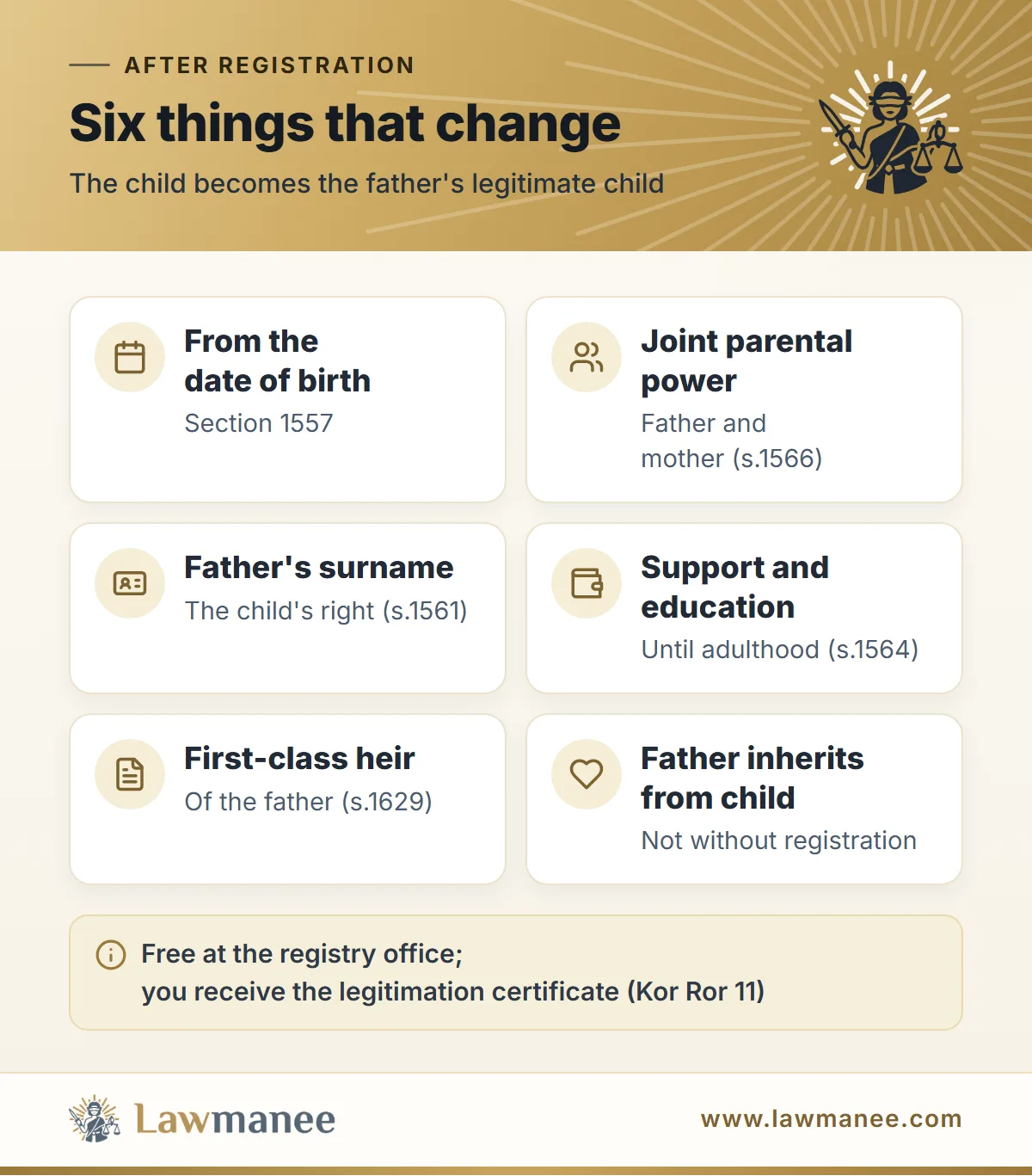
- Legitimate from the child's birth, though this cannot be used against third parties who acted in good faith (Section 1557).
- Parental power: a minor child is under the parental power of both the father and the mother (Section 1566). If the mother or the child thinks the father is unfit, they can ask the registrar to record this within 90 days of being notified of the registration, and a court decides (Section 1549).
- Surname: the child has the right to use the father's surname (Section 1561).
- Support: both parents must support and educate the child until adulthood (Section 1564).
- Inheritance: the child is a descendant, in the first class of the father's statutory heirs (Section 1629), and the father becomes the child's statutory heir too.
Without registration, can the child inherit from the father?
Yes, if the father acknowledged the child by his conduct. Section 1627 treats a child born outside marriage whom the father has acknowledged as a descendant, like a legitimate child. The Supreme Court has accepted support and paying school fees as acknowledgment (judgment 13665/2557). But this works one way only: a father who never registered is not his child's statutory heir. And after the father's death, proving acknowledgment is often hard and leads to disputes with other heirs, so registering early is far clearer.
If the father is a foreigner
A foreign father can register legitimation at a district office under the same rules, using his passport instead of a Thai ID card. Foreign-language documents must be translated and certified as the registry office requires, which is generally done through the Department of Consular Affairs. Call the district office for its document list before you go.
Talk to a family lawyer
When the mother does not consent, the child is very young or the father has died, legitimation usually goes to court, and preparing the evidence properly from the start helps a lot. On Lawmanee you can describe your situation for free, without personal details, and interested family lawyers reply in the platform chat, or search lawyers by case type, province and language.