
Many Thai and foreign couples want to register their marriage in Thailand, and most get stuck on the embassy document, the translation or the legalisation step. This guide explains the conditions under Thai law, the documents you need, the steps from your embassy to the district office, and the property questions worth settling before the wedding day.
Conditions for marriage under Thai law
A marriage exists in Thai law only once it is registered with a registrar. A wedding party or religious ceremony on its own does not make you legally married. The main conditions are:
- Age: both partners must be at least 18 (Section 1448), unless a court allows it earlier for good reason. Anyone under 20 needs the consent of their parents or guardian.
- Not already married: bigamy is not allowed; a previous marriage must have ended by divorce or death.
- Not closely related: no marriage between direct blood relatives or between full or half siblings.
- Both consent, in person, before the registrar.
Since the Marriage Equality Act took effect in 2025, the Civil and Commercial Code now speaks of "two persons" instead of "a man and a woman", so same-sex couples can register on exactly the same terms.
Documents you need
The Thai partner
- Thai ID card or Thai passport
- If previously married: proof of divorce, or the former spouse's death certificate
The foreign partner
- Passport
- An affirmation of freedom to marry (or certificate of marital status) issued by your embassy or your home authorities
- A Thai translation of that document, legalised by the Department of Consular Affairs
On the day: bring two witnesses, and a parent or guardian to give consent if either partner is under 20.
Registering in 5 steps
- Get the embassy document. The foreign partner applies in person at their embassy or consulate in Thailand for a document confirming they are single and free to marry under their own law. A document issued in your home country usually has to be legalised first by that country's foreign ministry and the Thai embassy there.
- Translate it into Thai. Use a reliable translator; names, nationality and date of birth must match the passport exactly.
- Legalise it at the Department of Consular Affairs. Submit the original and the translation to the Legalization Division on Chaeng Watthana Road in Bangkok.
- Register at a district office (amphoe or khet), anywhere in Thailand. Both partners attend in person with two witnesses. Some offices ask for extra documents or appointments, so call ahead.
- Keep your marriage documents. Store the marriage certificate safely and ask for certified copies of the marriage register; authorities abroad usually want them translated and legalised again.
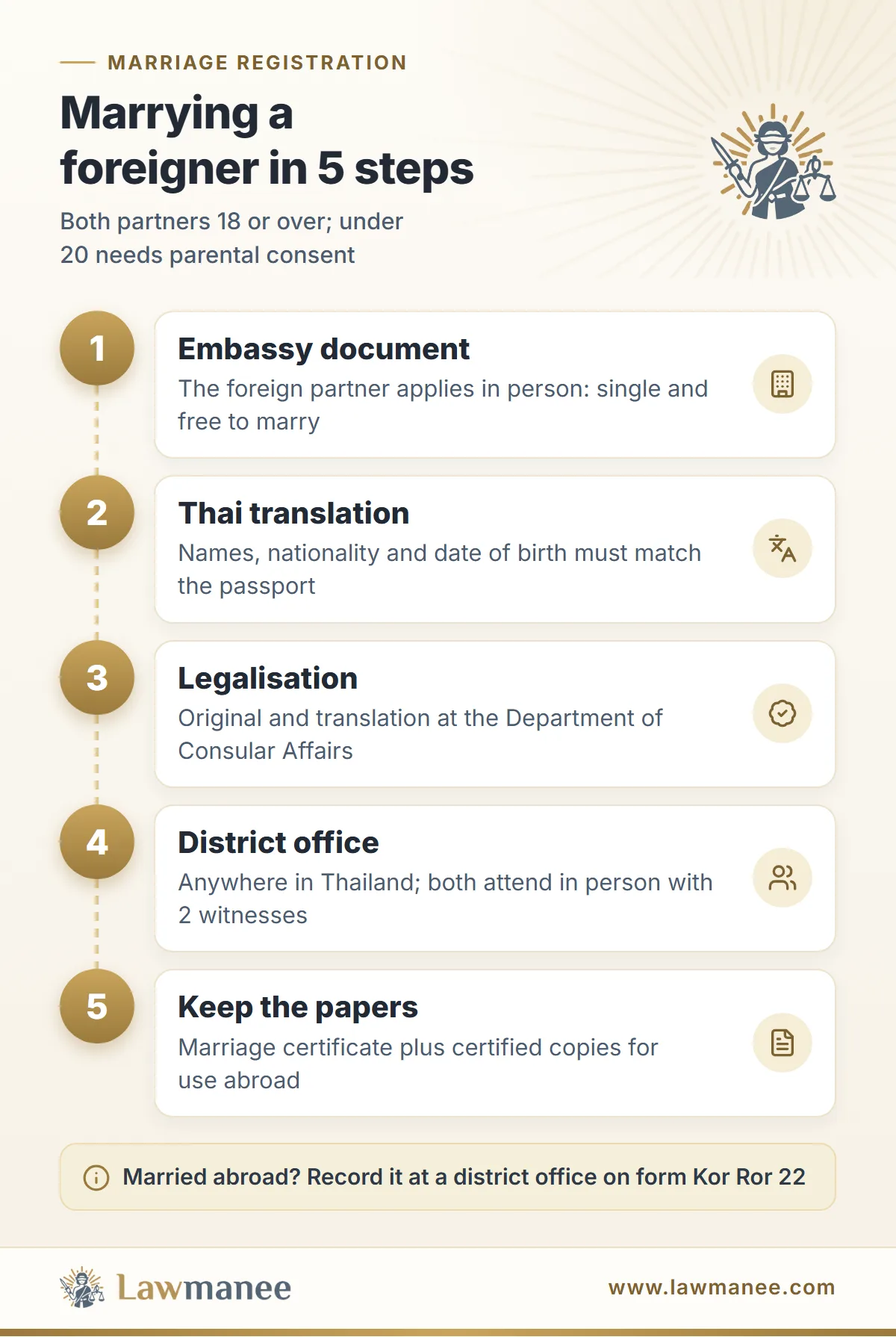
If you already married abroad, you do not marry again in Thailand. The Thai spouse should, however, take the translated and legalised foreign marriage certificate to a district office to record the marriage in the family status register (form Kor Ror 22), so the Thai civil records show the correct status.
Personal property and marital property
When you marry under Thai law without a prenuptial agreement, the couple's assets fall into two groups:
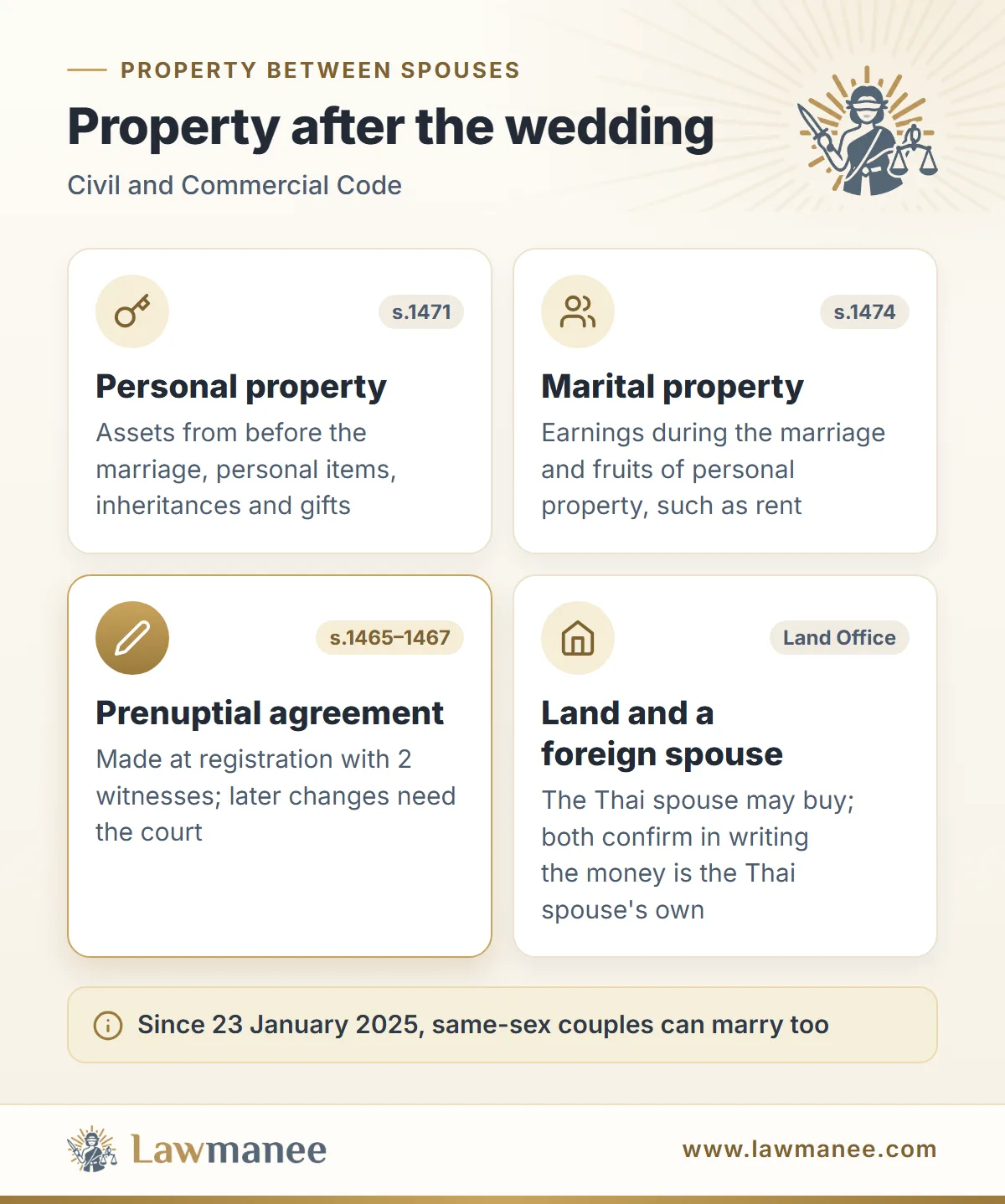
| Personal property (Section 1471) | Marital property (Section 1474) |
|---|---|
| Assets owned before the marriage | Assets acquired during the marriage, such as income earned |
| Personal items, jewellery suited to your station, tools of your trade | Inheritances or written gifts that state they are marital property |
| Inheritances or gifts received during the marriage | Fruits of personal property, such as rent or dividends |
| Betrothal gifts (khong mun) |
Example: Before the wedding, Nid owns a condominium unit. The unit remains her personal property. If she rents it out during the marriage for 12,000 baht a month, that rent is a fruit of personal property and therefore marital property. On a later divorce, whatever rent is left is shared equally, unless a prenuptial agreement says otherwise.
Prenuptial agreements
Couples who already own assets or a business often settle property matters in a prenuptial agreement. It is valid only if it follows the form set by law (Sections 1465 and 1466):
- It is made before or at the marriage registration.
- It is either entered in the marriage register, or made in writing, signed by both spouses and at least two witnesses, attached to the marriage register and recorded in it at the time of registration.
- Terms contrary to public order or good morals have no effect.
An agreement that does not follow this form is void, and once married you cannot change or revoke it without the court's permission (Section 1467). Have a lawyer draft it, in a language both of you understand.
Land when one spouse is a foreigner
As a rule, foreigners cannot own land in Thailand, and marrying a Thai national does not change that. A Thai spouse can still buy land in their own name, but at the Land Office both spouses must confirm in writing that the money used is the Thai spouse's personal property, not marital property. If the foreign spouse is abroad, this confirmation can be made through an embassy, a consulate or a notary public.
Make sure you both understand what this statement means before you sign it, and keep records of where the money came from.
Points for the foreign spouse
- Registering the marriage does not give you Thai nationality automatically.
Talk to a family lawyer
If you need a prenuptial agreement drafted, foreign documents checked or cross-border family assets planned, you can describe your situation for free on Lawmanee so that interested family lawyers reply in the platform chat, or search lawyers by case type, province and language.