

Loud music late at night, smoke from burning rubbish, smells from animals, branches hanging over your fence: these happen in every community. Many people put up with them because they do not want trouble with the people next door. But Thai law gives you several ways to act, from the gentlest to a court claim. This guide explains how each one works.
How much disturbance does the law protect against?
Section 1337 of the Civil and Commercial Code says that if a person exercises their rights in a way that causes the owner of immovable property damage or inconvenience beyond what can reasonably be expected in the ordinary course, having regard to the nature and location of the property, the owner is entitled to have the damage or inconvenience brought to an end, and may also claim compensation.
So the law does not forbid every sound or smell. Living close together always brings the ordinary noise and smells of daily life. What the law protects against is disturbance beyond the ordinary, judged by the nature and location of the property.
Four options
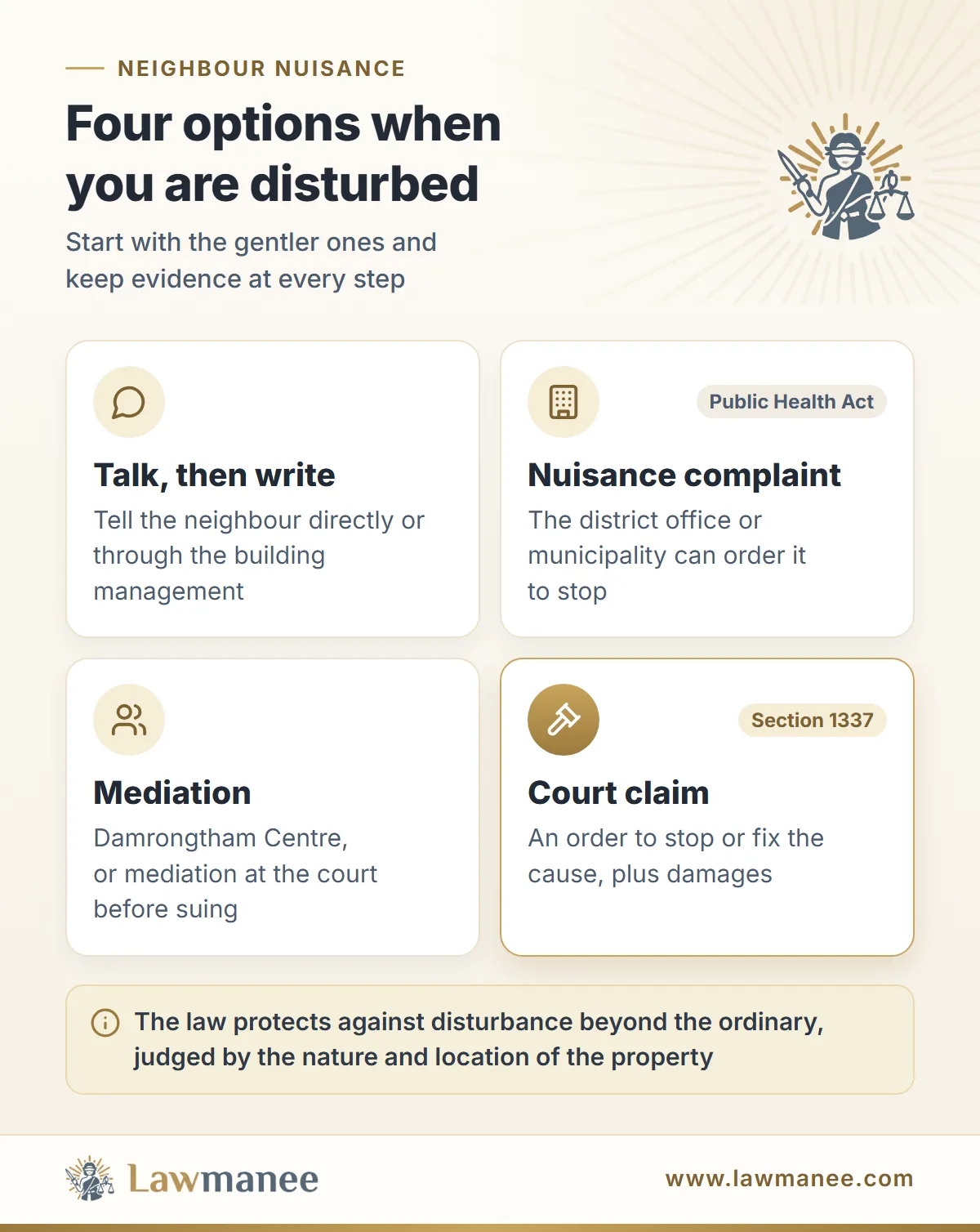
| Option | Where | What you get |
|---|---|---|
| Talk, then give written notice | The neighbour directly; the condominium or housing estate management | A quick fix, and proof that you raised it |
| Nuisance complaint | District office, municipality or subdistrict administration (TAO) | A written order from the local official to stop the nuisance |
| Mediation | Damrongtham Centre, or the court that would hear the case | An agreement both sides accept |
| Court claim | The court with jurisdiction | A judgment to stop or fix the cause, plus damages |
You do not have to follow this order, but starting with the gentler options usually keeps the relationship intact, and the evidence you gather works for all of them.
Start by gathering evidence
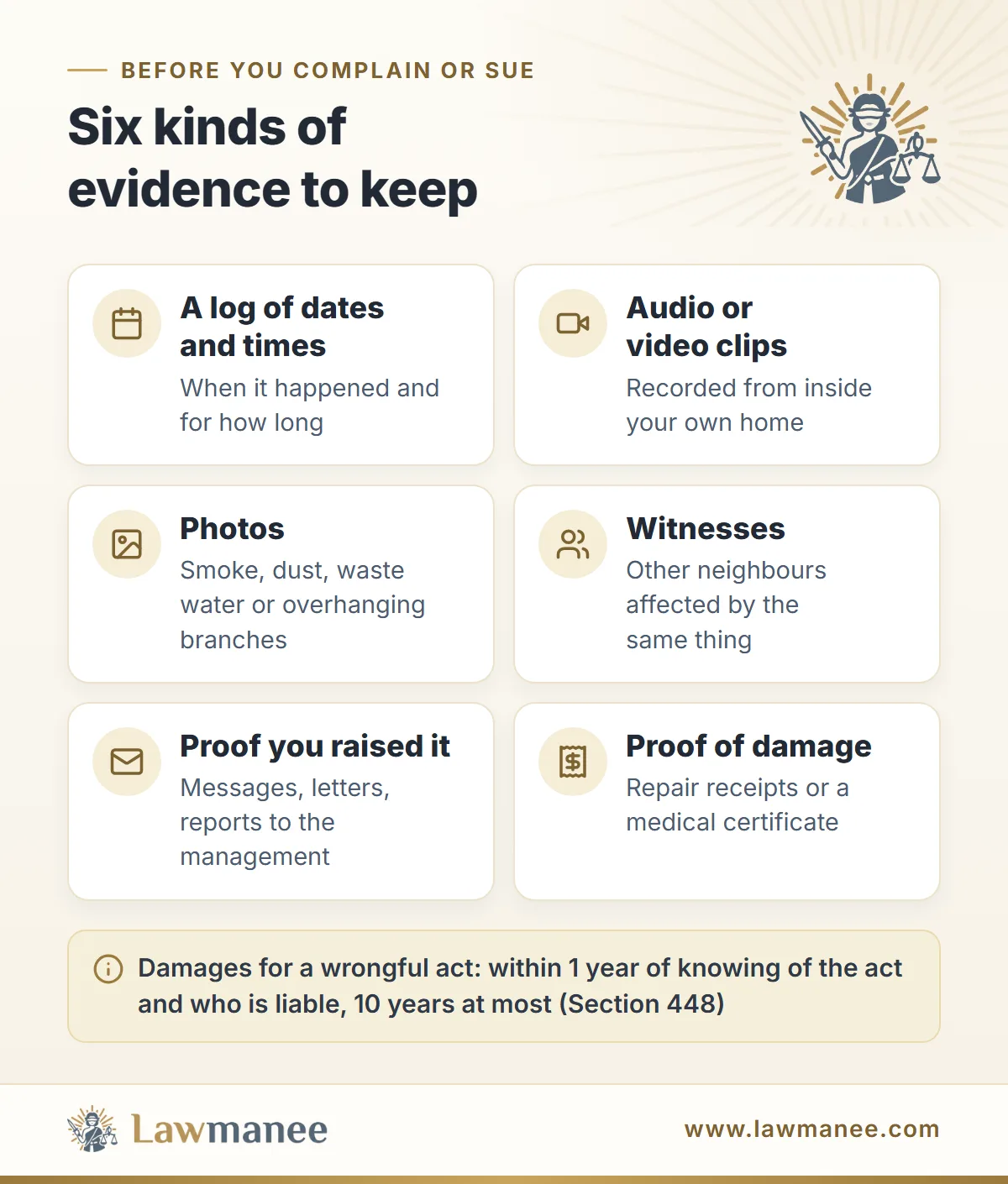
- A log of dates and times of each incident and how long it lasted
- Audio or video clips recorded from inside your own home
- Photos of smoke, dust, waste water or overhanging branches
- Witnesses: other neighbours affected by the same thing
- Proof that you raised it before: messages, letters, reports to the building management
- Proof of damage: repair receipts or a medical certificate
A nuisance complaint to the local authority
Under Section 25 of the Public Health Act B.E. 2535 (1992), something that may cause trouble to people living nearby, or to those who have to put up with it, is a nuisance. Examples:
- any act that produces smell, light, noise, heat, vibration, dust, soot or ash to the point of harming health or being likely to;
- keeping animals in a place, in a way or in numbers beyond what is reasonable, to the point of harming health or being likely to.
When a nuisance arises on private premises, the local official can order the owner or occupier in writing to stop it within a set time. If the order is ignored, the local official may step in and stop the nuisance, at the expense of the owner or occupier who caused it (Section 28). Failing to obey the order without reasonable cause is punishable by imprisonment of up to 3 months, a fine of up to 25,000 baht, or both (Section 74).
You do not have to own your home, or be Thai, to complain. A tenant or resident who is affected can do so at the local district office, municipality or subdistrict administration. In Bangkok you can report through the 1555 hotline or Traffy Fondue; in the provinces the Damrongtham Centre hotline 1567 is another channel. Complaints are handled in Thai, so bring a Thai speaker if you can.
Noise as a criminal offence
Section 370 of the Penal Code makes it an offence to make noise or cause a disturbance without reasonable cause so that the public is alarmed or troubled; the penalty is a fine of up to 1,000 baht. If the noise is happening right now and talking has not worked, you can therefore call the local police.
Overhanging branches and roots
Under Section 1347, a landowner may cut and keep roots that have grown in from the neighbouring land. For branches that hang over, you must first ask the occupier of the neighbouring land to cut them within a reasonable time; only if they do not may you cut them yourself. Ask in writing or by a message you can keep as proof.
Mediation before a lawsuit
If talking has not worked, try a go-between: the condominium or housing estate management, a community leader or the Damrongtham Centre.
Another route is pre-suit mediation at the court under Section 20 ter of the Civil Procedure Code. Before filing a civil case, a would-be party can ask the court with jurisdiction to appoint a conciliator to mediate, with no court fee. If you reach agreement, it is recorded as a settlement agreement.
Suing to stop the nuisance and claim damages
When nothing else works, the owner of the property can sue under Section 1337 for an order that the other side stop or fix the cause of the disturbance, and can claim damages for a wrongful act under Section 420.
A claim for damages for a wrongful act must be brought within 1 year from the day you knew of the act and of the person liable, and never later than 10 years from the act (Section 448), so do not let the matter drag on.
What you should not do is retaliate: playing loud noise back, damaging property, or shaming the neighbour online with their name and picture. You could end up as the one facing a case.
Talk to a lawyer about a neighbour dispute
If the problem drags on, your home or health has been damaged, or the other side is a business operating next to your home, a lawyer can assess your evidence, draft a notice and plan which route to take first. On Lawmanee you can describe your situation for free so that interested lawyers reply in the platform chat, or search lawyers by case type, province and language.