
Many couples avoid talking about money before the wedding. Yet agreeing on property early prevents a lot of conflict later, especially when one partner already owns a house, a condo or a share in a family business. Thai law offers a tool for this: the prenuptial agreement under Sections 1465 to 1468 of the Civil and Commercial Code.
This guide explains who owns what without a prenup, what a prenup can cover, how to make one that is not void, and whether it can be changed after the wedding.
Without a prenup: how Thai law splits property
If the spouses made no special property agreement before the marriage, their property relations follow the Code (Section 1465), which divides property into two groups.
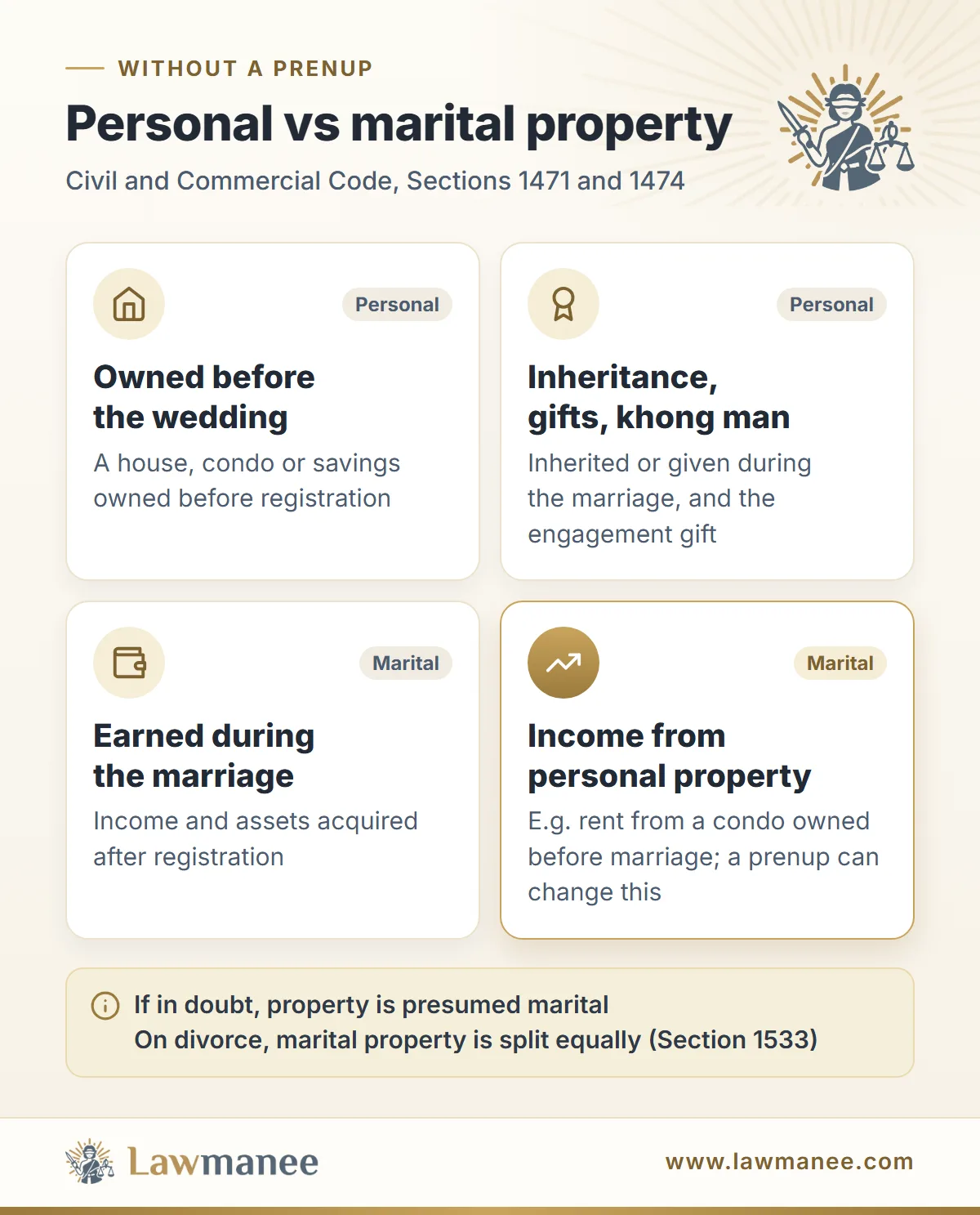
Personal property (Section 1471):
- Property either spouse owned before the marriage
- Personal belongings, clothing, jewellery suited to their status, and tools needed for their work
- Property received during the marriage by inheritance or as a gift
- The engagement gift (khong man)
Marital property (Section 1474):
- Property acquired during the marriage, such as the income either spouse earns
- Property received during the marriage by will or written gift that names it as marital property
- Income from personal property, such as rent from a condo owned before the wedding
When it is unclear whether something is marital property, the law presumes that it is (Section 1474, paragraph 2). On divorce, marital property is divided equally (Section 1533).
Management differs too. Each spouse manages their own personal property (Section 1473). For marital property, certain major transactions need both spouses or the other spouse's consent, for example selling or exchanging real estate, renting out real estate for more than 3 years, giving away more than a reasonable gift, or settling a dispute (Section 1476).
What a prenup can cover
A prenup is an agreement about property between the spouses, replacing the default rules above with their own. Common clauses include:
- Income from personal property, such as rent or dividends, stays the owner's personal property instead of becoming marital property
- A clear list of what each spouse owns before the marriage, such as a house, a condo or shares in a family business, to avoid later disputes
- Managing marital property differently from Section 1476, wholly or partly, which the law allows only through a prenup (Section 1476/1)
What it cannot do: any term contrary to public order or good morals, and any term choosing a foreign country's law to govern the property, is void (Section 1465).
Example
Amy owned a condo before the wedding and rents it out for THB 15,000 a month. Without a prenup, the condo stays her personal property, but the rent earned during the marriage is marital property: THB 900,000 over 5 years. If that money is still there when they divorce, her spouse is entitled to half, THB 450,000. If they had signed a valid prenup keeping income from personal property personal, all of the rent would remain Amy's.
| Item | No prenup | With a prenup (example) |
|---|---|---|
| Condo owned before the wedding | Personal property | Personal property |
| Rent from the condo during the marriage | Marital property | The owner's personal property |
| On divorce | Marital property split equally | The rent is not divided |
How to make a prenup valid
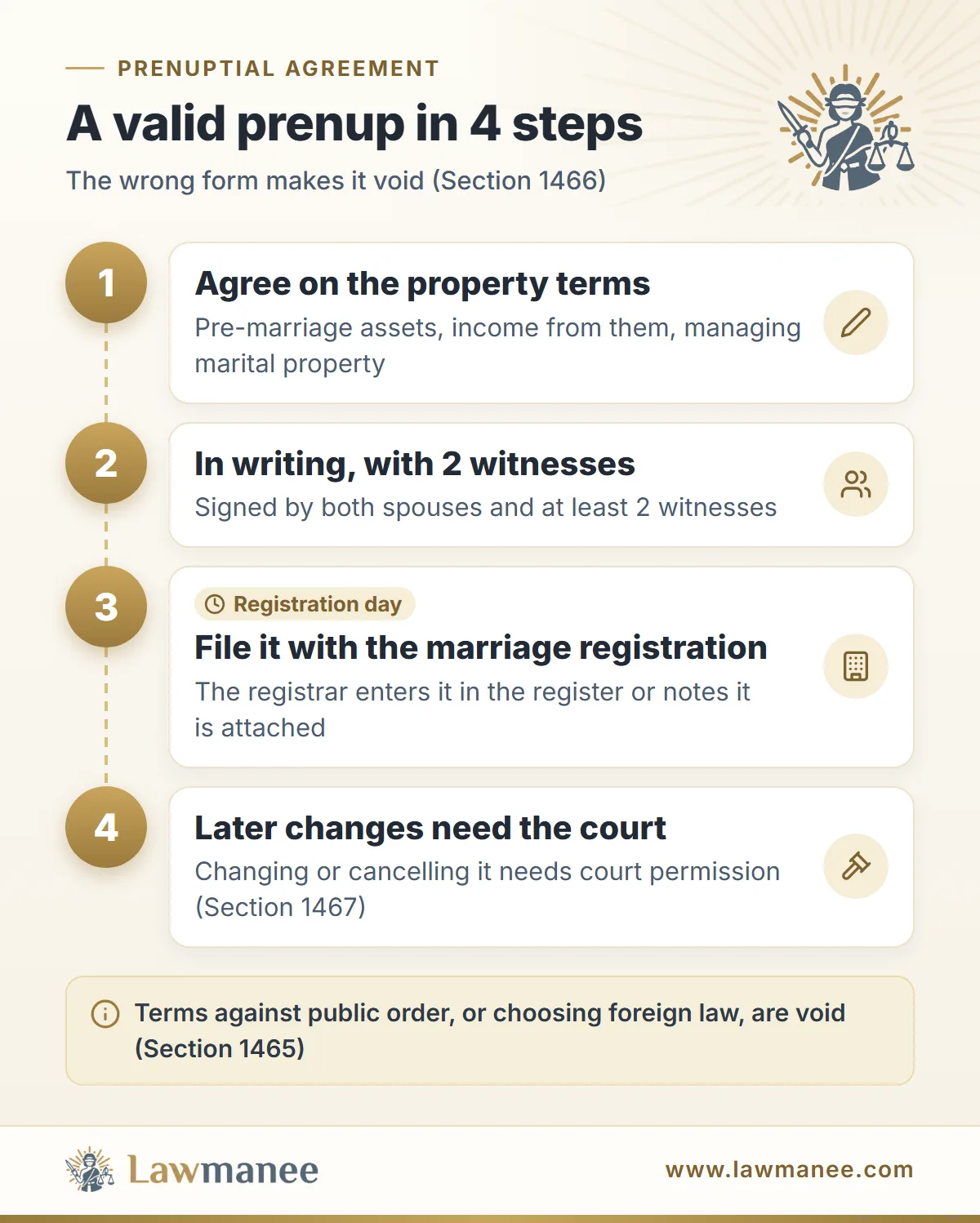
Section 1466 sets a strict form. A prenup is valid only if, at the same time as the marriage is registered, either:
- the agreement is entered in the marriage register, or
- it is made in writing, signed by both spouses and at least 2 witnesses, attached to the marriage register, and the registrar notes in the register that it is attached.
Otherwise the prenup is void. An agreement signed privately and kept at home, or one made after the marriage is registered, does not count as a prenup. Have the draft finished and the witnesses ready before you go to the district office to register.
Changing it after the wedding
Once married, the spouses cannot change or cancel the prenup without the court's permission (Section 1467). Whether or not the court allows a change, the prenup does not affect the rights of third parties acting in good faith (Section 1468).
A property agreement the spouses make with each other during the marriage is not a prenup. Either spouse may cancel it at any time during the marriage or within 1 year after the marriage ends, without affecting third parties acting in good faith (Section 1469). If you want an arrangement that lasts, put it in a prenup from the start.
Same-sex couples and foreign spouses
- Since 23 January 2025, Thailand's marriage equality amendment lets couples of any gender register their marriage, and the Code now says "spouses" instead of "husband and wife". The prenup rules apply to every couple in the same way.
- A foreign spouse can make a prenup in the same form, but it cannot choose foreign law to govern the couple's property (Section 1465). A bilingual version helps both partners understand exactly what they sign.
Talk to a lawyer before the registration day
You get one chance to make a prenup: on the day you register the marriage. A gap or a mistake in form is hard to fix later, so having a family lawyer draft the agreement and check the list of assets is worth it. On Lawmanee you can post your situation for free, and interested lawyers reply in the platform chat. You can also search for a lawyer by case type, province and language.