
An unreturned deposit after moving out is one of the most common complaints from people renting rooms, apartments and condos in Thailand. Since 4 September 2025, new rules from the Office of the Consumer Protection Board (OCPB) spell this out more clearly. Here is who the rules cover, when the deposit must come back, what may be deducted and what to do if it does not.
Who the new rules cover
The Notification of the Contract Committee making the renting of residential buildings a contract-controlled business B.E. 2568 (2025) was published in the Government Gazette on 6 June 2025 and took effect on 4 September 2025, replacing the 2019 version.
- It covers landlords who rent out three or more residential units (previously five), in one building or several.
- It covers short-term leases (up to 3 years) and long-term leases (more than 3 years, up to 30).
- The lease must be written in clearly legible Thai.
A landlord with only one or two units, such as a condo owner renting out a single unit, is outside the notification. The lease itself and the Civil and Commercial Code rules on hire of property still apply.
How much deposit, and when it must be returned
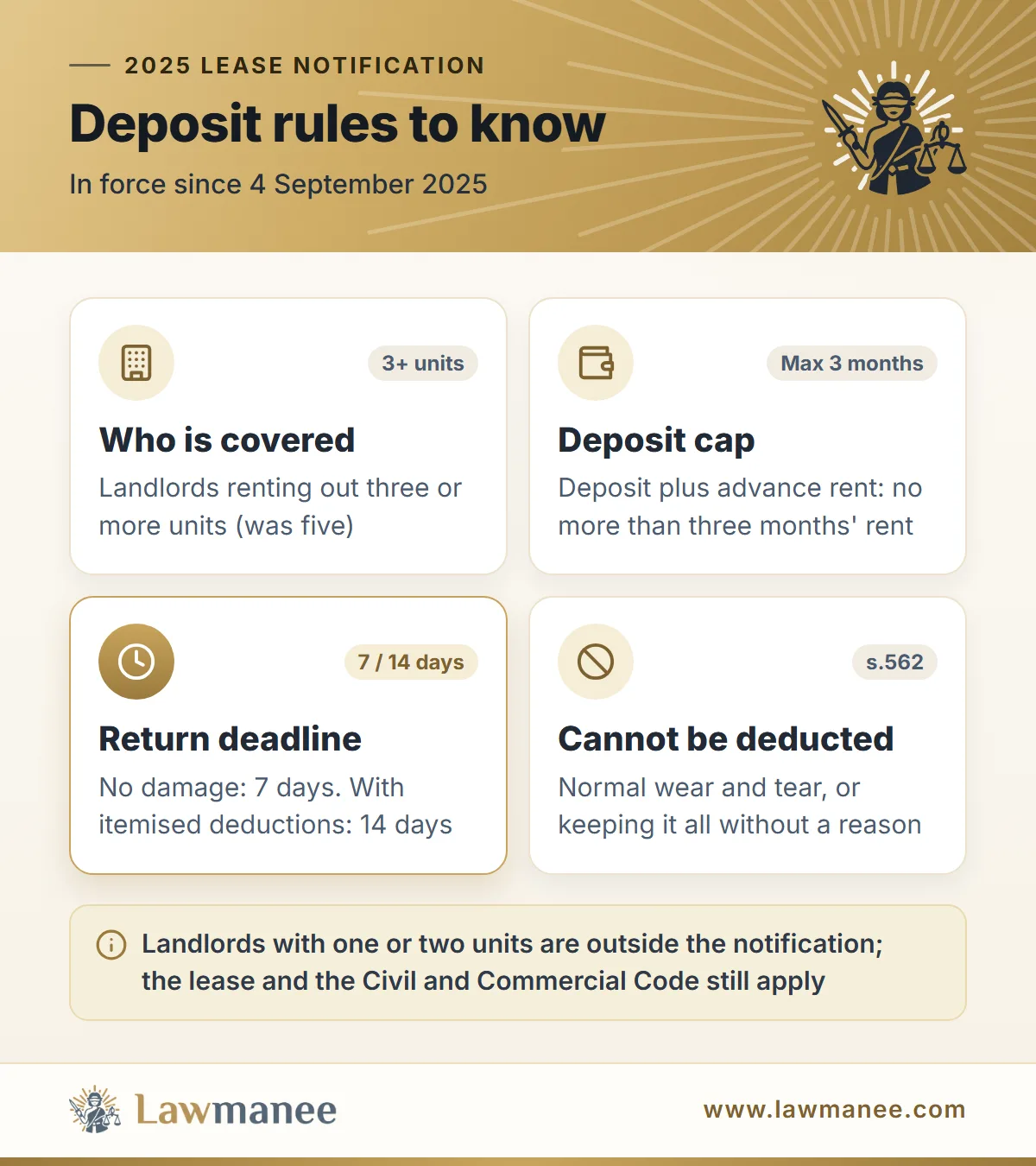
- Cap: the deposit plus any advance rent may not exceed three months' rent for short-term leases and long-term leases paid monthly (one year's rent for long-term leases paid yearly).
- No damage: the deposit must be returned when the lease ends, or within 7 days at the latest.
- Damage the tenant is liable for: the landlord may deduct the actual repair cost and return the rest within 14 days, with an itemised list and evidence.
What can and cannot be deducted
A tenant is liable for damage caused by their own fault or by people living with them, but not for wear and tear from normal use (Section 562, Civil and Commercial Code). The 2025 notification also bans lease terms that make the tenant pay for it.
| Can be deducted, with evidence | Cannot be deducted |
|---|---|
| A door, furniture or appliance the tenant broke | Faded paint or minor marks from normal use |
| Unpaid rent, water or electricity | Routine repainting or deep cleaning by the owner |
| Keys or key cards not returned | Keeping the whole deposit without a reason |
The notification also bans unfair terms such as raising the rent before the lease ends, keeping the deposit when the tenant is not at fault, charging water and electricity above the utility's rates, locking the tenant out or seizing belongings, and entering without notice except in an emergency. Such terms cannot be enforced even if the tenant signed them.
Example
Rent is 8,000 baht a month. The tenant paid a 16,000 baht deposit and 8,000 baht advance rent: 24,000 baht, exactly three months, so within the cap. At the end of the lease the landlord finds the bathroom door broken by the tenant; the repair receipt is 2,500 baht. The landlord must return 13,500 baht within 14 days with the itemised list and receipt, but cannot charge for repainting the whole room because the paint has faded with time (figures for illustration only).
Leaving before the lease ends
Under the 2025 notification, a tenant on a fixed-term lease may terminate once they have stayed at least half of the lease term, by giving at least 30 days' written notice and paying everything due up to the termination date. If you leave before that, the landlord may rely on the contract, so read the termination clause before you sign.
Getting your deposit back, step by step
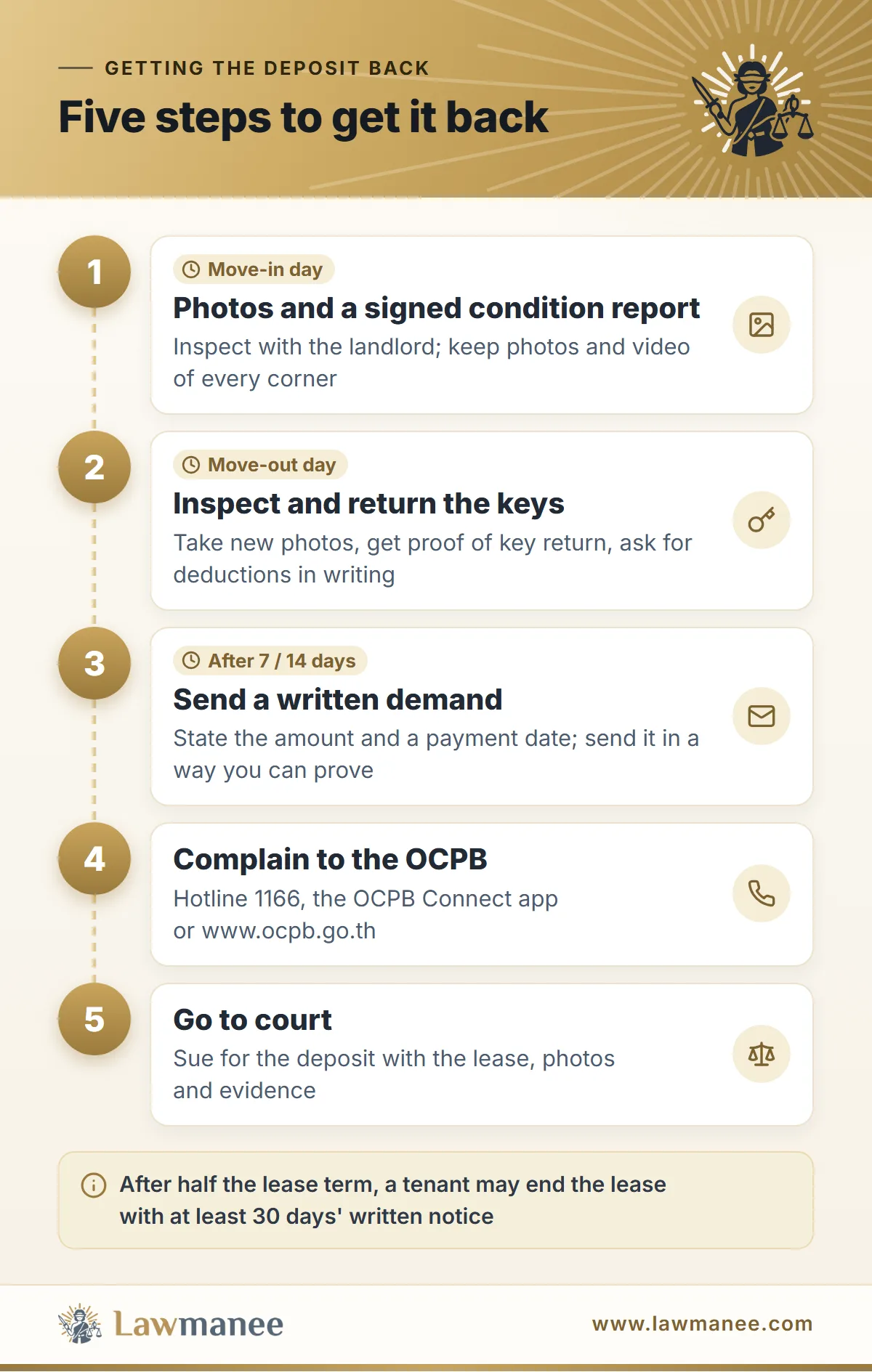
- On move-in day, inspect the unit with the landlord, take photos and video of every corner, and have both sides sign a condition report. The 2025 notification requires this report to be attached to the lease.
- On move-out day, inspect together again, take a second set of photos, hand back the keys with proof, and ask the landlord to write down any deductions.
- If the deadline passes, send a written demand, for example by registered mail or a message you can prove, stating the amount and a date for payment.
- Complain to the OCPB on hotline 1166, through the OCPB Connect app or at www.ocpb.go.th, attaching the lease, photos and proof of payment.
- Go to court if you still are not paid. A business landlord that breaks the rules can also be prosecuted under consumer-protection law: up to one year in prison, a fine of up to 200,000 baht, or both.
Landlords face a deadline too: a landlord's claim against a tenant under a lease must be brought within six months of getting the unit back (Section 563).
Foreign tenants
The notification does not distinguish tenants by nationality, so foreigners renting from a landlord with three or more units get the same protection. The main lease must be in Thai; if you cannot read it, ask for a translation or have someone you trust read it before you sign, and always keep a copy.
Talk to a lawyer
A small deposit is often recovered with a written demand or an OCPB complaint. If the amount is large, belongings were seized, or the lease has unfair terms, a lawyer can assess the case and write the demand for you. On Lawmanee you can describe your situation for free, without personal details, and interested lawyers reply in the platform chat, or search lawyers by case type, province and language.