
Once you realise you have sent money to a scammer, every minute counts. Money that lands in a mule account is usually moved on within a short time, so the sooner the account is frozen, the better the chance that some of it is still in the system. Here is what to do, in order.
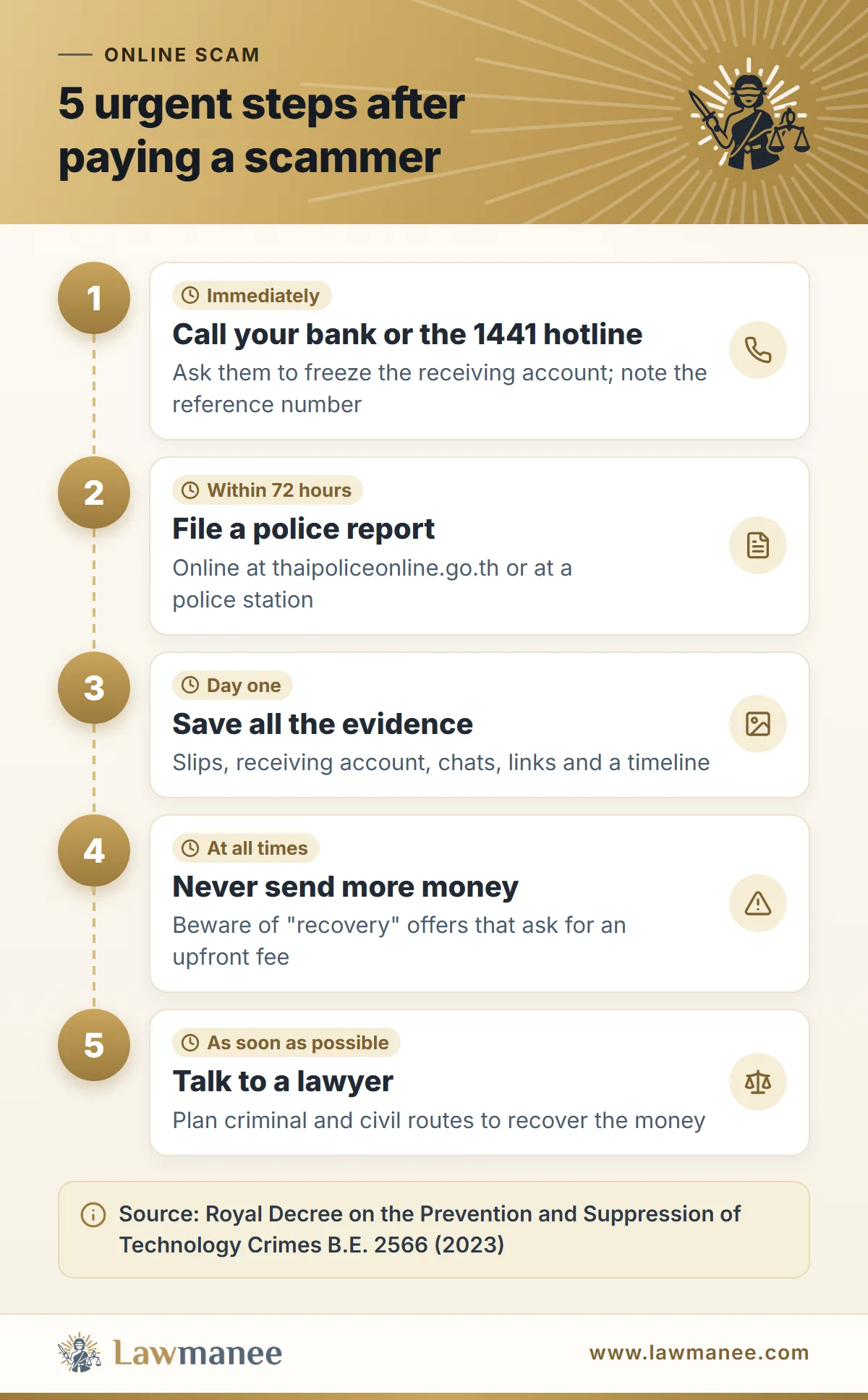
1. Call your bank or the 1441 hotline immediately
Call the 24-hour customer service line of the bank you transferred from. Say that you were tricked into a transfer and ask the bank to suspend transactions on the receiving account. Have the details ready: the receiving account number and name, the amount, and the date and time of the transfer. Write down the reference number the bank gives you.
If you cannot reach your bank, or the money went to several banks, call 1441, the Anti Online Scam Operation Center (AOC), which coordinates account freezes with banks and the police around the clock. If you do not speak Thai, the Tourist Police (1155) can help in English.
2. File a police report within 72 hours
Under the Royal Decree on Measures for the Prevention and Suppression of Technology Crimes B.E. 2566 (2023), a bank that receives a victim's notice suspends the transaction temporarily, and the victim must file a complaint with an inquiry officer within 72 hours. Without a police report the hold may be lifted and the money withdrawn.
You can report in two ways:
- Online at thaipoliceonline.go.th, the Royal Thai Police online reporting system, available 24 hours a day.
- In person at a police station.
Use one channel only to avoid duplicate cases, and keep the report number for follow-up and for your bank.
3. Save the evidence before it disappears
Scammers often delete chats or close their social accounts as soon as they have the money. Capture and keep the following right away.
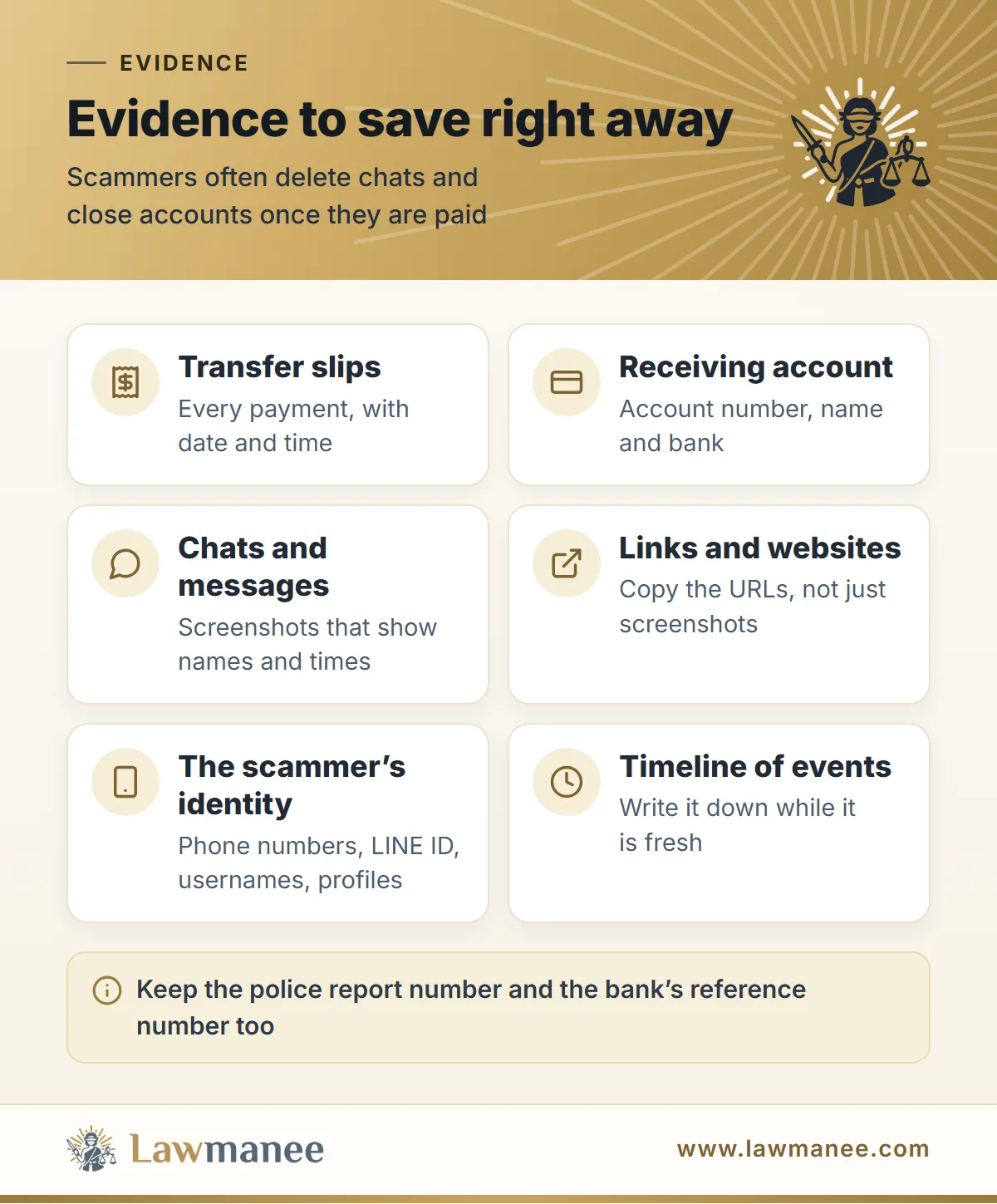
- Transfer slips or records for every payment.
- The receiving account number, account name and bank.
- Chats, messages, emails and links you received (copy the URLs, not just screenshots).
- The scammer's phone numbers, LINE ID, usernames and profile pages.
- The ads, pages, websites or apps used in the scam.
- A timeline of events with dates and times, written while you still remember them clearly.
4. Cut off access and beware of a second scam
- If you installed an app the scammer told you to, or gave away a password or OTP, uninstall the app, change your banking and email passwords, and ask your bank to check your own account.
- Never send more money for any reason, such as a "fee to unlock your funds" or "tax before withdrawal".
- Be wary of anyone who contacts you claiming to be the police, a lawyer or an agency that can "recover your money" for an upfront fee. This is the most common way victims get scammed twice. Filing a police report is free.
5. Talk to a lawyer about recovering your money
Freezing the account stops the money from moving further, but getting it back takes more steps. A lawyer can assess which route suits your case.
- Criminal case: online scams usually amount to fraud under Section 341 of the Criminal Code, or public fraud under Section 343, and may also breach Section 14(1) of the Computer Crime Act. Fraud under Section 341 is a compoundable offence, so a complaint must be filed within 3 months of learning of the offence and the offender.
- Restitution in the criminal case: when the public prosecutor files charges, the victim can ask the prosecutor to claim the property or its value on their behalf, or file their own claim for compensation within the criminal case under Section 44/1 of the Criminal Procedure Code.
- Civil case: sue the people involved to get the money back, which may include the owner of the receiving account. Opening an account for someone else's use, or lending your own (a "mule account"), is itself an offence under the same royal decree.
A good lawyer will explain the chances and costs of each route plainly, and will never guarantee that you will get your money back.
Find a lawyer for online fraud
On Lawmanee you can describe what happened for free, and interested lawyers will reply in the platform's chat. You can also search lawyers by case type, province and language.